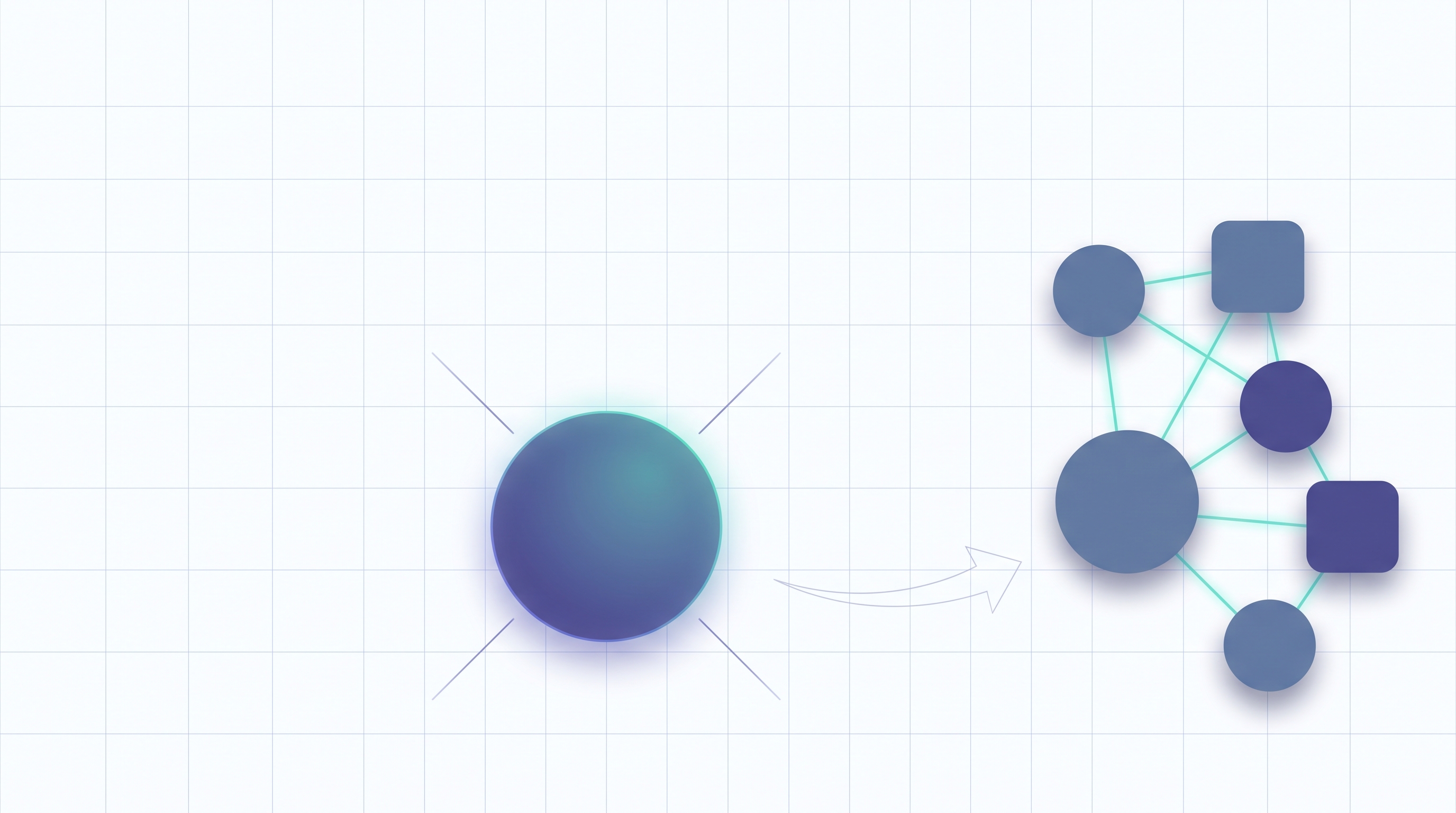
When a team sets up its first agent, a narrow, well-scoped task is the natural place to start, since its output is easy to check and the setup stays small. The next question is whether a larger workflow needs a second agent, or a whole team. Each agent a team adds brings coordination, more cost, and another result someone has to review, so a team of agents fits when the work splits into parts that can run on their own. This article weighs single agent vs multi agent setups by what each handles well, when a team of agents is worth the extra complexity, how to decide before building anything, and how a human-AI collaboration workspace such as Syfo keeps shared channels, task handoffs, and member review visible.
The short answer
A single agent fits one well-scoped task that lives in a single context, where its output is easy to check. A multi-agent setup fits when the work splits into parts that can run on their own, when different steps need different tools or context, or when the workflow exceeds what one agent can handle within the available context. The way to decide is to look at whether the work decomposes cleanly and whether the added coordination and review are worth what they buy. If the task stays as one coherent thread, a single agent is usually the steadier choice.
Where a single agent and a team of agents actually differ
The difference is the unit of work, not the model behind it. A single agent carries a whole task from prompt to output inside one context, so there are fewer handoffs where context can be lost. A team of agents divides that task into roles, and the moment work moves between them, three new things appear: a handoff, a shared record each agent reads from, and a second output that someone has to review. Those three points are where much of the design effort goes, and they are the reason a multi-agent setup costs more to run. Getting them right is the real work of building a team of agents, and it is what separates a setup that saves time from one that just adds moving parts.
What a single agent does well
A single agent is the stronger fit when a task is one coherent piece of work. It keeps the working context in one place, so there are fewer points between steps where context is lost. Its output is easy to review, because one agent produced it and there is one thread to read. It is cheaper to run, since there is no coordination overhead, and it is faster to set up, because there are no roles or handoffs to design. For a task like drafting a single document, answering support questions from one knowledge base, or running one analysis end to end, a second agent adds cost without adding much. Some workflows that feel like they need a team run fine on one agent once the task is scoped tightly, so it is worth confirming that the work truly divides before reaching for more agents.
What changes when you add more agents
Adding agents turns a task into a small operation that has to be coordinated. Each agent takes a role, such as research, drafting, checking, or delivery, and the work passes between them at defined points.
That brings gains: steps can run in parallel, and each agent can be tuned for its own job with its own tools and instructions. It also brings cost. Context has to travel across each handoff, and when it does not travel cleanly, steps repeat or a small early error reaches the final result. Each role may also produce work that needs review, so the number of results a person has to review can go up as roles are added.
A multi-agent setup pays off when the parallelism and specialization outweigh that coordination and review load, and it works against you when they do not.
When a multi-agent setup is worth it
A team of agents earns its place when the work genuinely divides into parts that do not depend on each other step by step. The clearest signals are below.
The work splits into parts that can run on their own
If a workflow breaks into sub-tasks that can each finish without waiting on the others, separate agents can run them in parallel and the whole job finishes sooner. Research across several sources, for example, can fan out to several agents and come back together at the end. When the parts are tightly sequential, though, splitting them mostly adds handoffs without adding speed, and a single agent keeps the flow simpler.
Different steps need different tools or context
Some workflows ask for skills that do not sit well in one agent, such as pulling data from an API, writing prose, and checking figures against a source. Giving each step its own agent, with its own tools and instructions, keeps each one focused on a job it is set up for. A single agent asked to switch between all three tends to lose the thread and produce weaker work at each turn.
The workflow exceeds what one agent can handle within the available context
When a job carries more material than one agent can hold in its working context at once, dividing it lets each agent work on a share that fits. This is a judgment about the specific workflow and model, not a fixed threshold, so the test is practical: if one agent starts dropping earlier detail as the task grows, that is the signal to split the work across more of them.
Stay with a single agent when the task is one thread that does not cleanly divide, because in that case the handoffs and extra review cost more than the split saves.
Quick comparison
The table below sets the two side by side on the working details that tend to decide the choice. The tendencies are relative, not fixed numbers, and the right answer still depends on the specific workflow.
| Dimension | Single agent | Multi-agent setup |
|---|---|---|
| Unit of work | One task, one context | A task split into roles |
| Handoffs | None | One per step boundary; more as roles grow |
| Coordination cost | Lower | Higher |
| Context loss risk | Contained to one thread | Rises at each handoff |
| Review surface | One output to check | Possible review work per role |
| Setup effort | Faster to stand up | More design up front |
| Where it fits | A coherent, well-scoped task | Work that divides into independent parts |
When each one is the right call
Choose based on the shape of the work, not the number of agents you can spin up. A single agent is the right call when:
- The task is one coherent piece of work with a single output.
- Speed of setup and low running cost matter more than parallelism.
- You want one thread to review and one place to trace what happened.
A multi-agent setup is the right call when:
- The work divides into parts that can run on their own.
- Different steps need different tools, data, or instructions.
- The volume or breadth is more than one agent handles well in one context.
- You can put review points where the work passes between agents.
Keeping a multi-agent setup visible and reviewable
- Records stay visible, and review follows the run. Selected work, handoff, and review records stay visible in a shared channel to members and agents at the same time, so a member reviews against the run as it happened, with the record in hand.
- Status and ownership stay clear. On a task, each piece of work carries a status and an owner, so who is working, where it stands, and who picks it up next stay clear to the team.
- Outputs are judged against a standard. The result of a step can be represented as a deliverable, which a member opens and assesses against the standard the team wrote down.
- Key actions get a human gate. An action a team marks in advance as high-risk or outward-facing can be prepared as an Action Card, which an authorized member reviews and submits under their own identity.
- Context carries across sessions. Across conversation turns and separate sessions the relevant context stays continuous, so a handoff does not start from scratch.
Adding agents buys parallelism, and it brings coordination cost with it: more owners on one job, more places where a handoff can stall, and more output for a member to check. Most of that cost lands after the decision to add an agent, in the ordinary business of keeping several workers aligned.
A multi-agent setup goes wrong for a team less on model quality than on visibility. Once the work splits, the record of who held which piece and what came back tends to scatter across wherever the agents run, and review turns into guesswork. Syfo keeps that record somewhere a member can read it, and the rest of this section covers what else sits around that initial problem.
- Every unit of work carries an owner and a state. A task shows who is on it and where it sits, so ownership is read rather than assumed.
- Handoffs land somewhere. The team adopts task states it names itself, and each pass from one agent to the next follows them.
- Finished work arrives as a Deliverable. A member opens the result and assesses it against the standard the team wrote down.
- Key actions wait for a person. An action the team marked in advance as high-risk or outward-facing can be prepared for an authorized member to review and submit in their own identity.
What stays with the team is the substance: which agents exist, what each may access, and who signs off. The same record keeps context continuous across sessions and turns, so a handoff does not restart from nothing, and stays readable later for a member who needs to retrace how a result was reached. The agents run the work; direction and acceptance stay with the member.
FAQ
What is a single agent vs a multi-agent system? A single agent is one AI agent that handles a task on its own within one context. A multi-agent system is several agents that divide a task into roles and pass work between them. The practical difference is coordination: the multi-agent version gains parallelism and specialization, and takes on handoffs and extra review in exchange.
When should you use a multi-agent system? Use one when the work splits into parts that can run on their own, when different steps need different tools or context, or when the workflow is more than one agent handles well in a single context. If the task stays as one coherent thread, a single agent is usually steadier and cheaper to run.
Can you give an example of a multi-agent system? One example is a research-to-delivery workflow: one agent gathers sources, a second drafts from them, a third checks the draft against the sources, and a fourth formats the result for delivery. Each step is a role, and the work passes from one to the next, and that division of roles is what makes it a multi-agent system.
Do you have to choose one, or can you use both? You can use both, and many teams do. One pattern is to start with a single agent on one workflow, then split off a second agent for the part that can run on its own once that part is clear. The choice is per workflow, so the same team can run single agents for coherent tasks and multi-agent setups for work that divides.
Where to start
Start from one workflow and one agent, and add a second agent once a specific part of the work can run on its own. That keeps the early setup small and the output easy to check, and it lets the shape of the work decide when a team of agents is worth the extra complexity. As you add agents, put each handoff and each result somewhere a member can see and review, so the workflow stays traceable as it grows.
Choose the smallest setup that fits the work.
Start with one coherent task, then add agents only when the work divides cleanly and the handoffs remain reviewable.