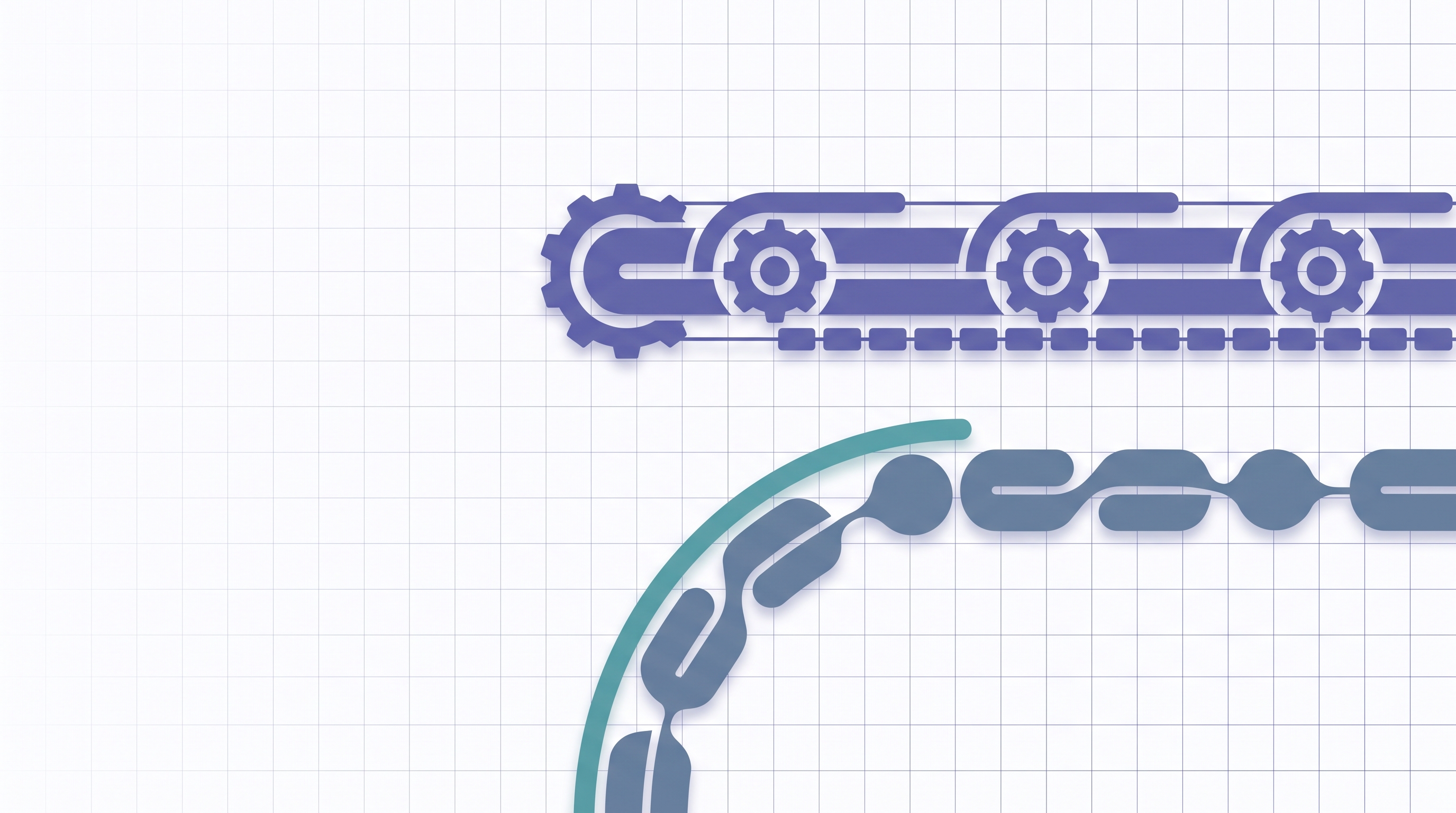
Traditional process automation is good at repeating a fixed procedure, and when a case falls outside the rules it was given, it may need to pass that case to a person. Agentic process automation adds a layer meant to read the situation, choose among steps, and handle the exceptions that used to land on a person's desk. This article explains what agentic process automation is, how it differs from rule-based robotic process automation (RPA), what a team should put in place before handing a process over, and how a human-AI collaboration workspace such as Syfo keeps a handed-over process and its member review visible in a shared channel.
The short answer
Agentic process automation, or APA, adds an agentic layer to process automation, one meant to read a case, choose among steps, and take on exceptions within a scope a team sets. Rule-based RPA runs a fixed script, doing the same steps in the same order and following preset handling when something falls outside its rules. The clearest difference shows at the exception, where rule-based automation follows its preset path and APA may attempt the case within the tools and limits it was given.
The two can sit in the same process, and APA can also stand as a process design on its own, so one is not an upgrade the other must lead to. Whether a team reaches for APA depends on how varied the inputs are, how much judgment a step needs, and what review it can put around the result. This article treats both as shapes a process can take, sets out how they differ, and covers what to put in place before handing a process over.
What agentic process automation is
Agentic process automation describes process automation with an agentic layer added, where a software agent reads the situation, chooses among steps, and works toward the outcome a process is set up to reach. In some designs it runs a whole process; in others it takes the parts where inputs vary and a fixed rule is hard to write, while steadier parts stay on a rule-based path. It is a category and a design shape, not a specific product, and the same shape shows up across different tools.
The layer does not depend on an existing RPA setup underneath it. A team can add it to a process that already runs on rules, and a team can design a process around it from the start. Which of these fits depends on the process, the inputs it handles, and where a member needs to review or approve.
How rule-based RPA works
Rule-based robotic process automation runs software robots that follow fixed rules to carry out repetitive digital tasks, such as moving data between systems, filling forms, or reconciling records. The steps and their order are set in advance, and the robot repeats them the same way each time. This can make the path more predictable and easier to check, which suits high-volume work where the inputs stay within a known range.
The design shows its edges at the unexpected. When a case arrives that the rules do not cover, a rule-based setup follows whatever handling it was given, which may mean logging an error, stopping, or passing the case to a member. Handling every variation calls for more rules, and past a point the rules grow harder to maintain than the work they cover.
How agentic process automation differs from rule-based RPA
The difference between the two shows up in a few specific places, namely how each handles an exception, the path a process takes, and the review a team needs around it. Each carries a tradeoff, and none of them retires the other approach.
At the exception
A rule-based setup meets an off-rule case with preset handling, which may stop the run, log the case, or send it to a member. Agentic process automation may take the case further, assessing it and choosing a step within the tools, permissions, and scope a team configured. What it can attempt is bounded by that configuration, so it does not cover every exception, and cases outside the defined scope still go to a member.
It helps to separate two kinds of exception. One is a variation the process can handle inside its design, such as an input in an unusual but known form, where the agentic layer may adapt and continue. The other falls outside the design, where the right move is to hand off, and run-time judgment does not grant the agent access or authority it was not given.
On the path a process takes
A rule-based process follows one fixed path, and reading the script tells you what it will do. An agentic process chooses among steps at run time from what each case presents, so the path can vary from one run to the next. That variation is the value where inputs differ, and it is also what makes the run harder to predict from the design alone.
The choice of path sits inside limits a team sets. An agent works through the steps and tools it was given, and it can reroute when a case calls for it, within that boundary. A team reads the record of what it chose to check the path after the fact, since the path is not fixed up front.
On the review a team needs
A predictable path may call for less ongoing review after testing, while a path that varies may call for review points placed where a wrong turn would matter. The less predictable the path, the more a team may lean on a check before a result takes effect. Where that check sits is a decision a team makes from the risk each step carries.
Run-time judgment does not move accountability. The team and its members stay accountable for the result and set who approves a sensitive action, whichever approach runs the process. The agentic layer changes what the software attempts, and it leaves the answer for the outcome with the people who own the process.
Where each one fits
The two can divide a single enterprise process between them. Steps that are stable and expressible as rules can stay on a rule-based path, where predictability and volume are the strengths that matter. Segments where inputs vary and a step needs judgment may go to the agentic layer, provided there is a review point and a rollback path around them.
Neither approach has to exit for the other to be used. A team matches each part of a process to the approach that fits it, keeping rule-based automation where the work is steady and adding the agentic layer where the work varies and a member can review the result. The mix a team lands on follows the process it has, not a rule that one approach supersedes the other.
What to put in place before handing a process over
Before a team hands a process to an agentic setup, a few things are worth settling so the handover holds.
- The scope: which parts the agent handles and which stay on a rule-based path or with a member.
- The exception policy: what counts as in-scope to adapt, and what gets handed off.
- The review and approval points: where a member checks a result and who approves a sensitive action.
- Accountability: who answers for the outcome, named before the process runs.
- The rollback path: how to undo or halt a run when a result is wrong.
- Visibility: where the steps, decisions, and review records stay readable.
These are the pieces that help a team define how it will stand behind the result when it hands a process over. Settling them up front keeps the agentic layer inside limits a team chose, and it gives a member the review points to catch a bad result before it takes effect. A process handed over without them leaves the accountability unclear, which is the part worth fixing before the scope grows.
Where a member stays in the loop
A team keeps two kinds of point for a member. One is the exception that falls outside the agent's scope, where the case goes to a member for a decision. The other is approval, where a member confirms a specific action a team has marked as sensitive, such as one that moves money or reaches a customer, before it runs.
Which points those are, and their number, is a decision the team makes from the risk each step carries and the standards it works under. Agentic process automation does not remove the member, and it does not imply a member checking every step. The team sets where the review and the approvals sit, and it holds the accountability for the result.
Keeping a handed-over process and its review visible
- Records stay visible, and review follows the run. Selected work, handoff, and review records stay visible in a shared channel to members and agents at the same time, so a member reviews against the run as it happened, with the record in hand.
- Status and ownership stay clear. On a task, each piece of work carries a status and an owner, so who is working, where it stands, and who picks it up next stay clear to the team.
- Outputs are judged against a standard. The result of a step can be represented as a deliverable, which a member opens and assesses against the standard the team wrote down.
- Key actions get a human gate. An action a team marks in advance as high-risk or outward-facing can be prepared as an Action Card, which an authorized member reviews and submits under their own identity.
- Context carries across sessions. Across conversation turns and separate sessions the relevant context stays continuous, so a handoff does not start from scratch.
Handing a process over is a decision made on paper, and the difficulty arrives the moment the process meets something its rules did not anticipate. Whoever carried that process before is no longer the one making the call.
Rule-based RPA follows a script, and an agentic process reads the situation and chooses. Either way, the step where a person used to decide has to go somewhere, and the team needs to see where. Syfo keeps a handed-over process and its review visible, and it covers the ordinary coordination a process brings along, namely how steps are recorded, who owns the status, how exceptions are handled, and who reviews the output.
- The handover has a record. The work, handoffs, and review records a team selects stay in one channel, so the process does not become a black box the moment it leaves a person's hands.
- Exceptions surface where a person can reach them. Because each step carries a state and an owner, a case that falls outside the rule is visible rather than stalled.
- Process output is assessed against a standard. A result arrives as a Deliverable a member opens and reads against the criteria the team wrote down.
- A consequential action waits for a signature. An action the team marked in advance as high-risk or outward-facing can be prepared for an authorized member to review and submit in their own identity.
Context that carries across sessions keeps a long-running process from starting each cycle cold. Where the process itself sits, and the audit and monitoring around it, belongs to the platform running it.
How it relates to nearby terms
Several terms sit close to agentic process automation, and they are easy to blur. For this article:
- Agentic automation is the concept-level treatment of what changes when an agentic approach meets scripted automation, and it lives in its own article.
- Rule-based RPA is the baseline this article compares against, a fixed-script approach to repetitive digital tasks.
- Orchestration is the coordination layer across steps, covering state, routing, dependencies, and handoffs, and it gets its own article.
- Agentic workflow is the run-time shape of the loop a process runs, covered separately.
- Workflow automation covers the tools that automate a process, in its own article.
Questions people ask
Will rule-based RPA go away as AI advances? It does not have to. Rule-based automation stays a good fit for stable, high-volume steps that are expressible as rules, and an agentic layer adds reach where inputs vary and a step needs judgment. A process can use both approaches, with each on the part it suits.
Is agentic AI the same as automation? They are related but not the same. Agentic AI is the wider idea of software that pursues a goal by choosing its actions, and agentic process automation applies that idea to automating a process. Automation is the broader family of making a process run without a person doing each step, and rule-based and agentic approaches are two shapes within it.
Can you give an example of agentic process automation? An invoice process is one case. A rule-based path can handle invoices that match a purchase order and arrive in a known format, while the agentic layer can take an invoice that varies, reading it, matching it against records, flagging a mismatch, and routing anything that needs a decision to a member. The path changes with each invoice, within the scope the team set.
What are the four types of automation? Sources group automation in several ways, and the counts differ, so there is no single settled list of types. What matters more for a process is whether the steps are fixed and rule-expressible or varied and in need of judgment, since that shapes which approach fits. Reading a taxonomy as one way to sort the field keeps it in proportion.
Where to start
Start with one process where the inputs vary, a rule-based path already handles the steady parts, and a member can review a result before it matters. Keep the early runs small, keep a rollback path, name who answers for the outcome, and put the steps and review records where members can see them. A small pass at that scale can help a team see where the agentic layer holds and where a member needs to stay close.
Once the review points hold and the records support a check, a team has a basis for judging whether to widen the scope. Whether to move a second process, or a second segment of the same one, is easier to weigh once the team has seen where the agent's choices need review and where they can run within the limits it set.
Start with the work your team needs to move.
Begin with one real workflow, keep ownership visible, and review the result before expanding the setup.