As persistent agents such as xAI's Grok Bot, which can keep working through routines or triggers without a step-by-step prompt, draw attention, the agentic workflow behind them is worth a closer look. In an agentic workflow, the system plans its next move toward a goal and calls the tools it needs to get there. This article covers how agentic workflows work, the design patterns behind them, where they earn their place over a simpler setup, and how a human-AI collaboration workspace such as Syfo keeps an agentic workflow's steps and their review visible in a shared channel.
The short answer
An agentic workflow runs as a loop. The system plans a step toward a goal, acts on it, checks the result, and decides what to do next from what it found. What sets it apart from a single question and answer is that the path can change mid-run based on intermediate results, within the steps and tools the design makes available.
Whether a given process fits this shape depends on how varied its inputs are, how many steps it takes, and whether a member can review the result before it matters. This article treats the term as the run-time shape of that loop and the design patterns it can take, which is a design description more than a product category, since the same shape shows up across different tools. The patterns section is the core; the rest sets out where the shape fits and where a member stays involved.
What an agentic workflow is
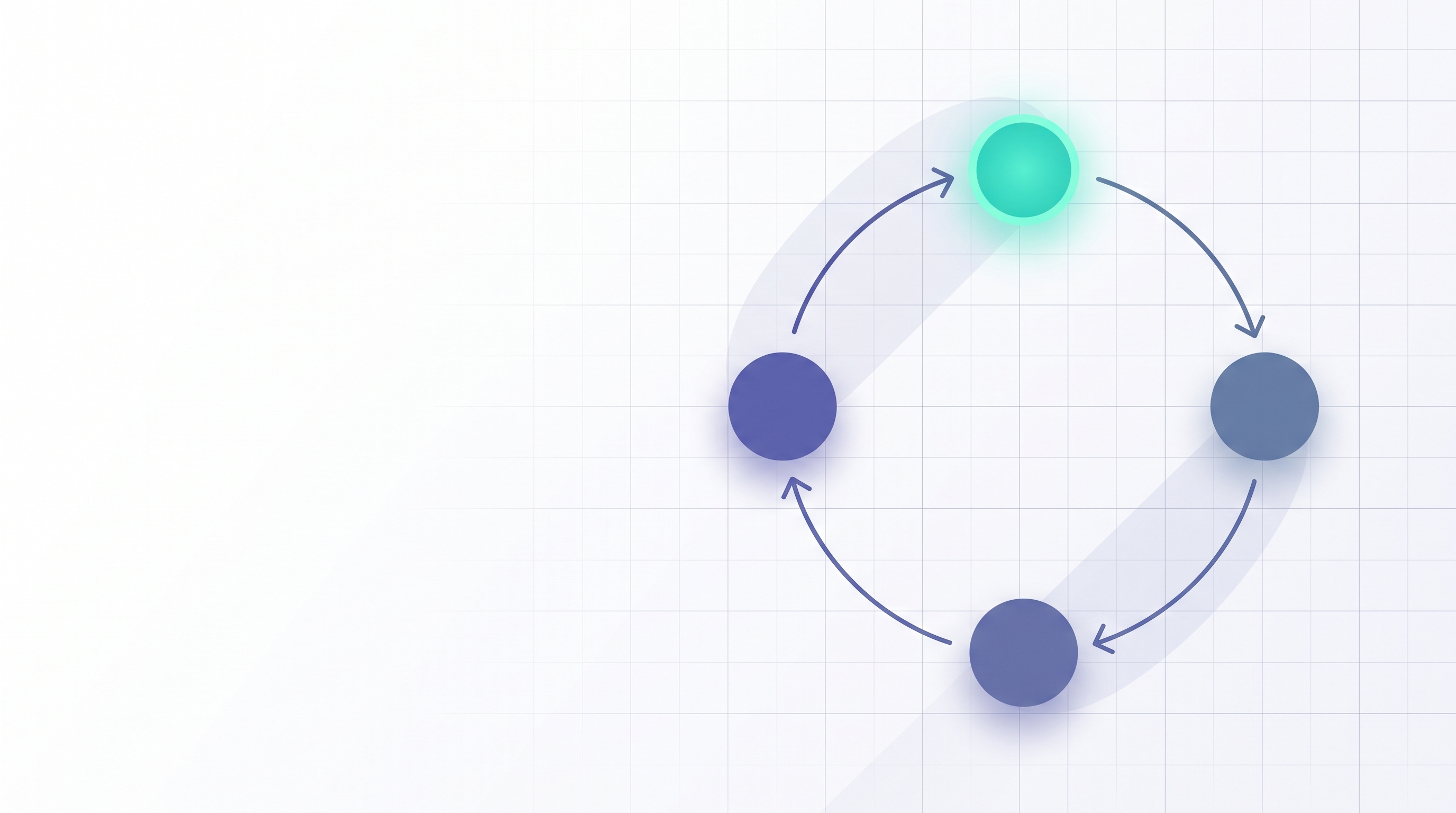
An agentic workflow describes a run where a system works toward a goal and, in some designs, decides its next step from the inputs and the results so far. The loop has four moves that repeat: plan a step, act on it, check what came back, and adjust the plan when the check calls for it. A run can stop when the goal is met, or hand off to a member when it reaches a point the design marks for review.
The word covers the shape of the run, not a specific model or product. A simpler setup may answer once and stop, and an agentic workflow keeps going through the loop until a stopping condition holds. How many turns it takes, and how much it can decide on its own, are things the team sets when it builds the workflow.
The design patterns behind it
A few design patterns show up when teams build these workflows. The names below describe the shape of each pattern and the kind of process it suits, framed as workflow patterns, not claims about any one product. They can combine inside a single workflow, so a working design can mix several.
Sequential steps
One pattern chains steps in a set order, passing the result of each into the next. A fixed order on its own is an ordinary workflow shape, and predefined step chaining of that kind belongs to the workflow automation discussion, so the order alone is not what makes a workflow agentic.
It reads as part of an agentic workflow when the chain sits inside a goal-driven run, where the system checks each intermediate result and can re-plan, call a tool, or retry a step before moving on. The order gives the run its structure, and the run-time checks are the part that makes it agentic.
Routing
Routing classifies the input, then sends it down one path or another. A support message might go to a refund path, a technical path, or a member review path, depending on what an early read finds.
This pattern helps where inputs arrive in different shapes and each shape needs a different sequence. The choice of path happens at run time, from the content of the input, which is what separates it from a branch a person hard-codes in advance.
Generate and check
A generate step followed by a check step forms another pattern, where the check reviews the output against the goal and loops back when it finds a problem. Drafting a summary and then checking it for missing points is one example, with the workflow revising until the check passes or a limit is reached.
This pattern suits work where an early result is rarely final and a clear check exists. The check can be a model step, a rule, or a member, and where the stakes are high a team may route that check to a member.
Tool use and planning
Tool use gives the workflow calls it can make mid-run, such as a search, a database query, or an action in another system, and lets it choose which to use from the situation. The tools available, and the limits on them, are set when the workflow is built.
Planning sits alongside tool use. The system breaks a goal into sub-steps at run time and works through them, adjusting the list as results come in. The two can appear together in a design, since a plan names the tools each sub-step needs.
How it differs from a single agent and a chatbot
These terms sit close together and blur easily. A simple chatbot interaction may answer a prompt and wait for the next one, and whether it carries a goal across turns depends on its setup. An agentic workflow carries a goal through a sequence of steps and decides what each step should be from the results so far.
A single agent is the actor that makes those decisions, while the workflow is the shape the run takes around it. One agent can run a whole workflow, and a workflow can call more than one agent, a case the multi-agent articles cover. The labels describe design choices, so they overlap in practice.
Where an agentic workflow earns its place
A process suits this shape when its inputs arrive in varied forms, its steps are hard to fix in advance, and it has a point where a member can catch a bad result before it matters. Triaging mixed incoming requests, gathering an answer across several sources, and drafting a reply that adapts to a record are cases where the next step depends on what the last one returned.
The reverse also holds. Where a process runs the same steps on predictable inputs, a simpler setup can do the job, and a fixed script may be easier to run and check. Matching the shape to the process the team has is the point, and the added structure of the loop suits work where the path cannot be drawn in full in advance.
Where a member stays in the loop
A team may reserve two kinds of points for a member. One is the exception, where an input falls outside what the design covers and the case goes to a member for a decision. Another is approval, where a member confirms a specific action a team has marked as sensitive, such as one that reaches a customer or moves money, before it runs.
Which points those are, and how many, is a decision the team makes from the risk each action carries and the standards it works under. An agentic workflow does not imply a member checking every step, and it does not remove the member either. The team sets where the checks sit.
Keeping the steps and their review visible
- Records stay visible, and review follows the run. Selected work, handoff, and review records stay visible in a shared channel to members and agents at the same time, so a member reviews against the run as it happened, with the record in hand.
- Status and ownership stay clear. On a task, each piece of work carries a status and an owner, so who is working, where it stands, and who picks it up next stay clear to the team.
- Outputs are judged against a standard. The result of a step can be represented as a deliverable, which a member opens and assesses against the standard the team wrote down.
- Key actions get a human gate. An action a team marks in advance as high-risk or outward-facing can be prepared as an Action Card, which an authorized member reviews and submits under their own identity.
- Context carries across sessions. Across conversation turns and separate sessions the relevant context stays continuous, so a handoff does not start from scratch.
A workflow that re-plans while it runs produces a plan nobody typed. The steps appear as the work proceeds, which makes the result hard to argue with and the reasoning behind it hard to reconstruct.
Planning at run time means the route to a result is itself an output. A reviewer who wants to know why a step happened needs the decision that produced it, not just the final artifact. Syfo keeps the steps and their review visible, and it carries the coordination a plan-then-execute workflow brings with it as well: how steps are recorded, who owns the status, how context carries forward, and who reviews what comes back.
- The plan becomes readable as it forms. Work, handoff, and review records a team selects sit in one channel, so the shape of a run can be followed while it is happening.
- Replanning shows up as a change of record. Because a step is recorded where it stands, a route that shifts mid-run shows the shift rather than hiding it.
- Each output meets the team's standard. A result lands as a Deliverable a member opens and assesses against the written criteria, whatever route produced it.
- A consequential step can wait for a person. An action the team marked in advance as high-risk or outward-facing can be prepared for an authorized member to review and submit in their own identity.
Continuity across sessions matters here too, because a workflow that plans toward a goal and runs across several sittings should not lose the thread between them. The workflow still does the planning and the execution.
How it relates to nearby terms
Several terms sit close to agentic workflow, and they are easy to blur. For this article:
- Agentic automation applies this shape to automating a process, and the concept-level treatment lives in its own article.
- Orchestration is the coordination layer across steps, covering state, routing, dependencies, and handoffs. Whether any single step gets decided at run time is a separate question from that.
- AI agent workflow and workflow automation each get their own article, one on the agent's run-time steps and one on the tools that automate a process.
- Agentic AI is the wider idea of software that pursues a goal by choosing its actions, and an agentic workflow is one shape that idea takes.
Questions people ask
Can you give an example of an agentic workflow? A support triage reads each incoming message, decides whether it needs a refund, a technical answer, or a member, gathers what it needs from the relevant systems, drafts a reply, and routes anything sensitive to a member for approval. The path changes with each message, within the steps the design allows.
Is ChatGPT an agentic workflow? It depends on how it is used. A single question and answer on its own is not enough to call it one; what matters is whether the configuration plans steps, calls tools, and checks results toward a goal. The label follows the setup, and the product name alone does not settle it.
What are the stages of an agentic workflow? Different sources group them differently. For this article, the repeating moves are plan, act, check, and adjust, with a stopping point when the goal is met or a member takes over. Treat any fixed stage count as one way to describe the loop, not a settled standard.
Does every process need an agentic workflow? No. A process with stable steps and predictable inputs may stay on a simpler setup, which can be easier to run and check. The shape can help where inputs vary, several steps are involved, and a clear review point exists.
Where to start
Start with one process where the inputs vary and a member can review the result before it matters. Keep the early runs small, keep the steps reversible where you can, and put the step and review records where members can see them. An early pass at that scale can help a team see where the workflow's decisions hold and where they need a closer look.
Once the review points hold and the selected records provide material for review, a team has a basis for judging whether to widen. Whether to move a second process onto the same shape is easier to weigh once the team has seen where the loop's decisions need review and where they can run without it.
Start with the work your team needs to move.
Begin with one real workflow, keep ownership visible, and review the result before expanding the setup.