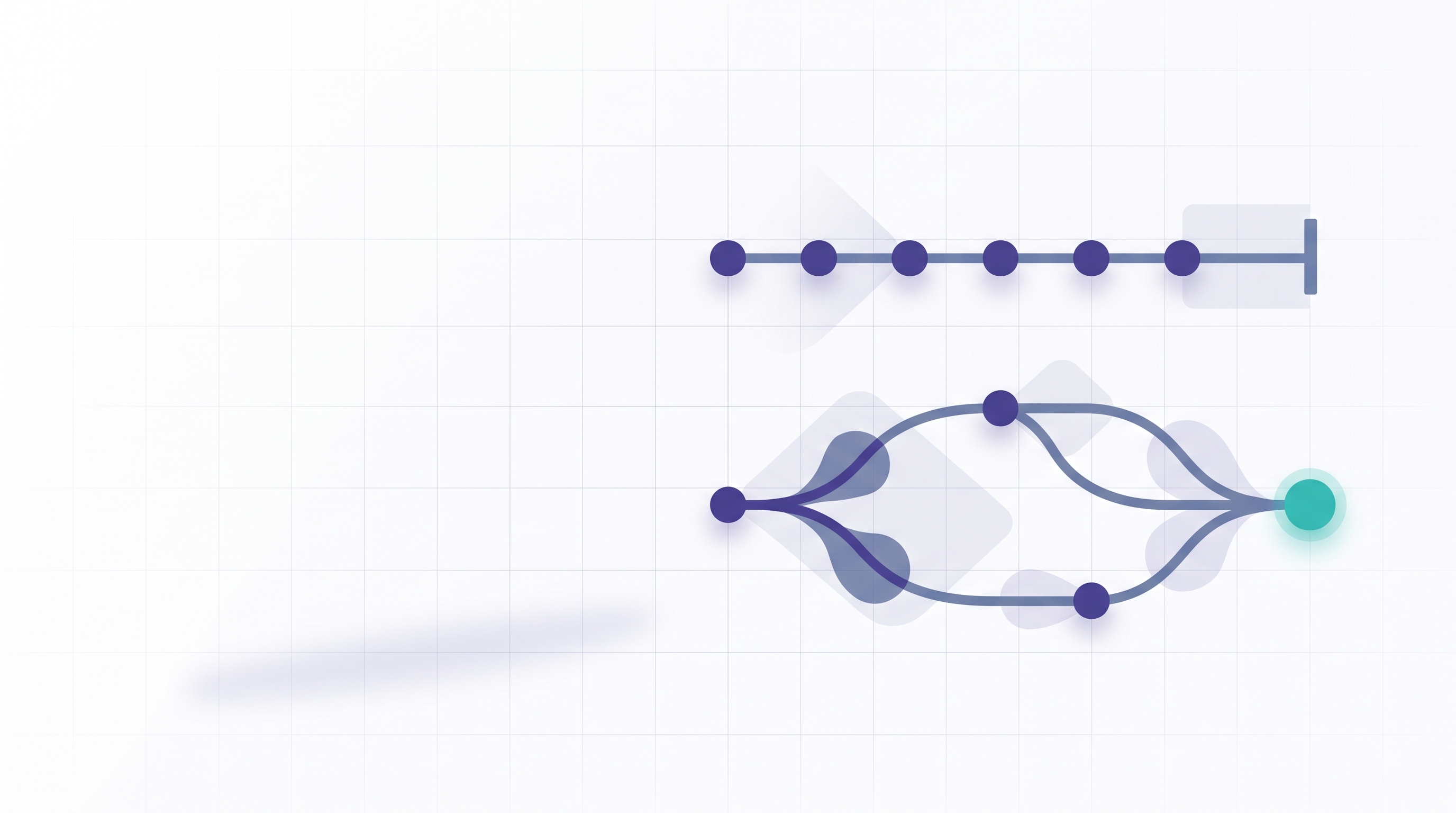
Traditional automation follows a fixed script, doing the same steps in the same order and handing anything unexpected back to a person. Some agentic automation designs loosen that script, letting a software agent decide the next step from the situation, call tools, and adapt when the inputs change. This article explains what agentic automation changes compared with rule-based automation, where it fits, which points a team keeps for a person to handle exceptions or review specific actions, and how a human-AI collaboration workspace such as Syfo gives those review points a place in a shared channel.
The short answer
The difference between agentic automation and the scripted automation a team already runs comes down to where the path gets decided. In a scripted setup, a person settles the sequence before the run, and the software repeats it. In some agentic designs, the software agent chooses among the steps and tools available to it at run time, based on the inputs and the results so far. Whether that fits a given process depends on how much the inputs vary, how much each action can affect, how easily a member can review what happened, and how the team configures the setup.
That shift can carry a cost. Letting an agent decide at run time can lower how predictable a run is and raise how much a team needs to record and review. So teams keep certain points for a member, such as handling an exception the design did not cover or approving an action they have marked as sensitive. A shared workspace gives those records and reviews a place to stay visible, which the section on Syfo describes.
What agentic automation is
Agentic automation describes a setup where a software agent works toward a goal and, in some designs, chooses the next step from the inputs and the current result, calls the tools it needs, or adjusts the path when something changes. A design can include a goal, a set of steps or tools the agent may use, and a decision each turn about which to take. That decision is the part that separates such a design from a run that follows one fixed order.
Not every automation needs this, and not every process suits it. Whether to hand that decision to an agent depends on how varied the inputs are, how much each action can affect, whether a member can check the result, and how the team sets the whole thing up. Where the steps are few and the inputs are predictable, a simpler setup can do the job and may be easier to follow.
How it differs from rule-based automation
The dividing line is where the path gets decided and how the setup handles something it did not expect. Two arrangements settle the path before the run, and one settles it during the run. They can overlap inside a single system, so the labels describe design choices more than fixed product types.
The path decided before the run
A fixed script runs a set sequence, doing the same steps in the same order. It suits work where the inputs stay within a known range and the sequence rarely changes. Because each step is written down ahead of time, the written steps show a member the path it will take.
Rule-based automation adds branches a team defines in advance, so the setup can take one path or another depending on conditions it checks. It handles more cases than a straight script while still settling each path before the run. A fixed script and a rule set overlap in practice, though they are not the same thing: one repeats an order, the other picks among orders a person wrote.
The path decided during the run
Agentic automation moves that decision into the run. Given the inputs and the results so far, the agent picks among the steps and tools available to it, which lets it take on cases nobody listed in advance. This is the change the term points to.
The trade may matter. A decision made at run time can lower how predictable the run is, and it can raise how much a team needs to record and review to stay confident in the result. Those are possible costs a team weighs against the range of inputs it faces, not effects that follow every time.
Where agentic automation fits
A process suits this approach when its inputs arrive in varied forms, its steps are hard to list out in advance, and it has a point where a member can catch a bad result before it matters. A few examples:
- Triaging incoming requests that show up in different shapes, where the next step depends on what each one contains.
- Looking across several sources for an answer, where the next lookup depends on what the last one returned.
- Drafting a response that adapts to what a record holds, with a member reading it before it goes out.
The reverse also holds. Where a process runs the same steps on predictable inputs at high volume, a script can be simpler to run and to check, and whether run-time decisions add anything depends on the process. The point is to match the approach to the process the team actually has.
Where a member stays in the loop
A team may reserve two types of points for a member. One is the exception: when an input falls outside what the design covers, the case can go to a member for a decision. Another is approval of a specific action a team has marked as sensitive, such as one that reaches a customer or moves money, where a member confirms before it runs.
Which points those are, and how many, is a decision the team makes from the risk each action carries and the standards it works under. Agentic automation does not imply a member checking every step, and it does not remove the member either. The team sets where the checks sit.
Keeping those decisions and reviews visible
- Records stay visible, and review follows the run. Selected work, handoff, and review records stay visible in a shared channel to members and agents at the same time, so a member reviews against the run as it happened, with the record in hand.
- Status and ownership stay clear. On a task, each piece of work carries a status and an owner, so who is working, where it stands, and who picks it up next stay clear to the team.
- Outputs are judged against a standard. The result of a step can be represented as a deliverable, which a member opens and assesses against the standard the team wrote down.
- Key actions get a human gate. An action a team marks in advance as high-risk or outward-facing can be prepared as an Action Card, which an authorized member reviews and submits under their own identity.
- Context carries across sessions. Across conversation turns and separate sessions the relevant context stays continuous, so a handoff does not start from scratch.
Agentic automation moves the decision into the run. An agent reads the situation and picks the next step, which is the point of it, and also the reason the decisions it makes deserve a record a person can read afterwards.
When system and script share the deciding, the questions a reviewer asks change shape. Not simply what ran, but what it weighed, which route it took, and who stands behind the result. Syfo keeps the decisions and the points a member reviewed somewhere they stay readable, and it does the same for the general coordination a run brings with it, namely who is doing what, who owns the status, how context carries forward, and who reviews the output.
- A decision can be read after the fact. Work, handoff, and review records a team selects stay visible in a channel, so a choice made mid-run can be examined later against what the agent saw.
- Automated steps and human judgment meet in one place. A task carries the owner and the state, so a step that needs a person to weigh in sits next to the steps that do not.
- The output is assessed on the team's terms. A result arrives as a Deliverable a member opens and reads against the standard the team wrote down.
- A consequential action can wait. An action the team marked in advance as high-risk or outward-facing can be prepared for an authorized member to review and submit in their own identity.
The workspace also keeps context continuous across sessions and turns, since an agentic run that resumes after a break should not be reasoning from a blank page. Runtime governance, security, and monitoring for the automation stay with the platform that runs it.
How it relates to nearby terms
Several terms sit close to agentic automation, and they are easy to blur. For this article:
- Agentic AI is the wider idea of software that pursues a goal by choosing its actions. Agentic automation is that idea applied to automating a process, and this article treats the two as a working relation, not a settled hierarchy.
- Agentic workflow points to the run-time shape and the design patterns behind this kind of setup. The patterns get their own treatment in the agentic workflow article, so this one leaves them there.
- Robotic process automation (RPA) runs software steps a person defines, and agentic process automation (APA) describes handing more of that decision to an agent. Both overlap with agentic automation; the process-level comparison with rule-based RPA lives in a separate article.
- Orchestration is the coordination layer across steps, covering state, routing, dependencies, and handoffs. Whether any single step gets decided at run time is a separate question from that.
What to settle before handing a process over
Before a process runs with an agent deciding steps, a few things are worth settling. Where the review points are, and who watches them. Which actions need a member to approve before they run, and which can proceed on their own. Whether a step can be undone if it goes wrong. And what the setup records, since a member has to work from what the run leaves behind.
These are design conditions worth confirming before a team picks a tool, since they shape whether a bad run can be caught and traced. A process with clear review points and a way back can serve as a starting point; one where a wrong step is hard to see or reverse is worth settling before the process runs.
Questions people ask
What does agentic automation mean? It describes automation where a software agent, in some designs, chooses the next step from the inputs and the current result, where a scripted run would keep to one fixed order. Whether a given setup works that way depends on how it is built and configured.
How is it different from ordinary AI or agentic AI? Agentic AI is the broader idea of software that chooses its actions toward a goal. Agentic automation is that idea aimed at automating a process, with steps, tools, and review points a team can set. This article uses that as a working distinction.
Is ChatGPT agentic automation? It depends on how it is used. A single question-and-answer exchange on its own is not enough to call it agentic automation; what matters is whether the configuration involves tool selection, path selection, or multi-step execution toward a goal. The label follows the setup, and the product name alone does not settle it.
Does agentic automation suit every process? No. A process with stable, well-specified steps and predictable inputs may stay on a script, which can be simpler to run and check. The approach can help where inputs vary and a clear review point exists.
Where to start
Start with one process where the inputs vary and a member can review the result before it matters. Keep the early runs small, keep the steps reversible where you can, and put the review records where members can see them. An early pass at that scale can help a team see where the agent's decisions hold and where they need a closer look.
Once the review points hold and the selected records provide material for review, a team has a basis for judging whether to widen. Whether to move a second process over is easier to weigh once the team has seen where an agent's decisions need review and where they can run without it.
Start with the work your team needs to move.
Begin with one real workflow, keep ownership visible, and review the result before expanding the setup.