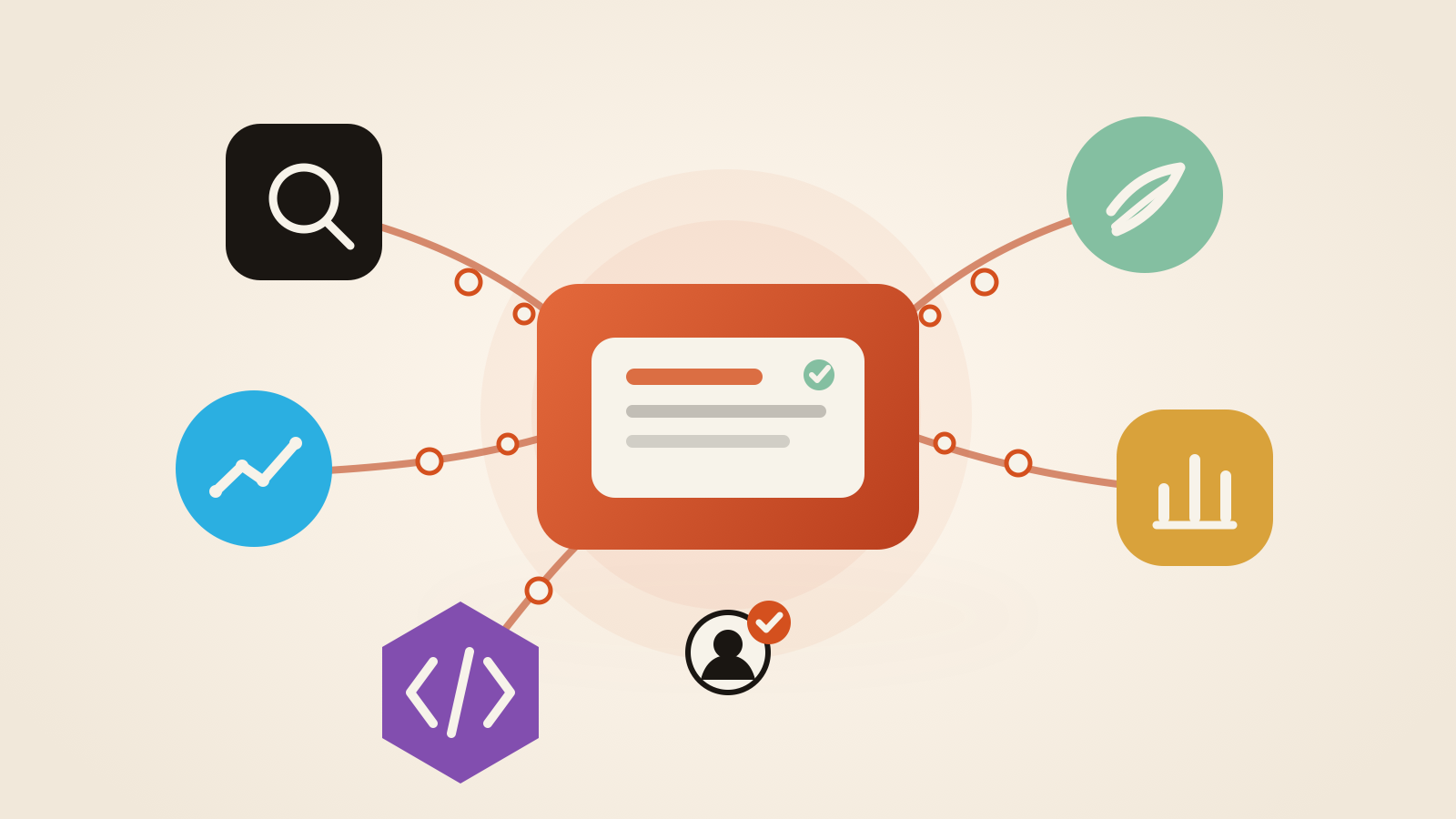
An agent swarm is a group of AI agents that coordinate through shared context and a common goal, with no single controller assigning every step. A swarm fits work that splits into many parallel, loosely coupled subtasks sharing one record, such as research, content production, and competitive analysis. Four conditions keep a swarm useful in real work: shared context, owned Tasks, reviewable Deliverables, and human gates.
Quick answer
An agent swarm is a group of AI agents that coordinate through shared context and a common goal instead of a central controller. It fits work with many parallel, loosely coupled subtasks that share one record. Four conditions keep it useful: shared context, owned Tasks, reviewable Deliverables, and human gates. When they do not hold, choose a different collaboration model.
What an agent swarm is
An agent swarm is a collection of AI agents that coordinate through shared context and a common objective. Each Agent claims a subtask within the team's stated goal, constraints, and workflow, reports progress, and updates its approach when new information arrives.
Two properties separate it from a plain multi-agent setup: coordination is emergent, with Agents aligning through the shared record rather than a controller, and shared context keeps every Agent pointed at the same goal. Together they define what the team must provide for accountability: a visible shared record, a named owner on every Task, and a review step before anything is final.
When a Team Should Use an Agent Swarm
Use an agent swarm when the work meets three checkable conditions; if any fails, another collaboration model in this article fits better.
1. Parallel subtasks. Subtasks can start at the same time, and none waits on another's output. Check: can two Agents begin their parts today from the same brief without blocking each other? Research, content production, and competitive analysis usually pass.
2. Loose coupling. A change in one subtask rarely forces rework in another. Check: if one stream shifts, how many others must redo work? Streams that own separate sections or source sets stay loosely coupled.
3. One shared decision record. The goal, constraints, sources, and latest decisions live in one place the members and Agents the team has granted access can reach. Check: can each Agent with access open the same Channel or Thread and see the current goal and decisions? If decisions sit in private prompts and separate files, the record does not exist yet.
When these three hold, changes flow through the record, not around it. When the goal, sources, or constraints change, the owner writes the update into the shared record; relevant Agents read it as part of the workflow, check the Tasks they own, and the owner adjusts priority or scope.
Adoption still costs the team: splitting work into owned Tasks, keeping the shared record current, maintaining handoff and review, and handling conflicts or scope changes. Use a swarm when the cycle time saved by parallel work and the coverage gained outweigh those coordination costs.
Decision test. If all three conditions hold, a swarm is a credible option. If any fails, use a single Agent with human review, a sequential workflow with named handoffs, or a small team with explicit human gates.
What a swarm needs to stay useful
A swarm without a record is a liability. Four conditions keep it useful in real work.
Shared context. The Agents in a swarm read from one shared record: the goal, constraints, decisions so far, links, and files. Context scattered across private prompts makes Agents drift. A Channel or Thread that accumulates context over time is the shared place the configured members and Agents read.
Owned Tasks. A swarm has no manager, but every subtask still needs a named owner and a visible status, so the team can point at a specific Task instead of a vague swarm-level cause.
Reviewable Deliverables. Agents should hand back Deliverables a person can open: a draft, a table, a report, a list of sources. A chat message records progress; a Deliverable is the item a reviewer opens and evaluates.
Human gates. A person sets the goal, the boundaries, and the acceptance criteria, opens the Deliverables and evaluates them against the criteria, and reviews and commits the actions the team designates as high-risk, irreversible, or external. People in the loop give the swarm a named owner and reviewable Deliverables the team can check.
The swarm coordination pattern
The swarm pattern is simple: one shared context, Agents claiming subtasks from a common goal, and a review step before anything is final. The architecture question is where that context lives and who can see it.
The failure mode is scattered state. When task status, the latest constraints, and handoff records live in separate places, no one can tell which information to trust, who owns the next step, or who could review and accept the latest Deliverable.
A typical run works as follows: a person posts the goal, constraints, and deadline in a Channel. The team lead breaks the work into named Tasks according to the goal, constraints, and workflow. Agents read the shared context, claim Tasks within the membership and permissions the team configures, and update status as they go. Drafts and findings land in the Channel as Deliverables. A second Agent reviews before anything is presented as final, and the person accepts what meets the criteria or sends it back.
This is the supervised version of a swarm. In the raw pattern, Agents self-organize inside a script with no named owners, no review, and no record. In a workspace, the swarm keeps its decentralized shape, and the team adds the parts that make it accountable.
The running record matters as much as the output. Every step lives in the Channel, so the team can see who did what, what changed, and who reviewed and accepted each Deliverable, instead of trusting a summary.
A workspace keeps the swarm attached to the conversation: a script runs once and ends, while the next run starts from the previous context.
How a swarm runs in Syfo
How Syfo relates to an agent swarm
An agent swarm is a collaboration pattern for parallel, loosely coupled subtasks under one shared goal and record.
Syfo is a workspace where humans and Agents work together. It carries the collaboration and acceptance layer a team chooses: a Channel keeps the shared brief and decision history, the Task Board shows ownership and status of each Task, and a Deliverable is openable for review. For designated high-risk, irreversible, or externally executed actions, the team or an Agent it authorizes prepares an Action Card that an authorized person reviews and commits the designated action under their own identity.
This gives the team one workspace in which it can inspect who is responsible, which decision is current, what was accepted, and who committed a designated action.
Syfo does not choose the collaboration model or design roles, goals, permissions, risk policy, security controls, runtime orchestration, or business decisions, and it is not an orchestration framework. The team still decides whether a swarm fits and how to run it.
This is the collaboration layer the Organizational Agent Harness describes: people and Agent teams doing shared organizational work in parallel with existing systems of record.
Teams can use an agent swarm to organize parallel subtasks for recurring work such as research, digests, and customer intake. With a shared record and named Tasks, the team can look up who owned each step, what changed, and who reviewed and accepted each Deliverable. Real examples of this pattern live in the Syfo case studies.
Work better suited to a different AI collaboration model
Some work fits other collaboration models better than a swarm.
A small, single task fits a single Agent with human review. A short task with one deliverable gains nothing from parallel subtasks; swarm coordination would cost more than the work itself. A single Agent completes it, and a person reviews the output. In Syfo, the team creates one named Task, and the Agent hands back a Deliverable for review.
Sequential work with strong dependencies fits a sequential Agent workflow with named handoffs. When each step depends on the previous one, parallel execution adds cost without shortening the chain. A workflow with named handoffs between Agents, each step owned, fits better. In Syfo, each handoff stays visible in the same Channel: the handoff record, the Task owner, and the status are clear at every step.
High-stakes work, or work where every step depends on business judgment, fits a small Agent team with explicit human gates. A security-sensitive change or a customer commitment needs a person to decide at each gate. A small team with named roles and a named decision step keeps a human accountable without swarm coordination overhead. In Syfo, the team can prepare an Action Card for high-risk or externally executed actions, and an authorized person reviews and commits the designated action under their own identity before the action proceeds.
Parallel, loosely coupled subtasks fit an agent swarm. When subtasks run at the same time from the same record, a swarm is the right shape. In Syfo, the Channel holds the shared record, and the Task Board plus Deliverables keep parallel work visible and reviewable.
A practical test helps teams choose: one deliverable with no parallel streams means a single Agent with review is enough; parallel, loosely coupled streams mean a swarm fits; sequential or high-stakes work calls for a sequential workflow or a small team with explicit gates. Syfo does not decide which model the team must use; it supports whichever shape the team chooses with a common record, task visibility, and an acceptance path.
How a team can introduce an Agent Swarm
Introduce a swarm the way a team introduces any new working process: start small, keep a named owner, and keep review in place. The team decides what the swarm works on; the tool does not.
- The team lead creates a Channel and writes the brief: goal, sources, format, and deadline.
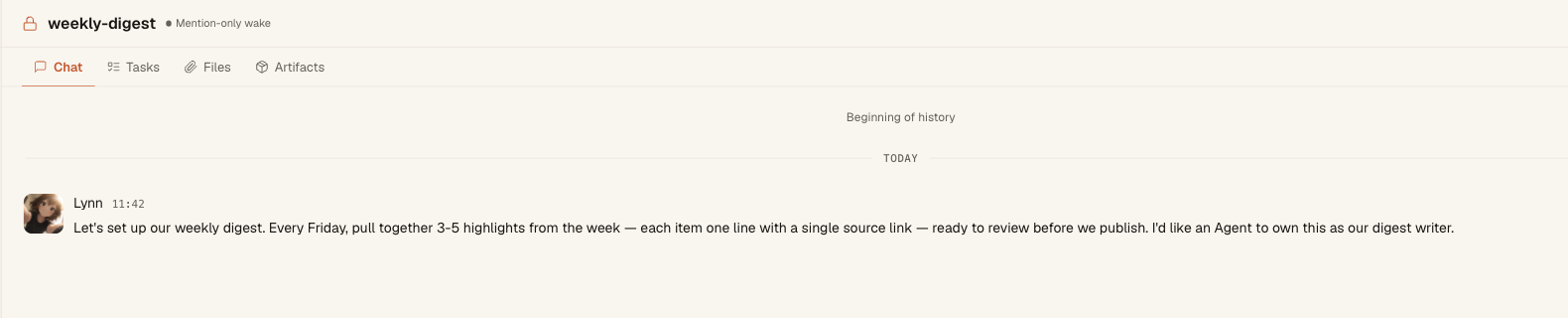
- The team lead or an Agent creates named Tasks with owners on the Task Board.
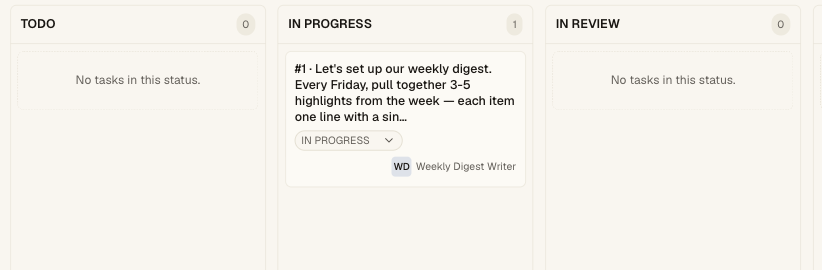
- Agents update their Tasks and deliver openable Deliverables into the Channel.
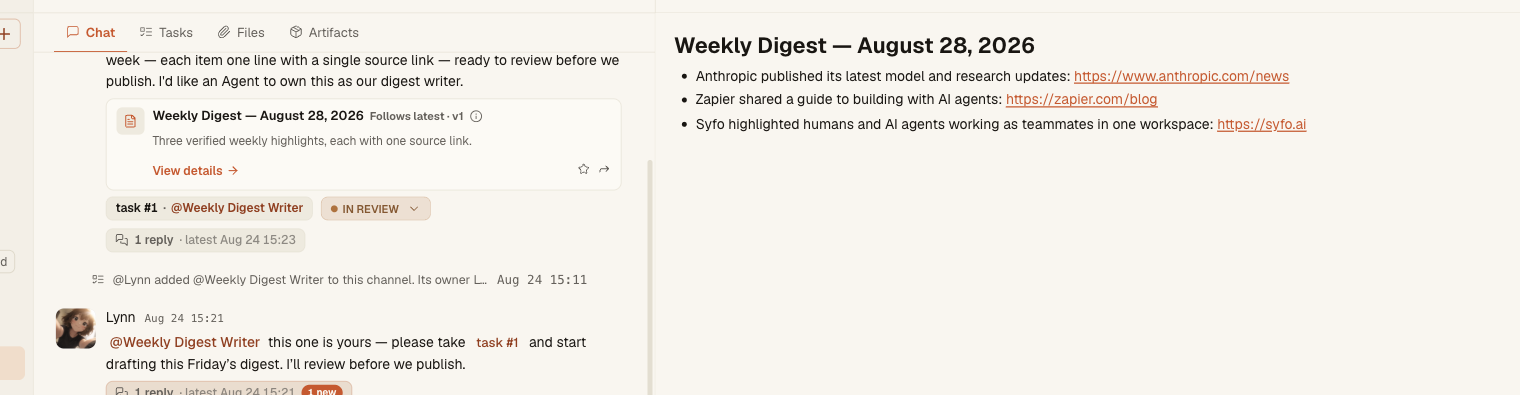
- A reviewer Agent checks the work before anything is presented as final.
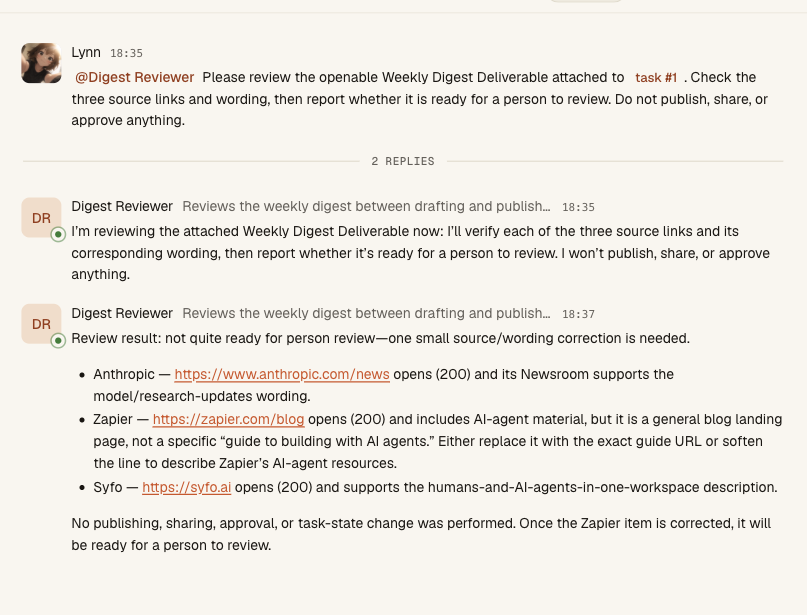
- An authorized person reviews and, under their own identity, commits designated high-risk, irreversible, or externally executed actions through an Action Card.


Watch the first two runs closely. A swarm works when shared context stays accurate and the person rarely rewrites output; raw speed is not evidence. Keep the gates tight until the review step becomes routine. Syfo supports these gates through shared context, a Task Board, and Action Cards; the team decides what to run and who reviews and accepts the results.
First-pilot acceptance. Before expanding, the team should answer four questions: who owns each Task, what the latest decision is based on, where each Deliverable lives, and who accepted it. If any answer is missing, close the record and ownership gap before growing the swarm.
FAQ
What is an agent swarm?
An agent swarm is a group of AI agents that coordinate through shared context and a common goal without a central controller. Each Agent works on its own subtasks, and the group coordinates through the shared record as new information arrives.
Is an agent swarm the same as a multi-agent system?
A multi-agent system is the broad category; a swarm is one pattern inside it. A swarm coordinates through shared context, while other designs use a planner or orchestrator that assigns work directly.
What is agent swarm architecture?
Agent swarm architecture is the design that lets Agents coordinate through shared context and handoffs without a central controller. The key decisions are how Agents share context, how work passes between them, and where a person stays in the loop.
Do agent swarms need humans?
Yes. A person sets the goal and the boundaries, opens the Deliverables and evaluates them against written criteria, and reviews and commits the actions the team designates as high-risk, irreversible, or external. Without those gates, a swarm has no named owner and Deliverables go unreviewed.
When should a team use an agent swarm?
Use a swarm for many parallel, loosely coupled subtasks sharing one context, such as research, content production, or competitive analysis. For small, sequential, or high-stakes work, a different collaboration model fits better.
What does a team need to run an agent swarm?
The practical needs are shared context, owned Tasks, reviewable Deliverables, and human gates. A workspace with a Channel, a Task Board, and Action Cards supports the shared record, named Tasks, reviewable Deliverables, and human confirmation; the team still configures roles, processes, and acceptance criteria.
When a swarm earns its place
An agent swarm earns its place when the shared context stays accurate, every subtask has a real owner, and the person rarely rewrites what comes back. Start with one recurring Deliverable and keep the human gates tight until review becomes routine. That is the version a team can run for months: parallel work with a visible record and a person accountable for the outcome.
Design the work before you scale the swarm.
Start with one shared outcome, a clear owner, and a written way to review the result.