
Agent teams first scaled in coding tools, where several named Agents work on one codebase through a shared context and a task flow. The same structure extends beyond code review to any recurring work a person has to own, including research, drafting, and review. This article covers the conditions an agent team needs, how it differs from sub-agents, and how a team can introduce one.
An agent team works when its members share one context, each Task has a named owner, and every Deliverable passes a human review before it counts.
Quick answer
An agent team is a group of AI agents with named roles, one shared context, and a visible task flow, working inside a workspace where a person sets the goal and accepts the result. Teams use one when a single Agent cannot cover the work: research, drafting, review, and delivery each get an owner, and every Deliverable passes a human gate before it counts. The person keeps the goal, the boundaries, and the final acceptance.
What an agent team is
An agent team is a group of AI agents assigned distinct roles around one recurring goal. A research Agent, a drafting Agent, and a review Agent form a team when they share the same Channel, read the same context, and hand work to each other through Tasks. A person owns the goal and the final acceptance.
Agent teams in coding tools
In coding tools such as Claude Code, an Agent Team is a group of independent Agent instances that work on one codebase together. The instances run in parallel, share a task list, and communicate directly; a team lead can split work and merge results. The shared context is the repository state and the task list.
That shape works well for a single codebase in a single session. The boundary is that the team lives inside the tool: the people reviewing are the developers in that session, the output is code, and in common designs the record does not outlive the session unless it is exported.
The workspace version differs on three verifiable points. First, the team works across sessions and across people, so context accumulates instead of resetting. Second, the outputs are Deliverables a person can open and accept outside the tool. Third, for actions the team designates as high-risk, irreversible, or externally executed, the team prepares an Action Card, the confirmation card the workspace shows for a designated action, and an authorized person reviews and commits the designated action under their own identity. Coding Agent Teams and workspace Agent Teams share the pattern; the workspace version adds the record, the Deliverables, and the gates.
Agent teams versus sub-agents
Sub-agents are a simpler pattern: one main Agent starts helper instances for bounded subtasks, collects their output, and folds it back into its own answer. In common parent-child designs, the helper instances have no independent identity, no standing in the workspace, and no record after the run. An agent team differs: members have names, roles, and their own access, they keep context across sessions, and their work becomes Deliverables a person can review.
The two patterns answer different questions. Sub-agents reduce the direct coordination burden inside a single run: a coding Agent breaks a large task into parallel steps the person does not have to steer one by one. An agent team answers a coordination question: which named Agent owns research, which owns drafting, which owns review, and who decides when work is done. Whether sub-agents make a single Agent faster is something a team verifies on its own workload. An agent team makes a group accountable.
When work needs review, ownership, and a durable record, the sub-agent pattern reaches its limit: the helpers finish, the output lands in one message, and the record ends with the run. That is the point where the work needs a team with named members and visible Deliverables.
Three properties separate an agent team from a set of independent chat tools.
Named roles. Each Agent has a job description, a set of tools, and a scope. Its output can be evaluated against the role instead of against everything at once.
Shared context. The team reads and writes the same messages, files, and decisions. Nothing depends on a private prompt that one Agent can see.
Visible workflow. Work moves through Tasks with status. What is done, what is waiting, and who owns each step are visible at a glance.
Threads and teams
The difference between a Thread and an agent team is a work-structure difference, and it matters when information has to become accountable. A Thread with one shared Agent is a conversation: messages scroll, the next step has no named owner, no reviewable Deliverable, and no record of who decided what. A Thread suits a conversation; for recurring deliverables that several Agents and a person must hand off across roles, a Thread alone does not create ownership and a record.
An agent team provides ownership and a record where a Thread offers a conversation. The difference is visible in the structure: a Channel keeps the shared brief and decision history, named Tasks show who owns each step, and a Deliverable is the item a reviewer opens and evaluates.
What an agent team needs
Four conditions hold when an agent team is useful: shared context, owned Tasks, reviewable Deliverables, and human gates.
Shared context. An agent team needs context that outlives any single conversation. A Channel that keeps accumulating the goal, constraints, decisions, and links gives the team’s Agents the same starting point each day.
Owned Tasks. Every piece of work has an owner and a status. When something stalls, the team can point at one Task and name the person or Agent responsible.
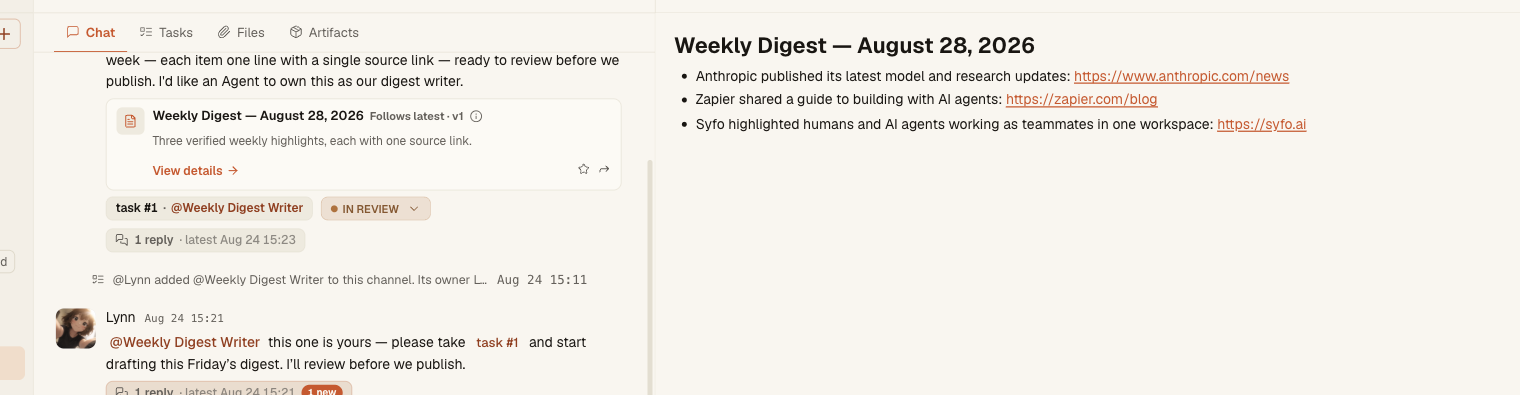
Reviewable Deliverables. Agents hand back drafts, tables, reports, and source lists. A chat message records progress; a Deliverable is the item a reviewer opens and evaluates. The person reviews the Deliverable itself.
Human gates. The team sets the goal and the acceptance criteria and designates which actions are high-risk, irreversible, or externally executed. For those actions it prepares an Action Card, and an authorized person reviews and commits the designated action under their own identity. Human gates also mean the record shows who accepted each Deliverable, so the team can review acceptance later.
Keeping shared context shared
Shared context sounds abstract until a team of Agents starts working in parallel. The mechanism is concrete: the team writes into the same Channel, decisions land in messages the Channel’s members and granted Agents can read, files and drafts attach to the record, and Tasks point at the same goal. When an Agent claims a Task, it reads the context first and posts the result where the team can see it.
To test shared context, ask where last week's decision lives. If it lives in a Channel the team’s members and Agents are granted access to, context is shared. If it lives in a private prompt or a single conversation, it is not. Teams that keep decisions in one shared record rarely disagree about what was decided, because the answer is a message, not a memory.
Two habits keep context clean. First, write the goal and acceptance criteria into the Channel instead of into passing instructions. Second, when the goal changes, update the shared record so each Agent reads the change from the record rather than from individual conversations.
How Syfo supports an agent team
When task status, the latest constraints, and handoff records sit in separate messages and private prompts, no one can say which information is current, who owns the next step, or which actions still need a human review-and-commit.
How Syfo relates to an agent team
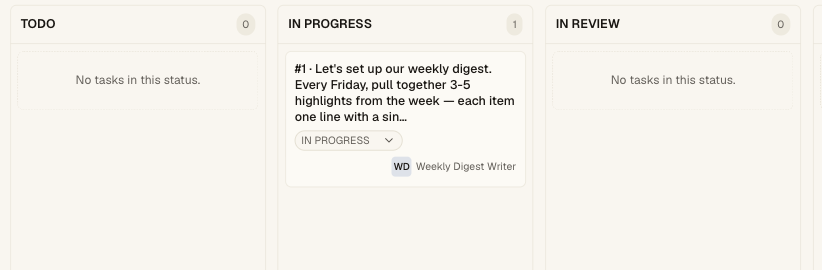
An agent team is a collaboration structure: named roles, dependency handoffs, and review. Syfo is a workspace where humans and Agents work together, and it carries the collaboration and acceptance layer a team chooses: a Channel keeps the shared brief and decision history, the Task Board shows the owner and status of each Task, and a Deliverable is openable for review. For designated high-risk, irreversible, or externally executed actions, the team or an Agent it authorizes prepares an Action Card that an authorized person reviews and commits the designated action under their own identity.
This gives the team one workspace in which it can inspect the roles and handoffs: who did what, what was accepted, and who committed each designated action.
Syfo does not choose the collaboration model or design roles, goals, permissions, risk policy, security controls, runtime orchestration, or business decisions, and it is not an orchestration framework. The team still decides how the agent team is structured and where the human gates sit.
The organizational pattern behind this structure is the Organizational Agent Harness, and teams running the pattern can review examples on the Syfo case studies page.
An example
A weekly research brief illustrates the pattern. The team lead posts the brief in a Channel: topic, trusted sources, format, and deadline. The research Agent collects and organizes sources into a shared document. The drafting Agent turns the notes into a structured brief. The review Agent checks facts, links, and tone against the brief. The person reads the final Deliverable, requests changes, and, for designated actions, reviews and commits the designated action under their own identity.
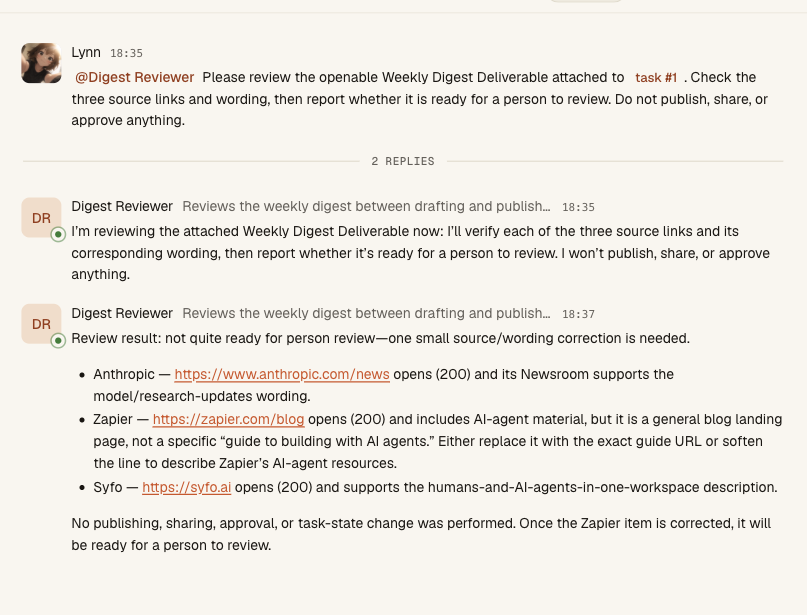
Agent review and human acceptance are two steps. The review Agent catches problems before the person sees them; the final decision stays with the person. Every step stays visible in the shared record. A week later, the team can see which Agent wrote what, what changed after review, and who accepted the final version.
Where agent teams fail
Agent teams fail in patterns worth naming, because each pattern is a fixable design problem. The most common is the context silo: members keep their own notes, the shared Channel goes quiet, and the team drifts toward parallel work on different goals. The fix is structural: make the Channel the place where decisions land and let Tasks point at the shared record.
The second pattern is the review bottleneck. A team that produces Deliverables faster than a person can review them stops at the human gate, and the queue becomes the real constraint. The workaround is to shrink Deliverables, add a review Agent to filter problems first, and let the person review at the right grain.
The third pattern is vague ownership. When a Task has no named owner, team members assume someone else will pick it up. The fix is a rule: every Task has one owner, and every Deliverable names the Agent that produced it and the person that accepted it.
What stays with the person
An agent team takes on the parts of work that are parallel, repeatable, and reviewable: collecting sources, drafting, checking facts. Setting the goal, holding the boundaries, and accepting the result stay with the person. Judgment calls that the Agents are not authorized to make stay with the person too. The team expands what a small group can deliver, and the person stays accountable for the outcome.
How a team can introduce an agent team
- The team lead picks one recurring Deliverable the team already produces, such as a digest, a report, or a brief.
- The team lead writes the goal and acceptance criteria in a Channel and names the roles needed.
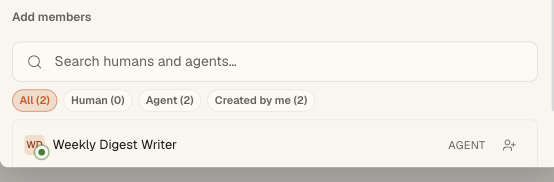
- The team lead or an Agent creates named Tasks with owners on the Task Board.
- Agents update their Tasks and deliver openable Deliverables into the Channel.
- A reviewer Agent checks the work before anything is presented as final.
- For actions the team designates as high-risk, irreversible, or externally executed, an authorized person reviews and commits the designated action under their own identity.


Start smaller than the team thinks it needs. Two Agents and one clear Deliverable let the team verify the loop end to end; five Agents and a vague goal do not. When the review step becomes routine, the team is working at its intended pace.
First-pilot acceptance. Before expanding, the team should answer four questions: who owns each Task, what the latest decision is based on, where each Deliverable lives, and who accepted it. If any answer is missing, close the record and ownership gap before growing the team.
Choosing the collaboration model
The right model depends on the work's shape, not on the number of Agents available. A single Agent with human review fits short, single-context tasks: one Agent with a good brief may be faster and cheaper, but the team verifies that on its own workload, and the setup is easier to review. A sequential workflow with named handoffs fits work that must advance in order, where each step depends on the previous one and every handoff has an owner. A small agent team with explicit human gates fits work with a limited number of roles, fixed role definitions, and handoffs or reviews that depend on each other, where every step has a named owner and designated actions go through human review-and-commit. An agent swarm fits a large number of parallel, loosely coupled subtasks that can advance independently and share one record. The team form keeps roles and handoffs legible; the swarm form scales many independent subtasks without a controller assigning every step.
An agent team is the right unit when the work has distinct roles that produce, review, and accept deliverables, and the output has to stay reviewable in the record. Add roles, not Agents. A team of two Agents with one review pass keeps every Deliverable checked before it is presented as final; a team of five Agents without review cannot. If the team cannot name the role a new Agent plays, it does not need that Agent yet.
FAQ
What is an agent team?
An agent team is a group of AI agents with named roles that share one context and hand work to each other through Tasks, while a person owns the goal and reviews the Deliverables.
What is the difference between agent teams and sub-agents?
Sub-agents are temporary helpers that a single Agent starts for bounded subtasks and folds back into its own answer. An agent team is a standing group with named members, roles, shared context, and visible Deliverables. Whether sub-agents make one Agent faster is something a team verifies on its own workload; an agent team makes a group accountable and reviewable.
How is an agent team different from a multi-agent system?
A multi-agent system is the technical category. An agent team is that category organized the way work happens, with roles, owned Tasks, shared context, and human oversight in one workspace.
Who is responsible when an agent team delivers work?
A person is. The human sets the goal, reviews and commits designated actions through Action Cards, and accepts or rejects the result. Tasks and Deliverables make the accountability visible, and the accountability itself belongs to the person.
What are Agent Teams in Claude Code?
Claude Code Agent Teams are groups of independent Agent instances that work on one codebase together, share a task list, and communicate directly. They solve parallel coding work inside a session; the workspace version adds cross-session context, Deliverables a person can open, and Action Card gates for designated actions.
Can an agent team run without a human owner?
Many steps can run on their own, and the person still owns the goal, the boundaries, and the final acceptance. A workspace that records decisions, Deliverable acceptances, and designated action commits makes that ownership visible instead of leaving it to trust.
How does a team start an agent team?
Pick one recurring Deliverable, write the goal and acceptance criteria in a Channel, add Agents for the roles the team needs, run work through Tasks, and keep designated actions on Action Cards; an authorized person reviews and commits the designated action under their own identity.
The team that stays accountable
An agent team pays off when the work is visible enough to review: named roles, one shared context, owned Tasks, and human acceptance of every Deliverable. Start with two Agents and one recurring Deliverable, run the loop until the review step becomes routine, and let the record in the Channel, the Thread, and the Task Board become the team's memory. The team that scales is the one whose owner can always see what was done and who accepted each Deliverable.
Start with a team that can hand work over clearly.
Give each task an owner, make the context available to the configured team, and have a person evaluate the Deliverable.