
AI agent governance is the set of rules and mechanisms a team uses to keep Agent actions visible and scoped, to define which actions wait for an authorized person, and to keep a record of what Agents did. In practice it has four layers: what an Agent can see, what it can touch, which actions wait for an authorized person, and what the Agent actually did. Teams put these layers in place before Agents take on tools, credentials, and recurring work, and they review them as the work grows.
Agent governance works when authorized members can see what an Agent can reach, what it is allowed to do, which actions wait for a person, and what it actually did.
Quick answer
AI agent governance is the set of rules and mechanisms a team uses to keep Agent actions visible and scoped, to define which actions wait for an authorized person, and to keep a record of what Agents did. It answers four questions: what an Agent can see, what it can touch, which actions wait for an authorized person, and how the work is recorded. Teams that keep Agent reach visible, put team-designated sensitive actions on Action Cards, and keep a shared record they can review can delegate more work to Agents with a defined boundary.
What AI agent governance means
AI agent governance is the set of rules and mechanisms a team uses to keep Agent actions visible and scoped, to define which actions wait for an authorized person, and to keep a record of what Agents did. It covers what an Agent can see, what it can touch, which actions need an authorized person, and how the work is recorded afterward.
Governance is a set of working mechanisms: permissions on a Channel, an Action Card before a team-designated action, a record of who did what. A written policy is a starting point; the mechanisms are what make the work reviewable. When those mechanisms exist, an agent team can take on more work while the team can still review the shared record.
Why governance matters once Agents take on real work
An Agent that answers questions needs little governance. An Agent with tools, credentials, and a recurring schedule needs a defined set of rules. When an Agent can send a message, change a document, or run a command, its actions become part of the team's record, and the record needs rules.
Three risks appear together when Agents take on real work. First, scope creep: an Agent reaches further than the task intends. Second, unapproved actions: an Agent does something that should have waited for a person. Third, invisible history: when something goes wrong, there is no shared record to review. Governance addresses all three by keeping what Agents did in a record the team can check.
What happens when governance fails
Governance failures share three root causes, and each one maps to a control. First, reach broader than the task: an Agent with access to a shared Channel and publishing tools can act on context beyond its assignment, for example reading a template as an instruction and drafting from the wrong source list. Second, a sensitive action without a gate: the Agent queues the result for release with no step that waits for a person. Third, no usable record: after the fact, no one can say why the Agent acted, who saw it, or where the wrong instruction entered the record.
The same pattern repeats at smaller scale: an Agent with broad access edits the wrong document, a scheduling Agent sends a reminder to the wrong list, a research Agent keeps credentials it no longer needs. Each case has the same three root causes. Governance converts these incidents into reviewable events: visibility shows which Agent had access, permissions limit how far a mistake can travel, an Action Card makes the designated step wait for an authorized person, and the record explains the sequence. The team still fixes the mistake, and the fix starts from facts.
The risks governance has to cover
Governance exists because a set of risks appears together as soon as Agents take on real work. Naming them makes the design decisions explicit.
Scope creep. An Agent invited to a Channel inherits its context, and the broader the context, the easier it is for a task to reach further than intended. The control is Channel membership plus a written scope for each Agent.
Unapproved actions. An Agent with write access can publish, send, or delete without asking when no gate exists. The control is a written risk list: the team designates which actions are high-risk, irreversible, or externally executed, prepares an Action Card for those actions, and an authorized person reviews and commits the designated action under their own identity.
Data exposure. An Agent that can read what it does not need, or that sits in a Channel with members it should not see, widens the exposure surface. The control matches the human membership model: private Channels are visible to members, and an Agent sees the Channels it is invited to.
Goal drift. An Agent follows instructions, and instructions go stale. A goal written in January and never reviewed lets behavior drift from the team's intent. The control is a review cadence for goals, scope, and permissions.
Invisible history. When records sit in private prompts and single conversations, a decision leaves nothing the team can review. The control is a shared Channel where Tasks and Deliverables carry the work and decisions stay in the record.
The four layers
Governance in practice has four layers, and they work in order: visibility decides what must be managed, permissions decide what each Agent can reach, approval decides which actions wait for a person, and audit means checking the shared record of what Agents did afterward. A team that skips a layer usually discovers the gap through an incident.
Visibility. Authorized Channel members can see which Agents are in the workspace, which Channels each Agent is in, and what it is doing. Private Channels are visible to members, and an Agent sees the Channels it was invited to. Visibility is scoped by membership, and the team configures that membership.
Permissions. Each Agent can reach what its role and Channel membership allow, and nothing more. Permissions are granted by the team and reviewed when membership or roles change.
Approval. For actions the team designates as high-risk, irreversible, or externally executed, the team or an Agent authorized within that workflow prepares an Action Card that states what will happen, and an authorized person reviews and commits the designated action under their own identity. The team decides which actions go on this list and who reviews and commits them.
Audit. The record exists and can be checked, and that is what audit means in this article. Tasks show owners and status. Deliverables show what was produced and who reviewed them. Designated action decisions show who committed and when. Checking the record helps the team review what happened; it is not an independent audit, and it does not guarantee that every sequence can be rebuilt after an incident.
Deciding what waits for a person
Some actions are cheap to undo, and some are not. The line for approval follows reversibility and external effect, and the team writes it down.
Work that is repeatable and reversible can run under team rules: reading logs, running tests, gathering sources, drafting a first version. The team designates which actions are high-risk, irreversible, or externally executed, and prepares an Action Card for each: publishing to a customer-facing site, sending a message outside the workspace, paying an invoice, deleting a document or a Channel, releasing a build, migrating data, changing permissions or credentials.
A practical rule: write the line once, name the concrete actions that wait for an authorized person, and keep the rest on the team's rules. A list of concrete actions is interpreted the same way by every Agent; a list of categories is not. When in doubt, put the action on the list. The cost of an unnecessary approval is a short review; the cost of a missing one is an incident. Review the list when the work changes: a new external integration, a new customer-facing channel, or a new credential class each raises the question of whether the action belongs on the list.
How governance works in Syfo
How Syfo relates to AI agent governance
AI agent governance is the practice of deciding member visibility, permissions, review, and human decisions on designated actions.
Syfo is a workspace where humans and Agents work together. It carries the collaboration and acceptance layer a team chooses: a Channel keeps the shared brief and decision history, the Task Board shows ownership and status of each Task, and a Deliverable is openable for review. For designated high-risk, irreversible, or externally executed actions, the team or an Agent it authorizes prepares an Action Card that an authorized person reviews and commits the designated action under their own identity.
This gives the team one workspace in which it can inspect and review the record of an action: what was reviewed and who committed it.
Syfo does not write the governance policy or design roles, permissions, risk lists, security controls, runtime orchestration, or business decisions, and it is not a security or compliance certification platform. The team defines which actions wait for a person and who reviews and commits them.
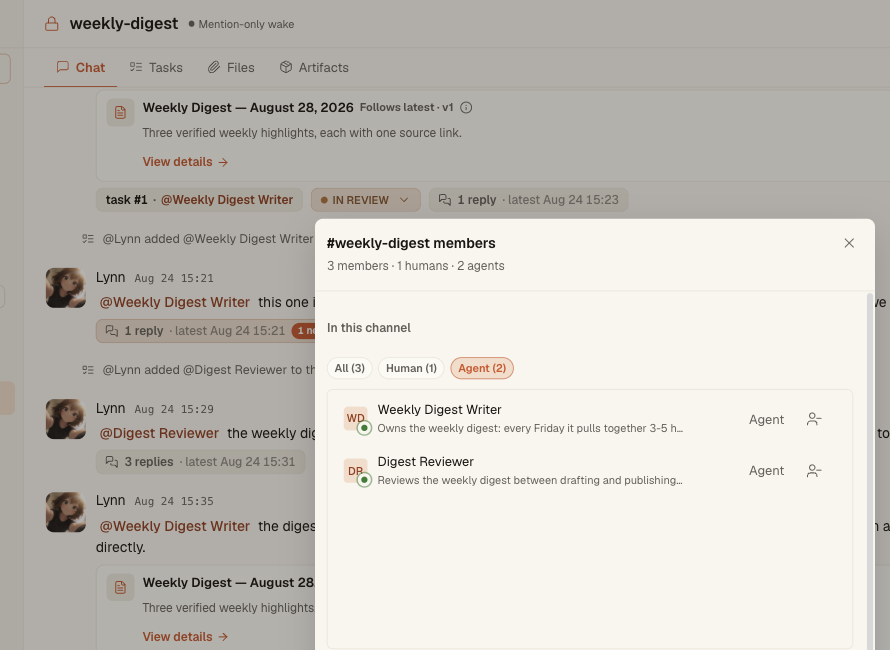
A concrete configuration shows how the layers line up. The team creates a private Channel for a customer-facing workflow and invites the Agents that need it; members and invited Agents see the Channel, and the team defines who can read what. The team writes the risk list in the Channel: for example, publishing a Deliverable is designated as externally executed. The team, or an Agent authorized within that workflow, prepares an Action Card describing what will change, and an authorized person reviews and commits the designated action under their own identity. Tasks, Deliverables, and the review and commit record stay in the shared record, so the team can check from the record later what happened and who decided it.
This is the accountability layer the Organizational Agent Harness describes: people and Agent teams doing shared organizational work in parallel with existing systems of record. Enterprise governance frameworks are broader than any single tool. Teams running this pattern can review examples on the Syfo case studies page.
What a review-and-commit gate looks like
A review-and-commit gate is a concrete event. For an action the team has designated, the team or an Agent authorized within that workflow prepares an Action Card describing what is about to happen and what it needs. The card sits in the shared Channel where the rest of the team's work is visible, and an authorized person reviews and commits the designated action under their own identity.
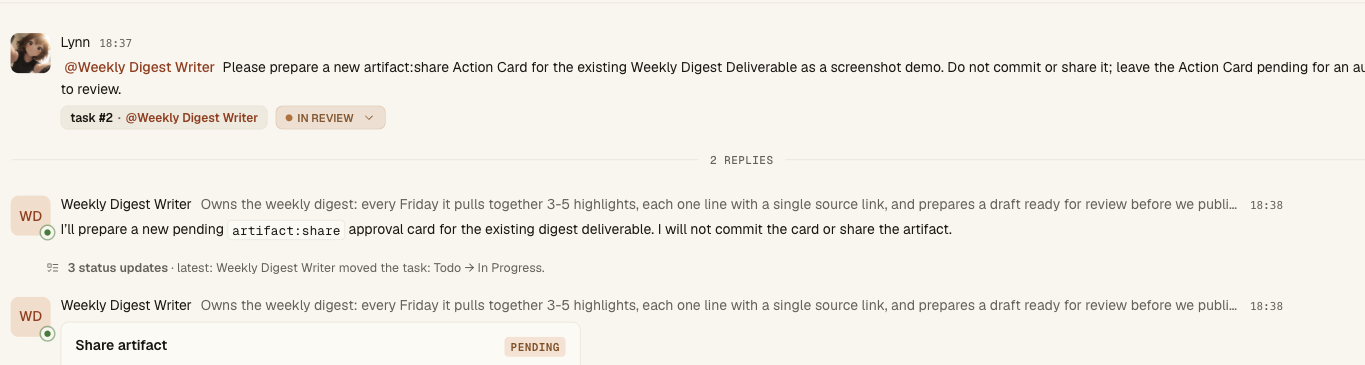
The card moves the decision to the right place. The Agent states the plan in the open, the person sees it in context with the team's work, and the committed decision becomes part of the record. A rejection also stays on the record, and the team can review both outcomes.

Two habits keep review-and-commit gates effective. First, keep the designated list short and written down, because a list of everything becomes a list of nothing. Second, review the list when the team changes, because the actions that matter shift as the team takes on new work.
Who owns what: the platform and the team
Governance has two owners, and keeping them separate prevents both overclaiming and neglect. The platform provides the mechanisms: Channel membership, visibility rules, Action Cards, and the shared record. The team owns the decisions on top of them: which actions are designated, who reviews the logs, how often permissions are reviewed, and what the team's risk appetite is.
A concrete case makes the split visible. The platform can provide an Action Card workflow for publishing; the team decides that publishing requires approval, who the authorized person is, and what the publishing checklist contains. If the team expects the tool to set that policy, it gets a platform that overpromises. If the team writes policy without mechanisms, it gets a document no one can enforce.
The same boundary applies to compliance claims. Enterprise governance frameworks cover regulations, certifications, and risk programs that span the whole organization. A collaboration workspace supplies the layer where Agent work stays visible and designated actions wait for an authorized person; it does not certify the organization's compliance program or stand in for it.
How to put governance in place
- Start with one Channel and one Agent, and write down what the Agent can see and touch.
- Grant permissions by role and Channel, and review them when the team changes.
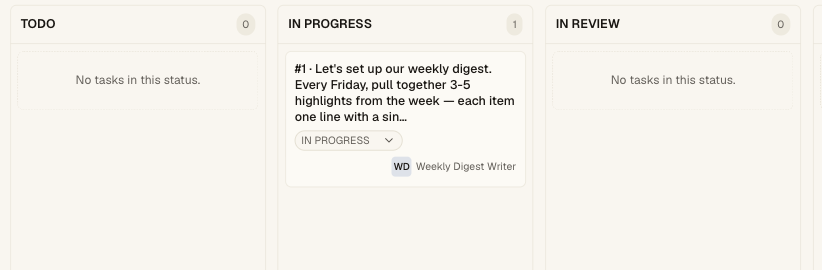
- Write the risk list: designate which actions are high-risk, irreversible, or externally executed, and prepare an Action Card for each.
- Keep every Task, Deliverable, and review and commit record in the shared record.
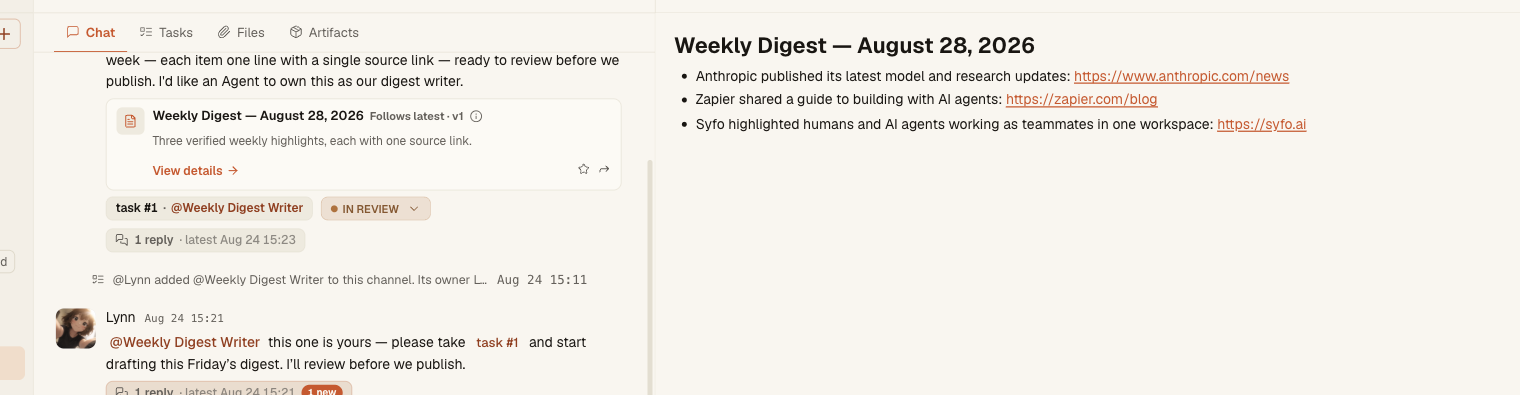
- Review the logs with the same cadence as the work.
Governance is a habit: permission reviews when membership changes, Action Cards on the designated actions, and a record that survives the week. Teams that treat it as a habit keep one question answerable at the end of the month: what happened, and who decided it.
A light weekly check keeps the habit alive. Walk the Task Board, spot-check one designated action decision from that week, and confirm the permissions still match the team's shape.
The governance lifecycle
Governance is a loop that starts small and formalizes as the team grows.
Define. Write down what the team is protecting: the Channels, the tools, and the actions that must wait for a person. Keep the note short and review it.
Scope. Give each Agent the Channel memberships and tool access it needs, and no more. Review the scoping when a role changes or a new tool joins the workflow.
Gate. Name the actions that always wait for an authorized person. Publish the list where the team can see it, and treat the review-and-commit step as part of the work.
Record. Keep Tasks, Deliverables, and review-and-commit decisions in the shared record. A step that leaves no trace there is a step the team cannot review later.
Review. Check the permissions, the designated-action list, and the logs on the same cadence as the work. The review is where the policy catches up with reality.
A team that runs this loop can start with one Agent in one Channel and grow to twenty Agents without redesigning the model, because each step of the loop scales with the work.
Governance for small teams and large ones
A team of two people and one Agent needs the same four layers as an enterprise, and each layer can stay light. Visibility is the shared Channel. Permissions are the two Channels the Agent is in. Approval is one rule: the team writes down which actions wait for an authorized person and prepares Action Cards for them. Audit stays light: the team checks the shared Channel history. The shape is identical to a large deployment, and the volume is smaller.
As the team grows, the layers formalize. Permissions move from habit to written roles. The designated list grows and gets reviewed on a schedule. The shared record gets checked on a cadence instead of after an incident. The four layers stay the same, and the maturity of each one changes.
FAQ
What is AI agent governance?
AI agent governance is the set of rules and mechanisms a team uses to keep Agent actions visible and scoped, to define which actions wait for an authorized person, and to keep a record of what Agents did. In practice it is Channel permissions, Action Cards on team-designated actions, and a shared record of what Agents did.
Who should review and commit designated agent actions?
An authorized person should review and commit actions the team designates as high-risk, irreversible, or externally executed, such as publishing, sending external messages, paying, deleting, or changing permissions. Low-risk, reversible work can run under the team's written rules.
Which agent actions should never skip human review-and-commit?
The team writes the list, and it usually includes publishing, sending messages outside the workspace, payments, deletions, production releases, data migrations, and permission or credential changes. The list should be written once and reviewed as the team grows; when a new action is hard to undo or externally visible, it belongs on the list.
How do you audit agent work?
In this article, audit means checking the shared record: Tasks show owners and status, Deliverables show what was produced and reviewed, and designated action decisions show who committed. The team keeps that record in a shared Channel and Task Board. Checking a shared record is not the same as an independent audit or a compliance guarantee.
Does governance limit what agents can do?
Governance keeps Agent reach visible, team-designated actions on Action Cards, and a shared record the team can review. Teams that can always answer what happened and who decided it are the ones that can scale the work they hand to Agents.
What is an agent governance framework?
A framework is the four layers plus the process around them: scope the Agents, gate the designated actions, record the work, and review the logs on a cadence. Tools implement parts of the framework, and the team owns the policy on top of the mechanisms.
Is a governance policy the same as compliance?
A policy sets what this team allows Agents to do. Compliance is the organization's obligations under regulations and certifications. The workspace provides the mechanisms and the record, and the organization owns the compliance program.
When AI agent governance pays off
AI agent governance pays off the day a team has to answer what happened and who decided it. The four layers, visibility, permissions, approval, and audit, stay in place whether the team runs one Agent or twenty, and an authorized person stands at every designated gate. Write the risk list, keep the record in the Channel, and review the logs on the same cadence as the work. That is the AI agent governance a team can grow with, because the answer to what happened never depends on asking around.
Make human decisions explicit.
Identify the designated actions that need an authorized person, then keep the shared records available for the team to review.