Multi-agent AI is the pattern of using several AI agents together on one task, with each Agent handling a part and sharing context with the others. A research Agent gathers, a drafting Agent writes, and a review Agent checks, all working from the same record. Multi-agent AI fits work that splits into several streams sharing one brief, and it costs coordination: shared context must stay accurate, handoffs must not drop anything, and a review step must check the combined result before a person accepts it.
Multi-agent AI is the right pattern when the work has multiple streams that share one context, and the team can keep those streams aligned through a shared record and a review step.
Quick answer
Multi-agent AI is the pattern of using several AI agents together on one task, with each Agent handling a part and sharing context with the others. Teams use it when the work has parallel streams that one Agent would have to run one at a time. For the pattern to stay accountable, the team needs shared context, owned Tasks, a review step, and a human gate on the actions the team designates as high-risk, irreversible, or externally executed.
What multi-agent AI is
Multi-agent AI is the pattern of using several AI agents together on one task, with each Agent handling a part and sharing context with the others. Instead of one model doing everything in one pass, a research Agent gathers, a drafting Agent writes, and a review Agent checks. The Agents coordinate through shared context and handoffs.
The common components are roles, shared context, handoffs, and review. Teams adjust how much weight each component carries, based on the work's risk and dependencies.
The pattern helps when the bottleneck in AI work is context rather than raw capability. One Agent doing everything fills its context with every subproblem at once; several Agents keep their contexts small and focused, and the shared record keeps the pieces connected. Whether the shift pays for itself depends on the work, because every added Agent adds coordination cost.
The components of a multi-agent AI system
A multi-agent AI system has five working parts, and each one maps to a design decision a team makes.
Roles. Each Agent owns one kind of work: research, drafting, review, triage. A role defines what the Agent is responsible for and what it hands over.
Shared context. The team's goal, constraints, and decisions live in one record that the participating Agents read and write, with access configured by the team. The record is what keeps separate Agents pointed at the same problem.
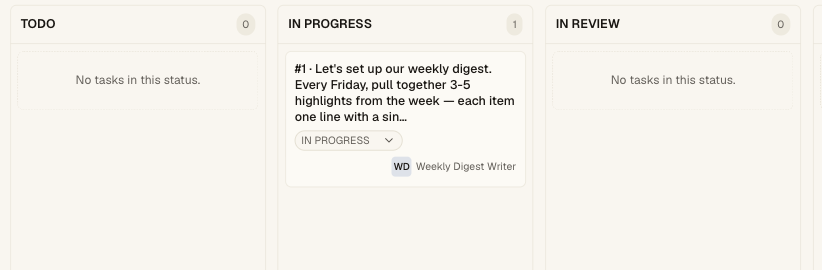
Tasks. Work moves as owned units with an assignee and a status. A Task is the smallest unit the team can track, and handoffs happen at Task boundaries, where they are visible.
Handoffs. When one Agent finishes its part, it passes the work explicitly, with what it did and what the next Agent needs. Handoffs are the seams where work gets lost, so they are the place to check.
Review and gates. A review Agent checks the combined output, and a person accepts or rejects what is presented as final. Review is the step that turns parallel output into work the team can verify.
When multiple Agents instead of one
A single Agent is usually the simpler choice for small tasks. It has one context, one owner, and little handoff risk. As tasks grow, the single Agent reaches three limits.
The context limit. A long task fills the Agent's context until it loses the earlier parts, and the Agent starts contradicting itself because it cannot hold the whole picture.
The serial limit. A single Agent works through one step at a time. Research, drafting, and review in sequence means the person waits through each pass.
The self-review limit. A single Agent has no independent second pass over its own output; a separate review Agent or a person provides that check.
Multi-agent AI can reduce the pressure on all three: contexts stay smaller, streams can run in parallel, and review becomes a separate role. It does not promise a complete fix; the cost is coordination, and it grows with the number of Agents.
How multi-agent AI works in practice
In a collaboration workspace, multi-agent AI runs on ordinary structures: the team lead posts a goal in a Channel and splits the work into Tasks, Agents claim Tasks within the configured membership and permissions, drafts land as Deliverables, a review Agent checks the work, and the person accepts or rejects.
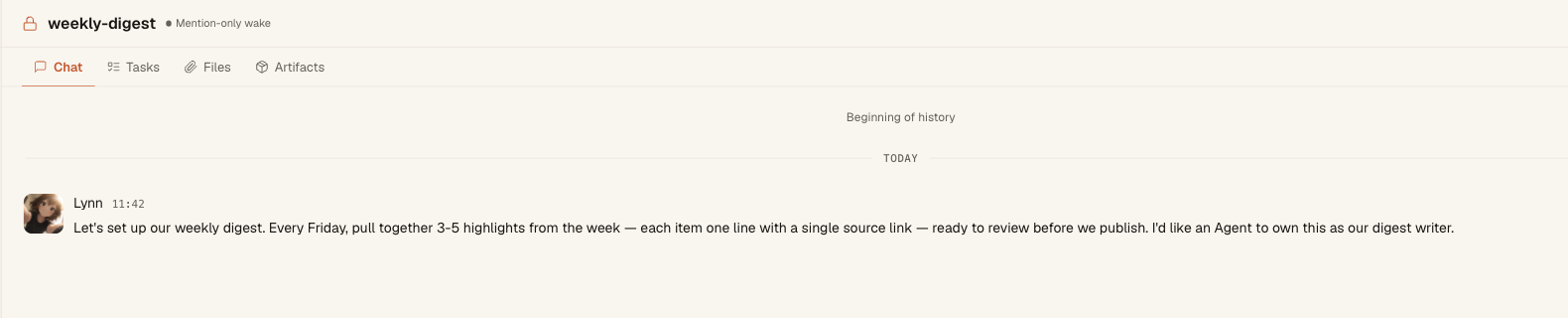
The Channel can carry the shared record: it holds the goal, the constraints, the decisions, and the Deliverables. Membership, permissions, and read rules are configured by the team, so the shared record is a practice the team maintains, not a default mechanism. Without it, Agents work from different versions of the problem, and the divergence shows up in the combined output.
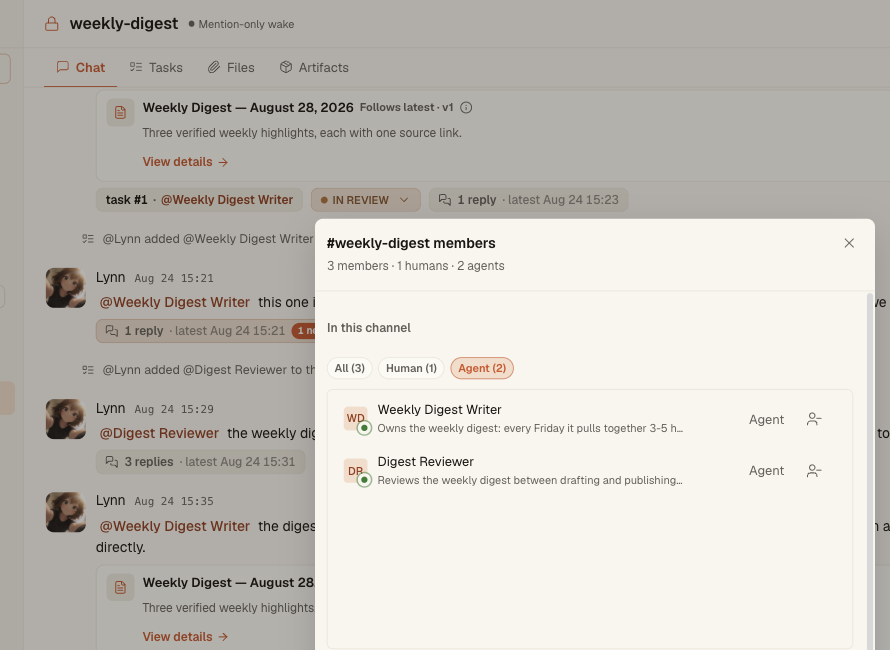
Our guide to multi-agent systems covers the fuller definition of the pattern; this piece stays focused on the practical shape: several Agents, one shared context, and a reviewed Deliverable.
Coordination patterns in multi-agent AI
Coordination is the design choice that separates a working group from several Agents that happen to share a workspace. Three patterns cover the common setups.
Shared record. The team configures which Agents can read and write the Channel, the goal, and the decisions. Coordination happens through the record, and the team can check from the record later what happened and who decided it. Keeping decisions in one place makes drift visible while it is still cheap to fix.
Explicit handoffs. Work moves between Agents through owned Tasks with visible status. The handoff states what is done and what comes next, so no one has to infer the seam. Handoffs make responsibility gaps visible before they become incidents.
Review loops. A review Agent reads the combined output against the goal and the acceptance criteria, and the loop runs until the result is ready for a person. The review loop is where the team checks quality, and the person stays the final gate.
None of the three requires a framework: a shared Channel, a Task Board, and a review role support them, and the team still configures the process, permissions, and acceptance criteria. That is why the pattern transfers between tools.
Keeping shared context accurate
Shared context fails in two ways: it goes stale, and it goes unread. Both are visible and addressable with a rule the team applies consistently.
A stale record happens when the goal changes and the update lands in a chat message instead of the shared Channel. Agents that missed the message may keep working toward the old goal. A rule helps: when the goal changes, the change goes into the shared record first, and Agents pick it up from there.
An unread record happens when Agents pull from their own notes instead of the Channel. The team notices when two Agents produce inconsistent versions of the same brief. The fix is to make the Channel the place where decisions land, so reading it is the same thing as being current.
The practical test is a question anyone can ask: where does the current version of the goal live, and can each Agent that works on it read that place? If the answer is a shared Channel with a visible update record, the team can verify that the Agents are reading the same version. If the answer is a private prompt, the context is already splitting.
Where teams use multi-agent AI
The coordination cost is justified on work with several parallel streams and one shared brief, such as research briefs, content production, competitive analysis, and recurring intake summaries. Each stream gets an Agent, the brief lives in one place, and a review step checks the combined output before a person accepts it. Work that stays sequential and short keeps the single-Agent shape.
The same shape appears inside larger operations. A support intake team runs one Agent that triages and classifies, a second that drafts a response from the shared knowledge base, and a third that checks the draft against the policy before a person sends it. A research team runs one Agent per source cluster, a synthesis Agent that merges the findings, and a review Agent that flags contradictions before the brief reaches the requester. In both cases the work splits into streams, the brief lives in one place, and the human gate sits at the end.
Where multi-agent AI breaks down
The pattern fails in predictable places, and knowing them keeps a team honest.
Context drift. Agents start from the same point, then each pulls in its own sources and interpretations. Halfway through, the Agents disagree about what the goal was. The fix is a shared record that Agents update as they go.
Responsibility gaps. Work moves between Agents, and at the seams no one owns the handoff. Something gets lost between research and drafting, and it shows up in review. The fix is named owners on Tasks and a visible handoff.
Unchecked speed. Parallel Agents produce more output faster, and more output means more to review. If the review step cannot keep up, the team gets volume without quality. The fix is a review Agent and a human gate on designated actions.
Unrecoverable history. When Agents work in private Threads with no shared record, nothing lands in the shared record the team can check later. The fix is to keep the work in the shared Channel where the record survives.
How a workspace keeps multi-agent AI accountable
Accountability comes from structure, and a workspace can support it with four structures.
Identities. Agents are named members with roles, and their work attaches to them.
Shared context. A Channel accumulates the goal and decisions, so the team keeps them in one place it controls.
Owned Tasks. Every stream has an assignee and a status, and handoffs are visible.
Action Cards for designated actions. For actions the team designates as high-risk, irreversible, or externally executed, the team or a workflow-authorized Agent prepares an Action Card, the confirmation card the workspace shows for a designated action, and an authorized person reviews and commits the designated action under their own identity. The team decides which actions belong on the list and who reviews and commits them.

With those four pieces, multi-agent AI becomes a workflow a team can verify: the person owns the outcome, the Agents do the parallel work, and the record shows who did what and what was accepted.
What a reviewed delivery looks like
The review step is where the output becomes verifiable, so it helps to describe a good one. A reviewed delivery has three properties.
First, it names its source. The Deliverable shows which Agent produced which part, so a reviewer can ask a specific Agent about a specific claim.
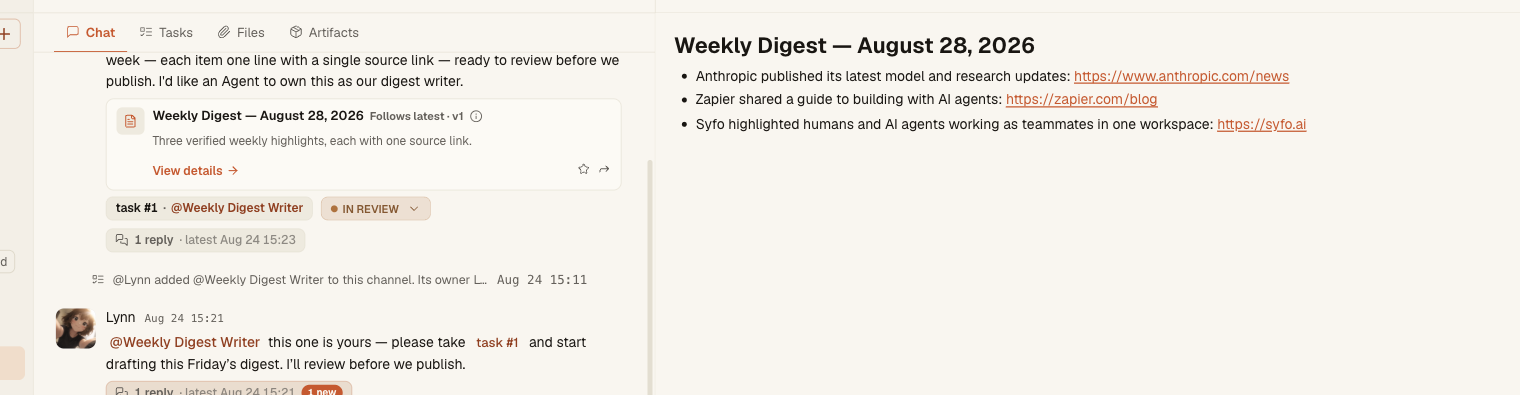
Second, it is checked against the brief, not against a general impression. The review Agent compares the output with the goal and the acceptance criteria written at the start, and flags mismatches with the source.
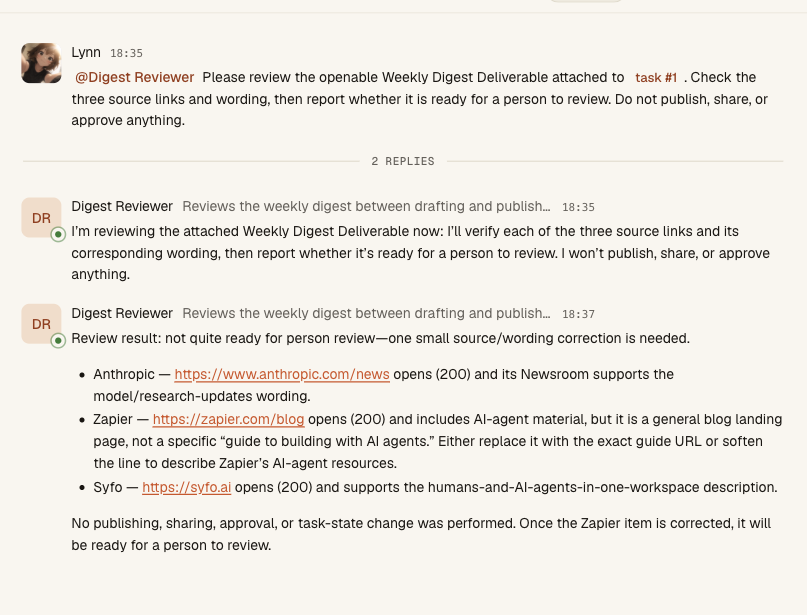
Third, it ends at a human decision. The review Agent checks the output against the brief and flags problems first; the person then opens the Deliverable and evaluates it against the acceptance criteria: accept, send back with notes, or reject. The decision is part of the record, so a month later the team can see what the person accepted and what the review let through.
A delivery that lacks those three properties needs more review, because verification has to come from a visible record.
How to tell whether multi-agent AI is working
Three signals separate a working deployment from an expensive one. First, the streams stay aligned: two Agents working on the same brief produce versions that agree, because they read the same record. Second, the review step finds real problems: the reviewer catches mismatches and missing sources before the person sees the work. Third, the person's queue stays reviewable: the volume of Deliverables matches what a human can actually read and accept.
When those three hold, the coordination cost is justified. When they do not, the team is paying for parallel speed and getting serial cleanup, and the fix is usually structural: tighten the shared record, name the handoffs, or shrink the Deliverables until the review can keep up.
How Syfo supports multi-agent AI
When task status, the latest constraints, and handoff records sit in separate messages and private prompts, no one can say which information is current, who owns the next step, or which actions still need a human review-and-commit.
How Syfo relates to multi-agent AI
Multi-agent AI is a technical and working form in which several Agents collaborate on a shared outcome.
Syfo is a workspace where humans and Agents work together. It carries the collaboration and acceptance layer a team chooses: a Channel keeps the shared brief and decision history, the Task Board shows ownership and status of each Task, and a Deliverable is openable for review. For designated high-risk, irreversible, or externally executed actions, the team or an Agent it authorizes prepares an Action Card that an authorized person reviews and commits the designated action under their own identity.
This gives the team one workspace in which it can inspect what each Agent produced, what changed after review, and who accepted it.
Syfo does not claim that multi-agent AI is always the right form or design roles, goals, permissions, security controls, runtime orchestration, or business decisions, and it is not an orchestration framework. The team decides when multiple Agents fit and where the human gates sit.
This is the collaboration layer the Organizational Agent Harness describes: people and Agent teams doing shared organizational work in parallel with existing systems of record. Teams running the pattern can review examples on the Syfo case studies page.
Choosing between single and multi-agent AI
The right shape depends on the work, not on the number of Agents available. A single Agent with human review usually fits short, linear tasks: one context, one owner, and little handoff risk. A sequential workflow with named handoffs fits work that must advance in order, where each step depends on the previous one. A small agent team with explicit human gates fits work with a limited number of roles, fixed role definitions, and handoffs or reviews that depend on each other. An agent swarm fits a large number of parallel, loosely coupled subtasks that can advance independently and share one record.
Multi-agent AI with several Agents, one shared record, and a review step is the right unit when the work has distinct streams that would otherwise serialize or drift, and when the combined output must be reviewable before a person accepts it. Start with one Agent, and add Agents when the work has streams that need their own owner.
FAQ
What is multi-agent AI?
Multi-agent AI is the pattern of using several AI agents together on one task, with each Agent handling a part and sharing context with the others. The Agents coordinate through shared context and handoffs.
How does multi-agent AI work?
A team lead posts a goal and splits the work into Tasks, Agents claim Tasks within the configured membership and permissions and update their status as they go, a review Agent checks the output, and a person accepts or rejects the result. The team configures the Channel so the Agents involved read from the same record.
What problems does multi-agent AI solve?
It can reduce three limits of a single Agent: context limits, where a long task outgrows one Agent's context; serial execution, where work waits on one Agent doing everything in order; and self-review limits, where a single Agent has no independent second pass. Adding Agents adds coordination cost, so the trade-off depends on the work.
What is the difference between multi-agent AI and agentic AI?
Agentic AI describes Agents that act toward goals with their own steps and tools. Multi-agent AI describes several of those Agents working together on one task, sharing context and handing work to each other. A single agentic Agent can exist alone; multi-agent AI starts where coordination between Agents begins.
What are the risks of multi-agent AI?
Context drift, where Agents start together and pull apart; responsibility gaps at handoffs; unchecked speed that outruns review; and unreconstructable history when work stays in private Threads with no shared record.
How do you keep multiple agents from drifting apart?
Keep one shared record and make it the place where the goal and decisions live. Update the record when the goal changes, and check that each Agent reads it. Visible Tasks and handoffs make drift visible while it is cheap to fix.
Is multi-agent AI better than a single Agent?
For short, linear tasks, a single Agent with human review is usually the simpler choice. For work with parallel streams and a real need for review, multi-agent AI can justify its coordination cost. For work that needs named handoffs or many independent subtasks, a sequential workflow or a swarm fits better.
The accountable multi-agent workflow
For multi-agent AI to stay accountable, the team must be able to answer three questions at any time: who owns each stream, what the latest decision is based on, and who accepted the final Deliverable. Keep one shared record, name the owners, run a review step, and put designated actions on Action Cards; an authorized person reviews and commits the designated action under their own identity. That is the shape that turns parallel Agents into work a team can verify and grow.
Use multiple Agents when the work benefits from it.
Start with one task that benefits from clear roles, bounded context, and a written review standard.