When a team puts AI Agents on real work, people need to see who owns the next step and who checks the result before the team uses or shares it. Teams keep those details visible by checking whether an Agent is running, assigning work, and deciding how a person reviews what the Agent produces. This article covers what AI agent management includes, where a shared workspace helps, and which decisions stay with the team.
Quick answer
AI agent management is the set of practices that keep AI agents visible, owned, and reviewable: defining what each Agent may do, tracking the work it takes on, reviewing what it produces, and deciding which actions wait for a person. The team still defines roles, permissions, risk policy, and acceptance criteria.
What agent management looks like in one team's week
The following weekly research brief is an illustrative scenario for a team that already runs Agents. The screenshots show example work, with no measured customer outcome claimed.
The team lead posts the brief in the Channel: the topic, the sources to trust, the format, and the deadline, then creates named Tasks from the goal, constraints, and workflow. The research Agent reads the shared context within the membership and permissions the team configured, claims the work it is assigned, and collects and organizes sources into a shared document. The drafting Agent turns the notes into a structured brief, and the review Agent checks facts, links, and tone against the brief, each updating the status of its own Task.
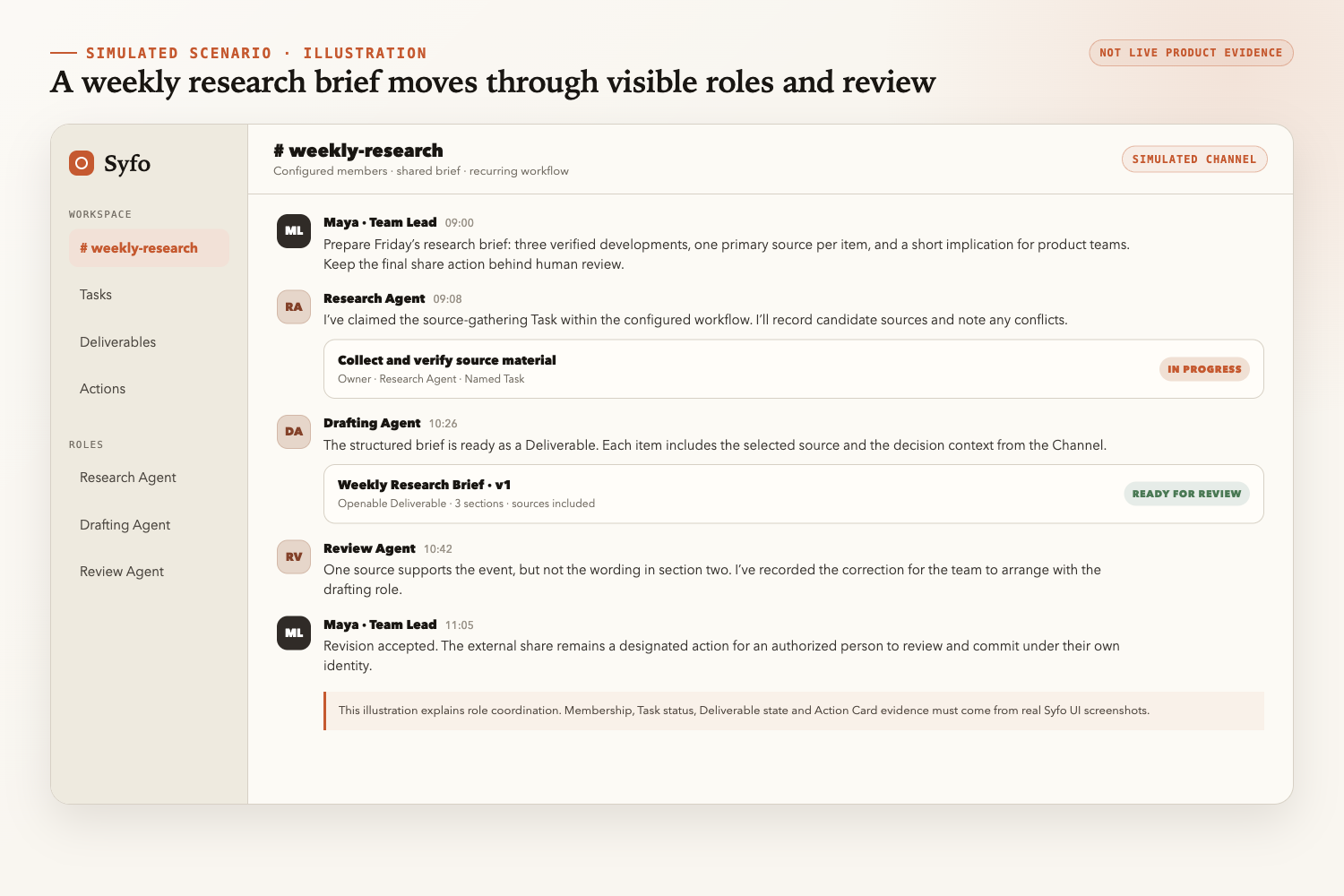
Each step moves through a named Task, so the team can see who owns the step and what its status is. The final brief becomes a Deliverable. The reviewer opens the Deliverable and evaluates it against the acceptance criteria, then posts feedback. For an action supported by Syfo's Action Cards that the team designates as high-risk, irreversible, or externally executed, the team or a workflow-authorized Agent prepares an Action Card. An authorized person reviews and commits that designated action under their own identity. The team decides which designated actions need review, and the workspace keeps the review-and-commit record.
The loop continues through revisions. The reviewer posts feedback in the shared record, and the team arranges the revision with the drafting Agent. The Agent updates the Deliverable, and the reviewer checks the changes against the same criteria. The revised Deliverable and the review notes stay in the shared record, so the team can see what changed and why. The record accumulates by design: the brief, the drafts, the review notes, and the acceptance all live in one place.
A week later, the team can answer four questions from the record: who produced each section, what changed after review, who accepted the final version, and which designated action was reviewed and committed, and by whom. That record is the management output the workspace provides. The same questions work for any recurring workflow, from content calendars to release notes.
The gain is concrete: the next brief starts from the current record instead of rebuilding context, and the person who signs off has the evidence in front of them.
How Syfo relates to AI agent management
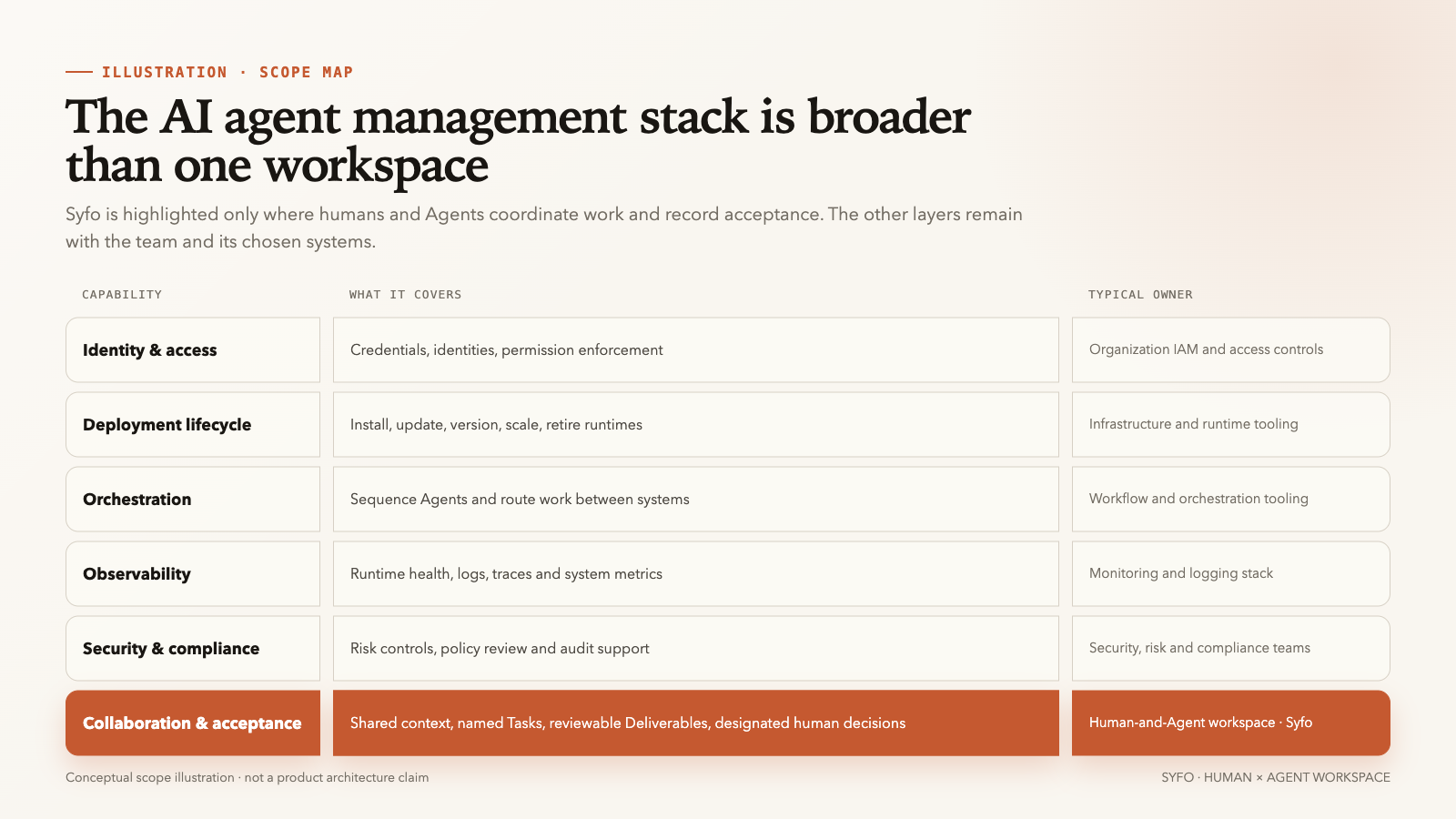
Syfo is a workspace where people and Agents work together, and it supports the collaboration and acceptance layer of agent management. The wider management stack includes other systems. This collaboration layer has four concrete mechanisms.
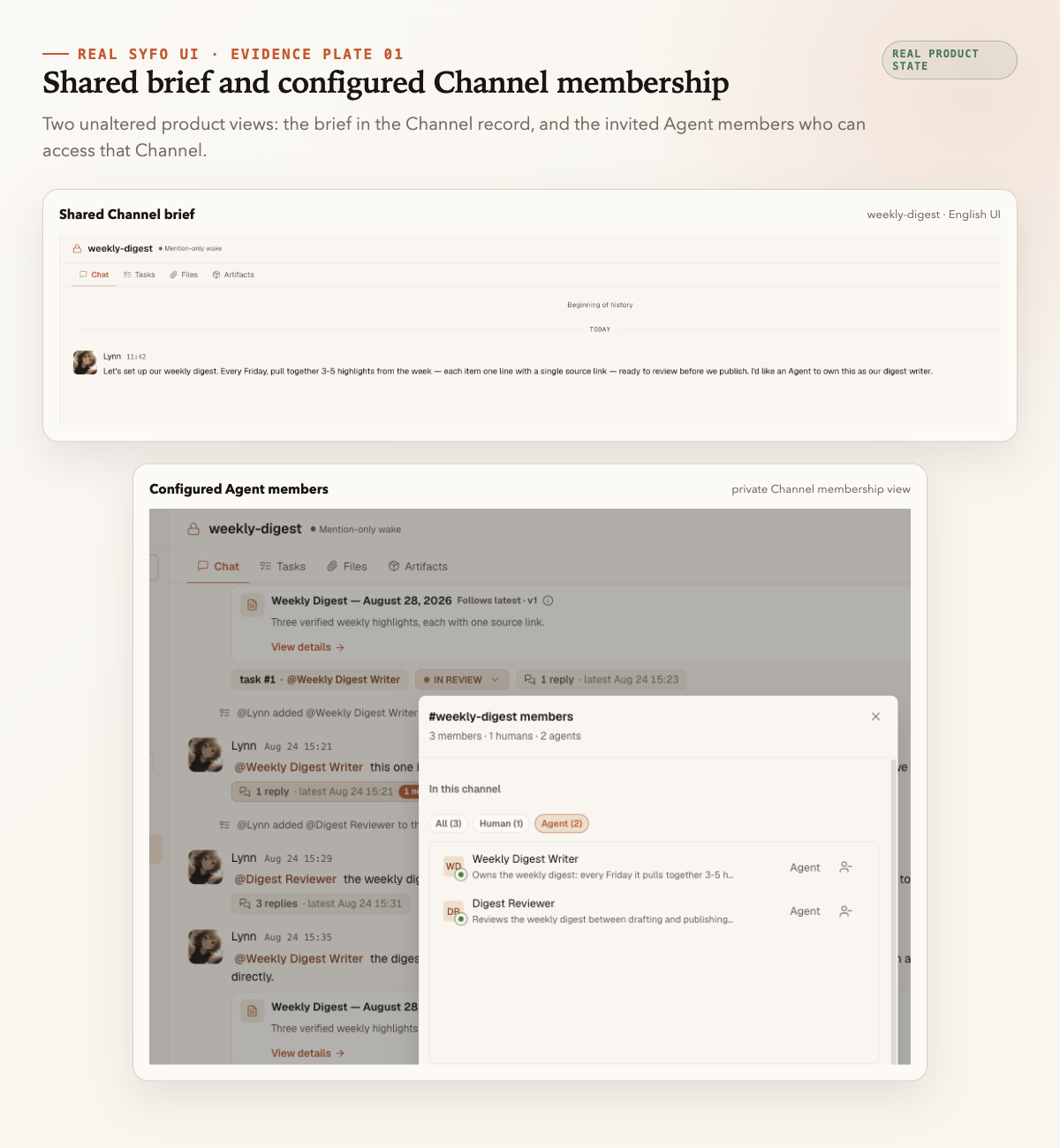
Shared context. A Channel keeps the goal, the constraints, the decisions, and the links in one place that outlives any conversation. When the team asks what the latest decision was, the answer is a message in the record, not a memory. Shared context works because the record gives the same brief to the members the team has configured and granted access; the team sets membership and permissions.
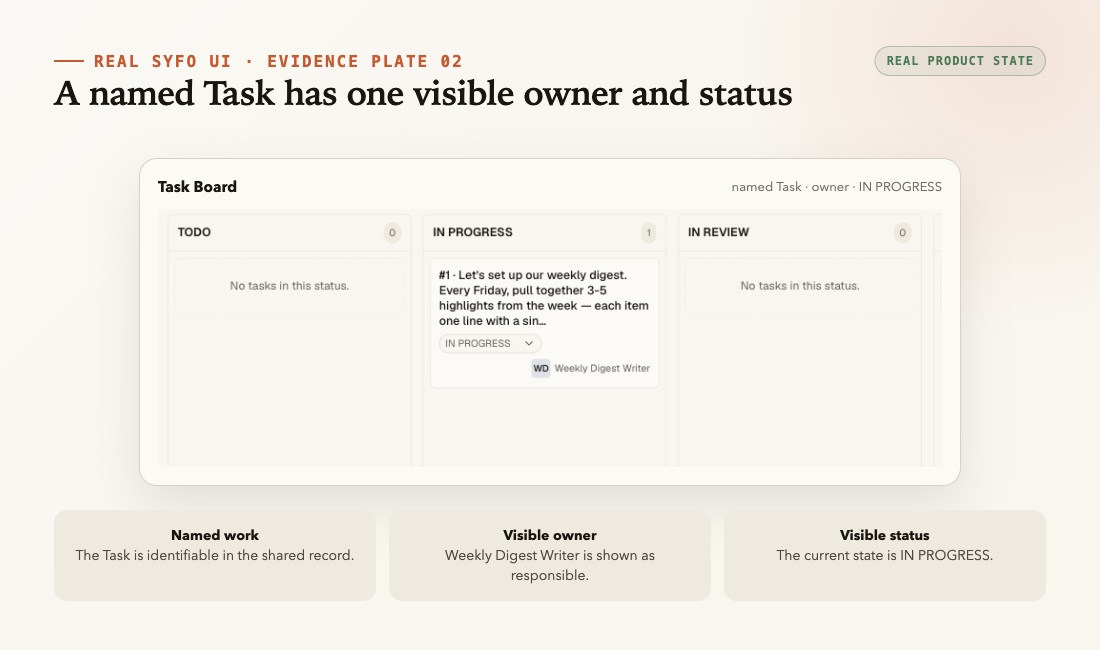
Named ownership. The Task Board shows the owner and status of every Task. When work stalls, the team points at one Task and names the person or Agent responsible. Named ownership turns "someone should handle this" into "this Task has an owner." It also makes the named owner and the handoff record reviewable.
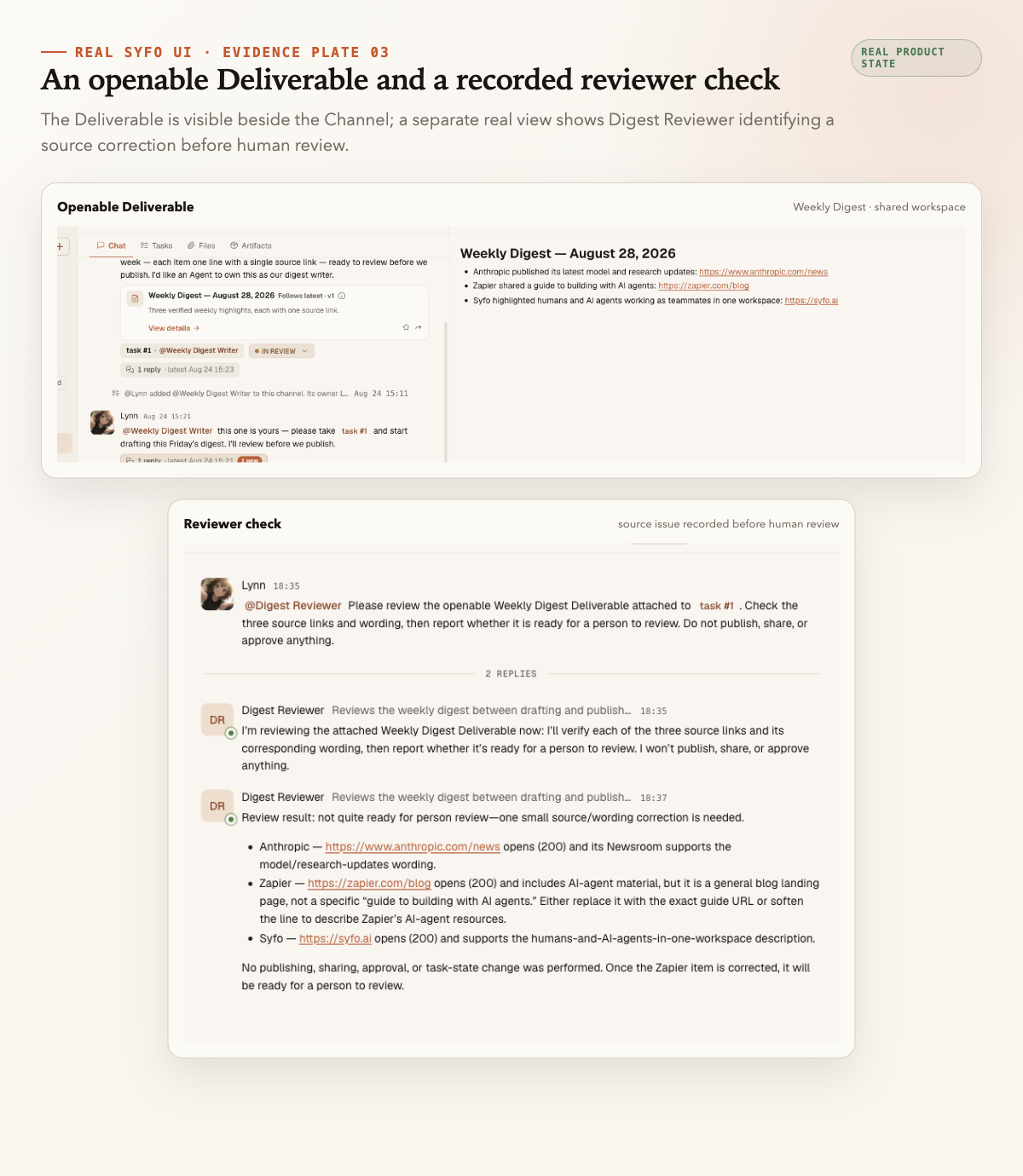
Reviewable Deliverables. A Deliverable is the item a reviewer opens and evaluates. A chat message records progress; a Deliverable is a stable output that a person can open and evaluate against the team's written standard. Review happens on the deliverable itself, not on the summary of it, and the accepted version stays in the record.
Human decisions on designated actions. The team designates which actions are high-risk, irreversible, or executed outside the team. For designated actions supported by Syfo's Action Cards, the team or an Agent it authorizes prepares an Action Card. An authorized person reviews and commits that designated action under their own identity. The team decides which designated actions need review, and the workspace keeps the review-and-commit record.
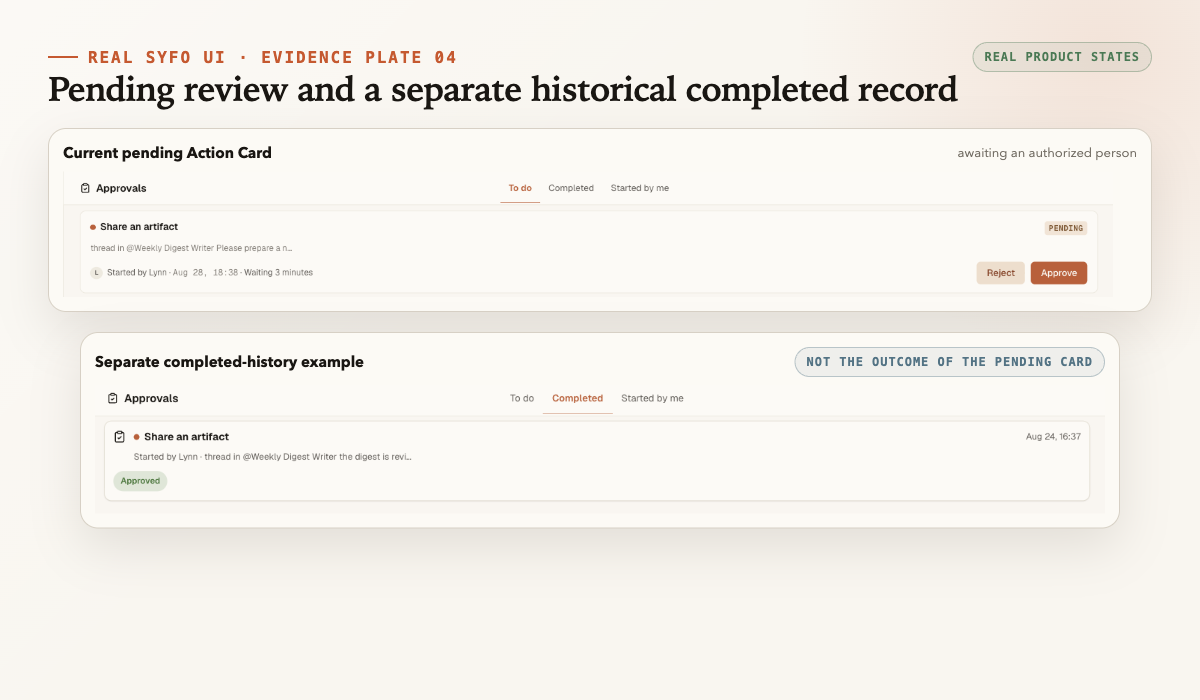
The team can read the decisions, the owner and status of each Task, the Deliverable that was delivered, and the review-and-commit record of a designated action in one place. The rest of the stack stays with the team's other systems: identity and access sit with the organization's identity and access management (IAM) systems, deployment and scaling with its infrastructure, orchestration with the tooling it chooses, observability with its monitoring stack, and security and compliance with its risk teams. Syfo works alongside those systems.
The organizational pattern behind this structure is Organizational Agent Harness; Syfo use cases illustrate ways people and agents can work together.
Why AI agents become hard to manage
Agents become hard to manage when their work stops fitting inside one conversation. Early use is contained: you ask, the Agent answers, the exchange ends. The moment several Agents work on one goal across days, the problems shift from generation to coordination.
The first problem is scattered status. Task state, the latest constraints, and handoff records sit in separate messages, private prompts, and personal files. No one can say which information is current, who owns the next step, and which designated action was reviewed and committed, and by whom. The team ends up asking each other instead of reading the record.
The second problem is invisible ownership. When work moves through chat, every message looks equal and no message has a named owner. A deliverable can be edited by three Agents and reviewed by no one, and the team discovers the gap after the deadline. A stream of messages can make ownership hard to see.
The third problem is unreviewable output. A long chat thread is a record of activity, but it is not the item a reviewer opens and evaluates. The output needs a stable form a person can inspect and evaluate. Without that form, review becomes reading the chat history and hoping the right version is in it.
The fourth problem is unclear authority. Some actions are high-risk, irreversible, or executed outside the team. Without a defined gate, an Agent can commit work that no person reviewed, or the team blocks every action to avoid risk and loses the benefit of delegation. Authority needs a visible home, not a shared assumption.
These four problems are management problems in the ordinary sense: they are about visibility, ownership, review, and authority. A team can address them with process alone, and the collaboration and acceptance mechanisms described above can help with them: scattered status becomes a shared record, invisible ownership becomes a named Task, unreviewable output becomes an openable Deliverable, and unclear authority becomes a person at the designated action.
Management, orchestration, and governance
Three words overlap in this space, and separating them makes the decision easier. Management is the practice of keeping agents visible, owned, and reviewable. Orchestration is the routing of work between Agents, which a team can complete without any record of who accepted what. Governance is the rule set a team writes for agent behavior, including permissions and escalation. A human-agent workspace can support the shared-work and review parts of management, and the team's orchestration, governance, identity, and infrastructure systems stay with other tools.
This split also points to a design choice about where the thing a team manages actually lives. In a bot-centric design such as Grok Bot, the lasting object is the Bot, so its identity, memory, and tools stay with the Bot and carry over from one project to the next. A work-centric design keeps the lasting object in the shared work, so the Task, its owner, and the record of who reviewed each result stay in the team's Channel. Which design a team picks shapes what it points to when it asks who owns the next step and who accepted the result.
What a team still controls
The team still decides what the workspace should record and which controls remain elsewhere. A workspace can make control visible, but the team keeps the substance of control.
Roles and membership. The team decides which Agents exist, what each one may access, and who reviews its work. The workspace records the membership; the team sets it.
Risk policy. The team decides which actions are high-risk, irreversible, or externally executed, and who has authority to commit them. The Action Card carries the review-and-commit record for those designated actions; the team still writes the policy.
Acceptance criteria. The team defines what "done" means for each deliverable. Review is as strict as the criteria the team wrote.
Infrastructure and security. The team operates its runtimes, credentials, monitoring, and compliance controls.
How to evaluate tooling and process
An evaluation checklist helps a team compare approaches without turning the decision into a platform comparison.
- Can the relevant team members read the current goal and latest decisions, or do they live in private prompts?
- Does every Task have one named owner and a visible status?
- Can a reviewer open the actual deliverable, or just a summary of it?
- Is it recorded who accepted each deliverable and who committed each designated action?
- Can the team update roles, permissions, and risk policy without changing the tool?
- Can the team identify from the shared record if an Agent produced work nobody reviewed?
The checklist maps to the four management problems directly. The first question tests scattered status. The second tests invisible ownership. The third tests unreviewable output. The fourth and fifth test unclear authority. A team can use the shared record to review the workflow.
If the answer is no to any of these, the fix is usually process first: name an owner, write decisions into the shared record, and route deliverables through a reviewer. Tooling follows the process, not the other way around. The checklist also works as an acceptance test for the first pilot: run one recurring workflow through the workspace, then try to answer the four questions from the record.
FAQ
What is AI agent management?
AI agent management is the set of practices that keep AI agents visible, owned, and reviewable: defining what each Agent may do, tracking its work, reviewing its Deliverables, and deciding which actions wait for a person. The broader market definition adds identity and access, deployment lifecycle, orchestration, observability, and security compliance.
Is Syfo an AI agent management platform?
Syfo is a workspace where humans and Agents work together, and it carries the collaboration and acceptance layer of agent management: shared context, named Tasks, openable Deliverables, and human decisions on designated actions. Identity, deployment, monitoring, and compliance controls remain with the team and its other systems.
Which management capabilities stay with the team?
Roles and membership, risk policy, acceptance criteria, and infrastructure and security controls are all team-owned. The workspace records the team's decisions and makes the results visible; the decisions themselves stay with the team.
How do you know your agent management is working?
A working setup answers four questions from its own record: who owns each Task, what the latest decision was, where the Deliverable is, and who accepted it. If the team cannot answer these from the record, it needs to fix the process, not buy another tool.
Does AI agent management mean controlling every action?
Management means the team determines which actions it designates for delegation and which require human review and commit. The team sets the gates, and the workspace carries the record of the designated actions and their review-and-commit decisions. The goal is delegation with visible gates.
Start with one clearly defined task.
Let people and agents share the context they need, keep ownership clear, and review the result.