A multi-agent large language model (LLM) system divides a large task among several LLM-based Agents, each handling a defined part. To keep the work connected, the team saves shared context, passes work between Agents clearly, and decides when a person checks the result produced across the parts. This article explains what a multi-agent LLM system is, when splitting the work helps, and how to run a first pilot.
Quick answer
A multi-agent LLM system is a class of systems, not a single product. A system is multi-agent when more than one LLM-powered Agent takes part in the same workflow, each with a defined role, shared or isolated context, and a way to coordinate. Whether the arrangement helps depends on whether the task benefits from decomposition, specialization, or parallel work, and on whether the team can review the output and decide on the actions each step requires.
How a multi-agent LLM system works
A multi-agent workflow runs through a few repeated steps:
- The team defines the goal, the constraints, and the acceptance criteria, and records them where the relevant members and Agents can read them.
- The runtime assigns or selects Agents for the work, based on roles the team or the framework configured.
- Each Agent reads the context it is allowed to see, works on its assigned part, and produces output.
- Output moves to the next step through messages, shared state, or tool calls, depending on the runtime design.
- The team evaluates the result against the written criteria, reviews any designated action, and records the decision.
None of these steps is automatic by default. A runtime can automate parts of steps 2 through 4, but the team decides the goal, the boundaries, and the acceptance criteria in step 1, and the human gates in step 5 are where responsibility is recorded. The distinction matters because a team that adopts a framework still has to design the workflow, name the owners, and review the output.
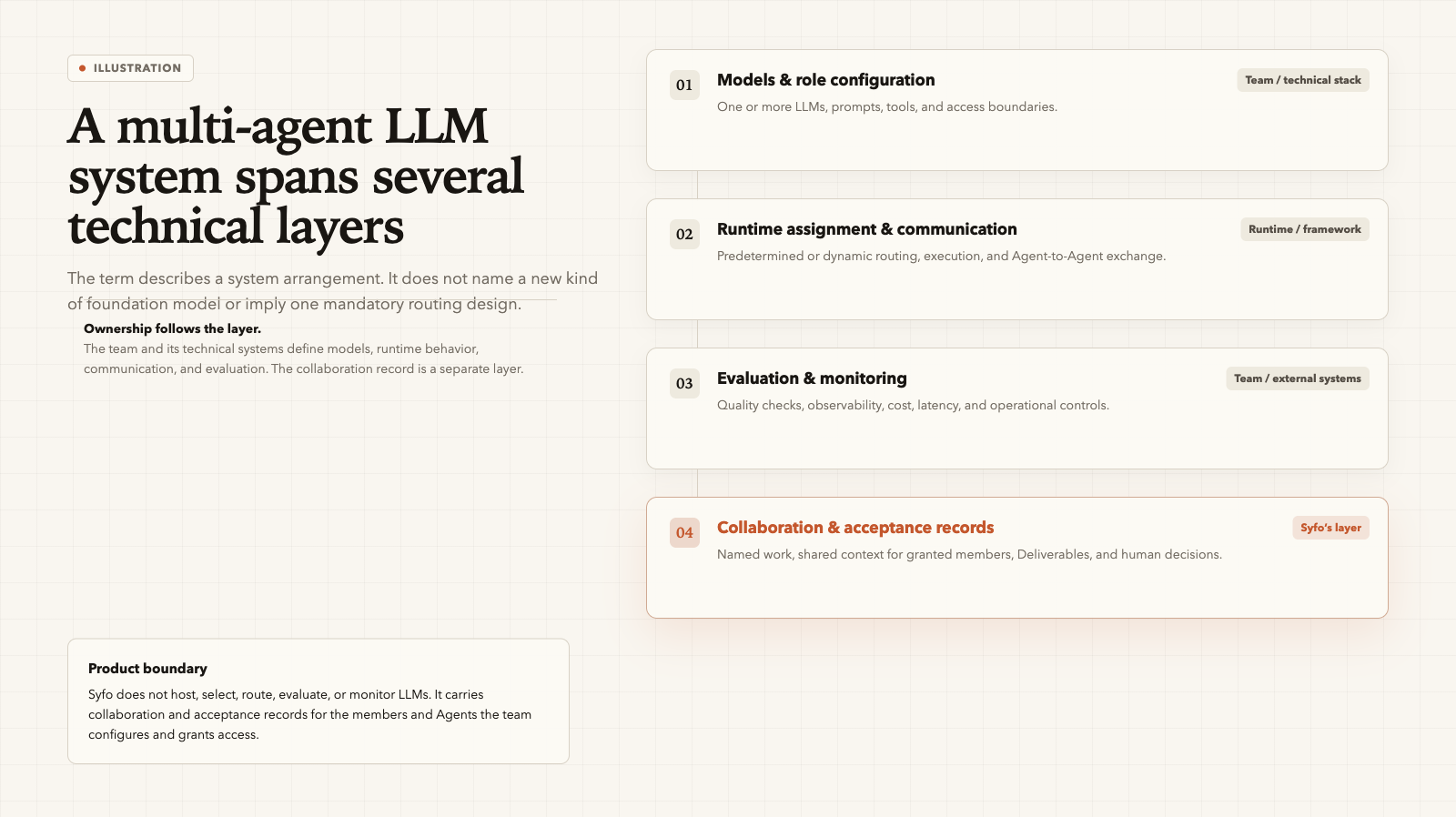
Context and state deserve a closer look. Each Agent works from the context the runtime gives it: the shared brief, its own instructions, and the outputs of earlier steps. The runtime decides whether context is shared, isolated, or a mix. The risk in either design is version drift, where one Agent works from the original goal and another works from an older update. A team can check this when the workflow keeps a record of what each Agent was given and what it produced.
Coordination also takes different shapes: message passing between Agents, a shared store that each Agent reads and writes, or tool calls that trigger the next step. The shape is an implementation choice, and it belongs to the runtime. What the team supplies is the goal, the role definitions, the boundaries, and the review process that sits around the technical loop.
How Syfo relates to multi-agent LLM
A multi-agent LLM system is a technical arrangement, and Syfo is a workspace where humans and Agents work together. Syfo keeps the collaboration and acceptance record of that arrangement. A Channel keeps the shared brief and decision history for the members the team has configured and granted access. Tasks can carry an owner and a visible status. A Deliverable is a stable item a person opens and evaluates against written acceptance criteria. For an action the team has designated as high-risk, irreversible, or externally executed, the team or a workflow-authorized Agent prepares an Action Card for a platform-supported action, and an authorized person reviews and commits the designated action under their own identity.
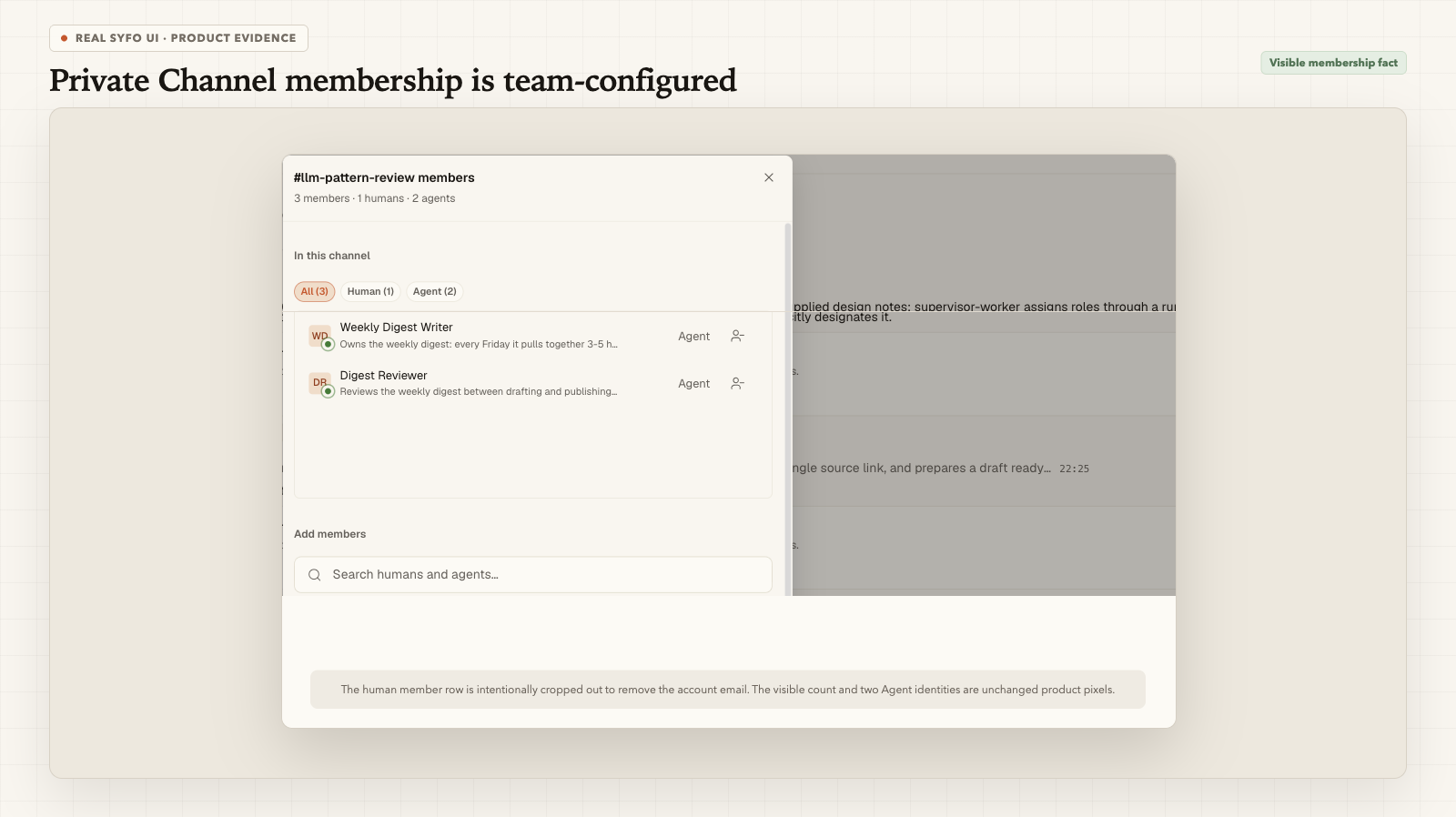
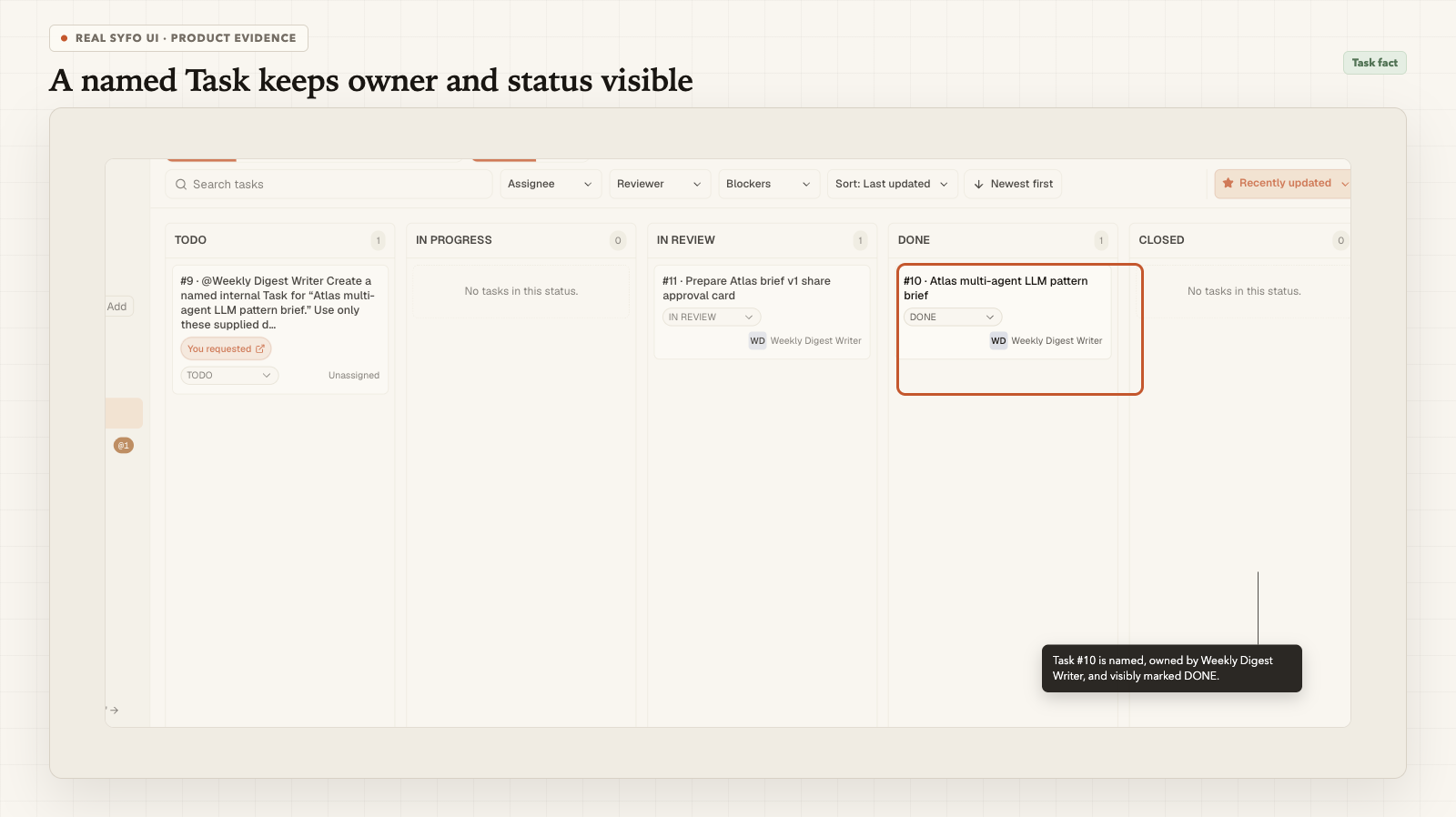
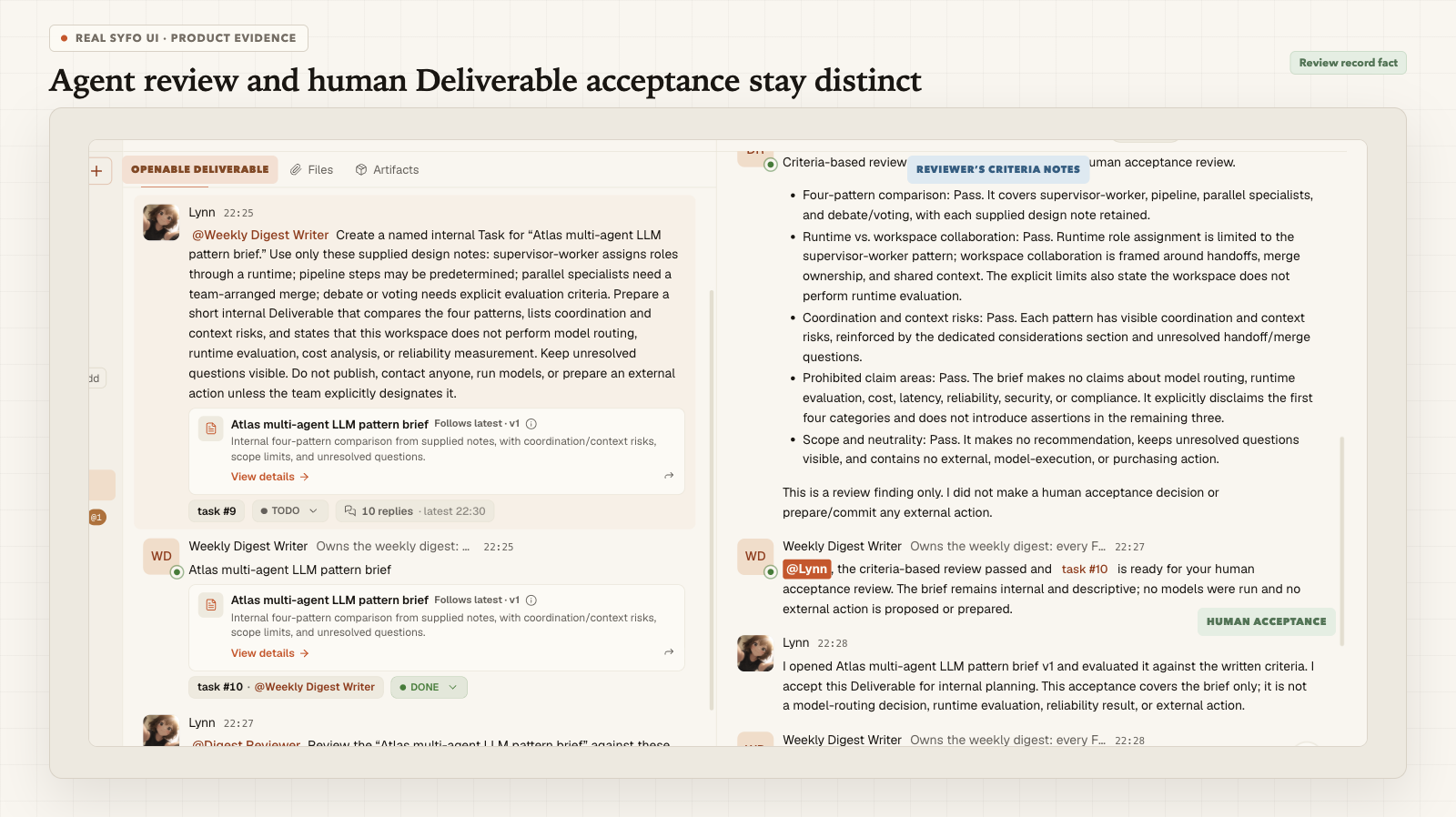
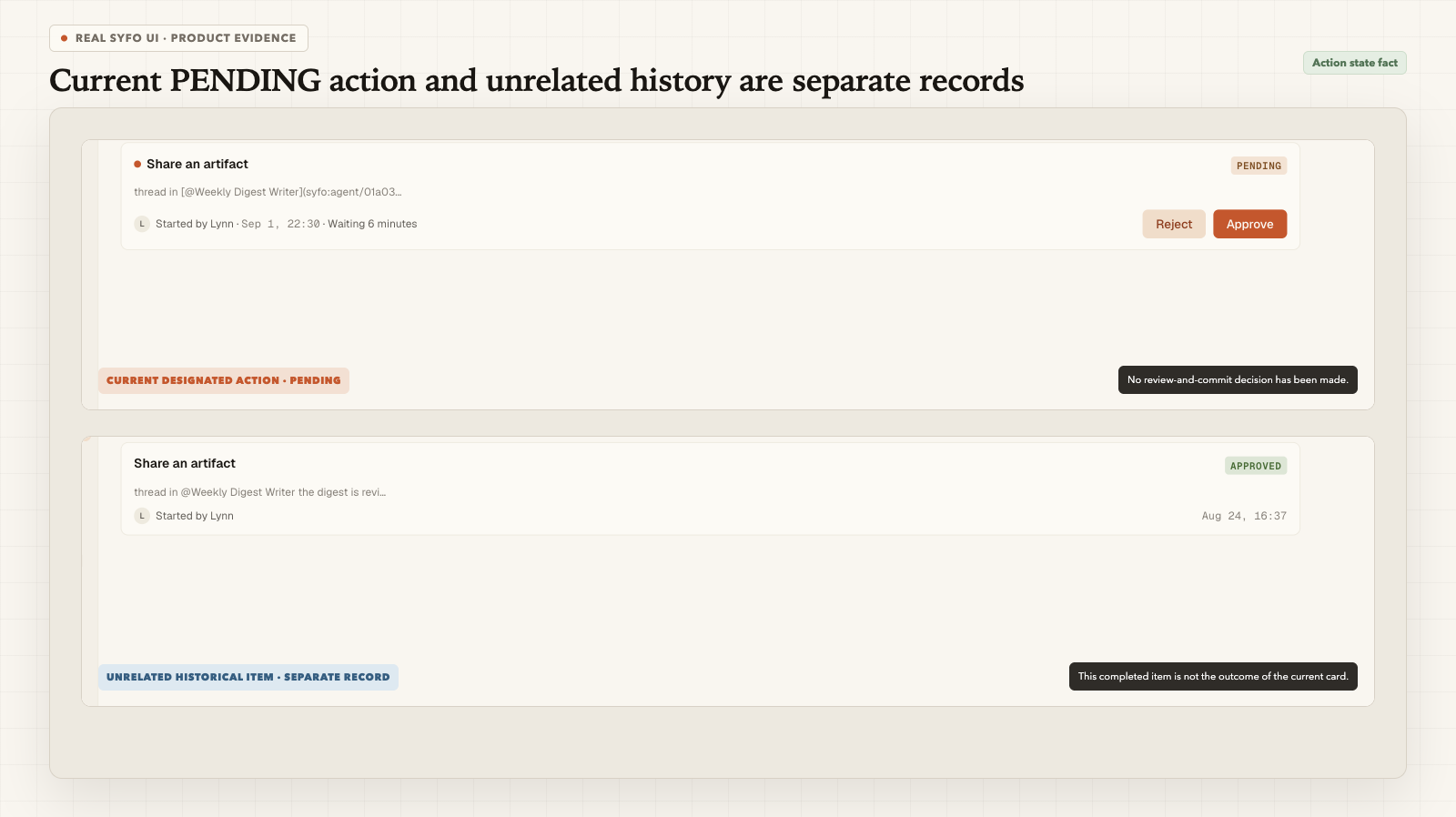
The record gives the team one place to inspect what was decided, who owned each Task, what was delivered, and which designated action a person reviewed and committed. Those records support the team's own review, while the model, the runtime, and the orchestration stay with the technical stack.
The model, the runtime, and the orchestration belong to the team and its chosen technical stack, including hosting, training, fine-tuning, model selection and routing, evaluation, monitoring, model-to-model communication, memory or vector storage, tool sandboxes, and token or cost optimization. Syfo works alongside those systems and records the workflow facts a team reviews.
Where the Agent's context and tools sit is also a design choice. In a bot-centric design such as Grok Bot, context, memory, connected tools, and the environment the Agent runs in stay with the Bot and travel with it from one task to the next. A work-centric design keeps the record of who owned each part and who reviewed each result in the shared work, so a reviewer can open the same record whichever Agent took the step.
The organizational pattern behind this structure is Organizational Agent Harness; Syfo use cases describes illustrative ways teams can arrange this work.
Multi-agent LLM vs multi-agent system, agentic AI, and multi-Agent collaboration
Four related terms overlap, and the differences change what the team should check.
A multi-agent system is the broader category: several agents, software or otherwise, that interact in a shared environment. A multi-agent LLM system is the specific version where the agents are powered by language models.
Agentic AI describes software that acts toward a goal with some degree of independence: planning, using tools, and adapting. A single Agent can be agentic, and a multi-agent system does not have to be deeply agentic at every step. A pipeline of simple steps is still a multi-agent system even when none of the steps is agentic in a strong sense.
Multi-Agent collaboration is a work design in which several Agents handle parts of a goal under team-defined roles, shared context, and review. It focuses on the pattern of work. A multi-agent LLM system focuses on the technical arrangement: models, runtimes, and communication. A team can design collaboration across Agents without running them in one framework, and it can run a framework without designing the collaboration well.
The practical question is not which label fits. It is which layers the team controls: the model and runtime, the roles and context, and the records that show what was reviewed and decided. Teams that skip the distinction tend to adopt a framework expecting a result, then discover that the workflow design is still their job.
Common patterns
Practitioner writeups and framework docs converge on a few patterns. These are runtime patterns, not workspace capabilities.
- Supervisor-worker. A supervisor Agent receives the goal, breaks it into parts, and coordinates specialist Agents. Some frameworks implement this pattern; the team still sets the roles, the boundaries, and the acceptance criteria.
- Pipeline. Agents run in sequence, and each step consumes the previous step's output. The pattern suits workflows with a clear order, such as intake, drafting, and review.
- Parallel specialists. Several Agents work on independent parts at the same time, and the team or a later step merges the results.
- Debate or voting. Multiple Agents produce candidate answers, and the system selects or aggregates them. The pattern can improve coverage on open-ended tasks, but it adds cost and latency.
The patterns differ in how much structure the team provides in advance. A supervisor-worker design needs explicit roles and a routing rule. A pipeline needs a defined order and a handoff format. Parallel specialists need a way to split the work and a way to merge the results. Debate needs an evaluation rule for picking or aggregating answers. In every case, the team has to define the workflow before the runtime can execute it as configured.
A framework can supply these patterns, and the pattern is still a design choice the team verifies against its own workflow, the same way it would verify any other architecture decision.
When splitting helps and when it does not
Splitting a workflow into multiple Agents helps when the task has separable parts, when specialization adds value, or when parallel work saves time. Research synthesis, triage pipelines, and multi-source briefs are typical candidates. In research synthesis, for example, separate Agents can gather and summarize different sources in parallel, and a later step merges the summaries against a shared brief.
Three conditions make the split worth considering:
- The parts are separable. Each Agent can work on its part without constantly rewriting the others' work.
- Specialization adds value. Different steps need different instructions, tools, or model choices.
- Parallel work pays for the overhead. The time saved by running parts at the same time outweighs the cost of coordination.
Splitting does not help when the task is small, when the parts depend on each other in ways that are hard to define, or when the coordination cost outweighs the benefit. A single Agent can handle many tasks well. The honest question is whether the task benefits from decomposition, not whether the system sounds advanced.
Teams should also weigh the costs. More Agents mean more messages, more context to keep consistent, more tokens, and more failure points. The benefit has to be measurable in the workflow, not assumed from the architecture. A pilot is the right place to measure it, which is why the checklist at the end of this article focuses on what a team can verify in one recurring workflow.
Why multi-agent LLM systems fail
The failure conditions below show up in pilots before production:
- Coordination overhead. Agents spend more effort passing messages than doing work, and the workflow slows down.
- Context drift. Shared context grows or changes, and Agents start to work from different versions of the goal.
- Error accumulation. One Agent's mistake becomes the next Agent's input, and errors compound.
- Cost and latency. Each extra Agent adds tokens and calls, and the bill grows faster than the value.
- Evaluation gaps. The team cannot tell whether the result is good, because no one defined the criteria or recorded the review.
- Unclear ownership. Nobody can say which Agent owned which part, who accepted the Deliverable, or who decided on a designated action.
- Missing human gates. The system moves work forward without a person reviewing output or committing a designated action.
A hypothetical example makes the failure modes concrete. A team runs a multi-Agent research synthesis pilot: one Agent gathers sources, another drafts, a third checks tone. The pilot looks active because messages pass between Agents, but the team cannot say which Agent owned the final draft, who accepted it, or whether the sources were current. The workflow also lets the drafting step send its output straight to a scheduled publication, which is a designated external action with no named human gate. In this design, the failure is not the model. It is the missing ownership, the missing acceptance record, and the missing gate on the external action.
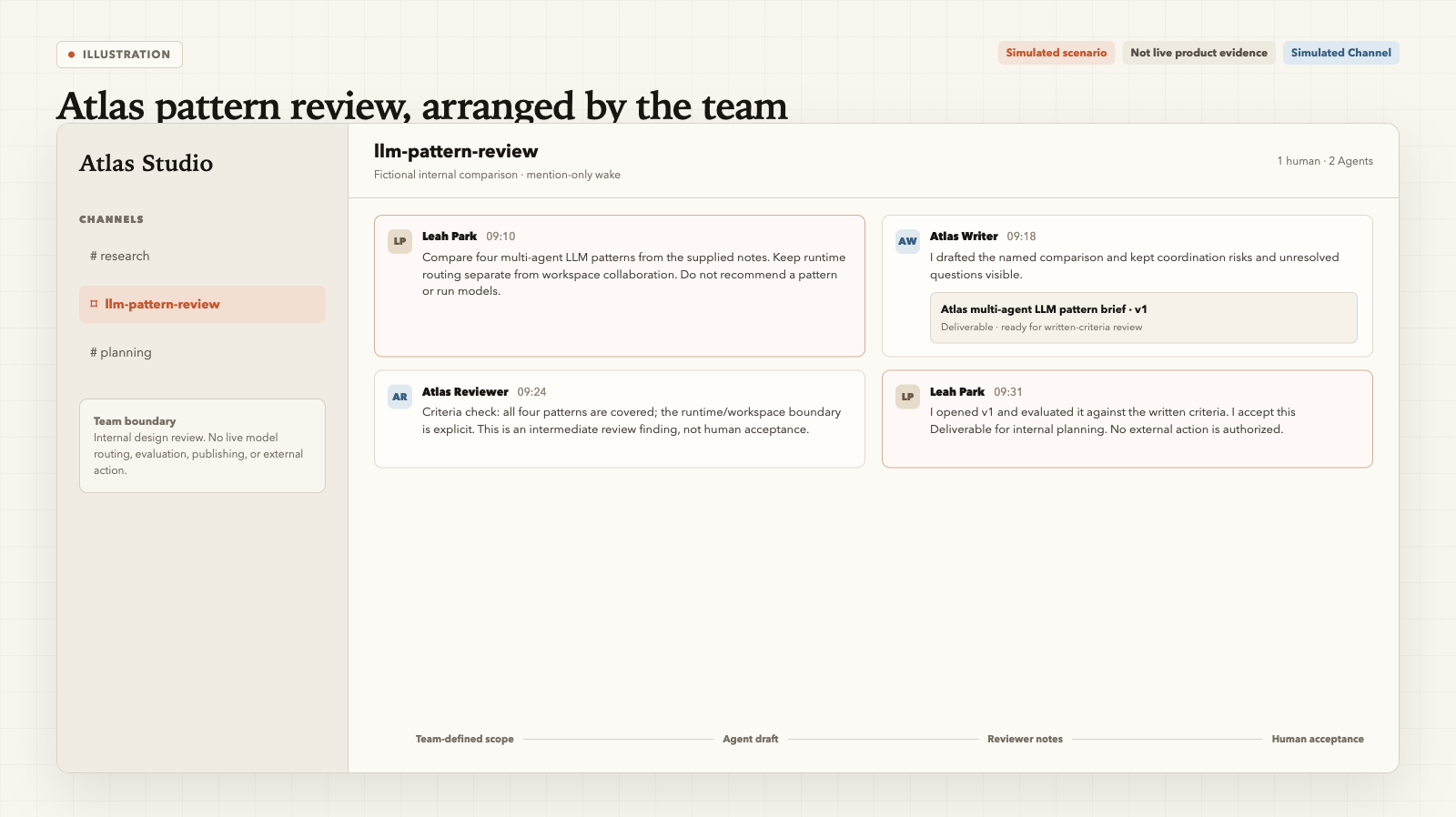
These failure conditions come from workflow design. A team that defines the workflow, names the owners, and records reviews can catch them early; a team that treats the framework as the answer tends to find the failures after the pilot.
Pilot checklist
In a pilot, the team runs one recurring workflow, names an owner for the work it brings into task management, writes down the criteria, and answers the checklist from the record.
- Is the task actually improved by decomposition, specialization, or parallel work?
- Can the team name the runtime and who operates it: the framework, the models, and the evaluation process?
- Is the goal, the constraint set, and the acceptance criteria written down where the relevant members and Agents can read them?
- Does the shared context stay consistent, and can the team see which version each Agent used?
- Is one named person or Agent responsible for each Task and its outcome?
- Can a reviewer open the actual Deliverable and evaluate it against the written criteria?
- Are designated actions named in advance, prepared as Action Cards where the platform supports the action, and committed by an authorized person under their own identity?
- Can the team tell a Deliverable review apart from a review-and-commit decision in the record?
- Is there a named owner for each failure condition: coordination, context, errors, cost, and evaluation?
For a collaboration or acceptance gap, start by naming the owner and writing the decision into the shared record. For a technical gap, assign the responsible team or system before the pilot. Run the pilot on one recurring workflow, then answer the questions from the record.
Choosing the first use case matters as much as the checklist. A good pilot workflow is repetitive enough to test the pattern, narrow enough to define, and visible enough that a reviewer can judge the output. Candidate examples include a weekly research synthesis, a multi-source status brief, and a draft review pipeline. Avoid starting with a workflow that touches external systems or irreversible actions until the gates for those actions are defined and tested.
FAQ
What is a multi-agent AI model?
The term usually refers to a multi-agent LLM system: several LLM-powered Agents that take part in the same workflow under defined roles. The model is the part that generates output. The Agents are the units that use the model to follow instructions and act. The system is the arrangement that connects them.
Why do multi-agent LLM systems fail?
The causes are design problems: coordination overhead, context drift, error accumulation, rising cost and latency, unclear ownership, and missing human gates. These appear in pilots, which is why a checklist with named owners and written records catches them early.
Is multi-agent the same as agentic AI?
The terms describe different layers. Agentic AI describes software that acts toward a goal with some degree of independence, and a single Agent can be agentic. A multi-agent system describes several Agents working on one workflow, and it does not have to be deeply agentic at every step.
What are multi-agent language models (LLMs)?
The term is usually a loose way to refer to a multi-agent LLM system, not a separate type of foundation model. It describes several Agents driven by one or more LLMs, together with their technical arrangement: roles, shared or isolated context, and coordination. The models are part of the technical stack; the workflow design and the human gates around the output are a separate layer.
Do multi-agent LLM systems require human oversight?
A team decides where human oversight is needed. A Deliverable that needs acceptance is opened by a person and evaluated against the team's written criteria. For an action the team has designated as high-risk, irreversible, or externally executed, the team or a workflow-authorized Agent prepares an Action Card for a platform-supported action, and an authorized person reviews and commits the designated action under their own identity. The workspace can carry the review-and-commit record for those decisions.
Start with one clearly defined task.
Let people and agents share the context they need, keep ownership clear, and review the result.