When an AI Agent can access real data and systems, a team has to consider both security and compliance. Security focuses on protecting the systems and data the Agent can reach, while compliance asks whether a planned use meets the organization's policies and legal obligations. This article explains the AI agent security and compliance features teams can examine, how the two areas differ, and which sensitive actions need a member to check the result or make the final decision.
Quick answer
AI agent security and compliance features cover two kinds of checks that teams often treat as one word: security checks on how systems protect data and access, and compliance checks on which policies and legal requirements apply. In practice a team verifies four areas: how data and access are protected in the systems that process the work; what runtime safeguards, monitoring, and response process apply; which policies or legal requirements apply; and whether a person reviewed the Deliverable and committed any designated action.
Human review for Deliverables vs review-and-commit for designated actions
Two review moments in an Agent workflow are often confused. The distinction changes how a team reads its records.
Deliverables. A Deliverable is a stable item a reviewer can open. Before it is accepted, a person opens it and evaluates it against the acceptance criteria the team wrote down. The review record makes the decision inspectable: who reviewed, what they found, and whether it was accepted or returned.
Designated actions. Some actions are high-risk, irreversible, or executed outside the system: sending a file to an external party, publishing content, making a payment. For those, the team designates the action in advance. For a team-designated action, the team or a workflow-authorized Agent prepares an Action Card for a platform-supported action, and an authorized person reviews and commits that specific action in their own identity. The workspace keeps the review-and-commit record.
A scenario keeps the two moments separate. A reviewer opens a weekly launch brief, checks it against the written criteria, and records the result. That is a Deliverable review. Separately, the team decides that sharing the final brief with an external partner is a designated action, because it is irreversible from the team's side. For this share, the team or a workflow-authorized Agent prepares an Action Card for a platform-supported action, and an authorized person reviews and commits it in their own identity. The record now shows two different kinds of human involvement: one for the output, one for the action. A reader can tell them apart.
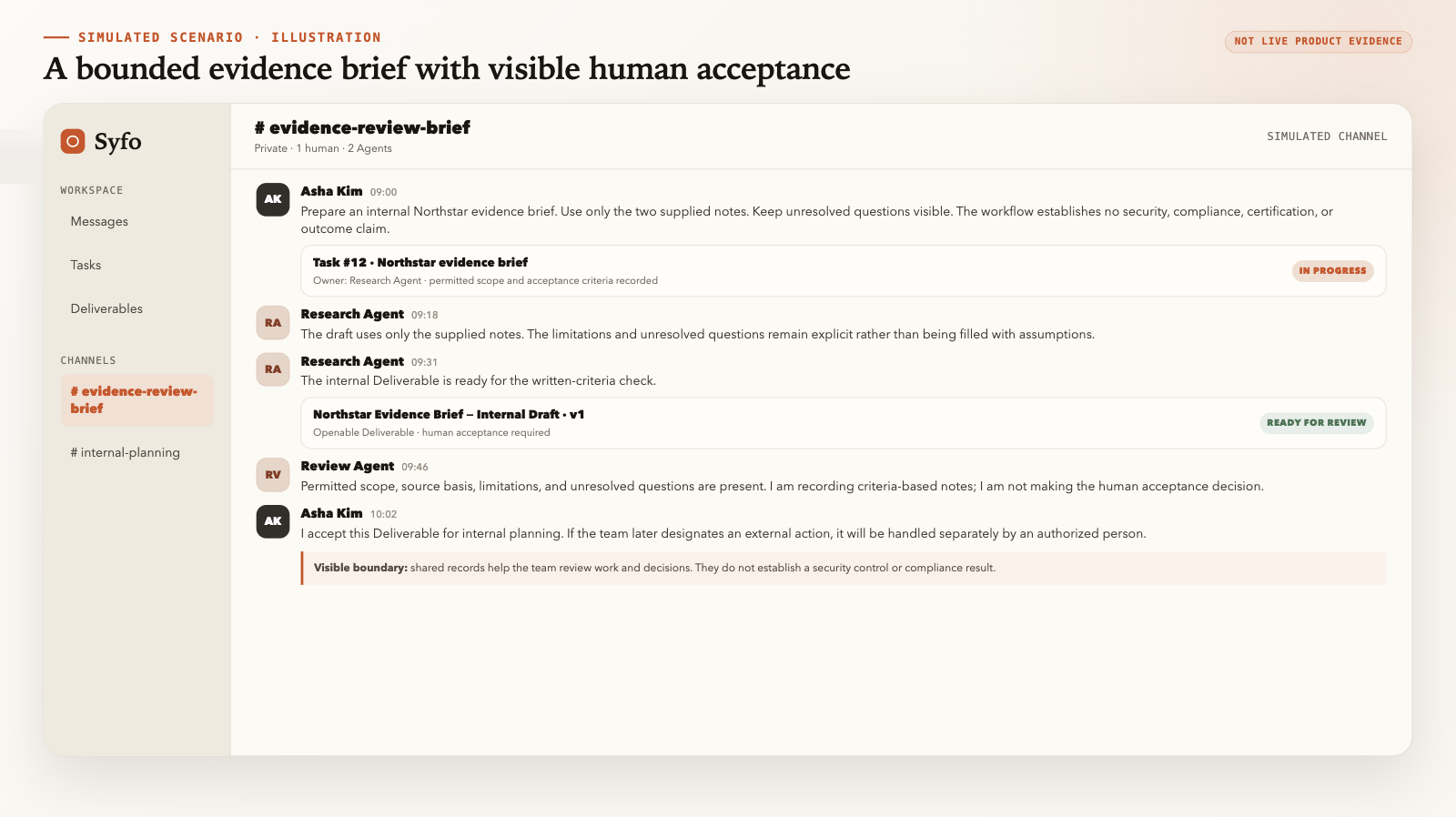
Both review moments serve the team's own acceptance decision. A Deliverable review checks the output against the team's acceptance criteria, and those criteria may or may not include security requirements. An Action Card review records a human decision on a designated action, while enforcement of the surrounding controls stays with the identity, data, runtime, and monitoring systems the organization owns. The decision record supports whatever internal review the team runs later.
How Syfo relates to AI agent security and compliance features
The systems around an AI Agent carry most of its security and compliance controls. Syfo is a workspace where humans and Agents work together, and it keeps the collaboration and acceptance record that the team reviews.
Beside those controls sits a different set of questions: how people and Agents share the brief, who owns each Task, whether a Deliverable was checked against written criteria, and who commits a designated external action. Syfo records those collaboration and acceptance facts and works alongside the identity, data, runtime, and monitoring systems that hold the controls. In the product, the record takes four concrete forms:
- Channels set the boundary of visibility. A Channel keeps the shared brief and decision history for the members the team has configured and granted access, and a private Channel requires an explicit invite, so access is limited to invited people and Agents.
- Tasks can carry a named owner and a visible status. The team can then see who is responsible for what and where it stands.
- Deliverables make output reviewable. A Deliverable is a stable item a person opens and evaluates against written acceptance criteria, and the review decision is recorded.
- Designated actions keep a human decision in the loop. For an action the team designates as high-risk, irreversible, or externally executed, the team or a workflow-authorized Agent prepares an Action Card for a platform-supported action, and an authorized person reviews and commits that specific action in their own identity.
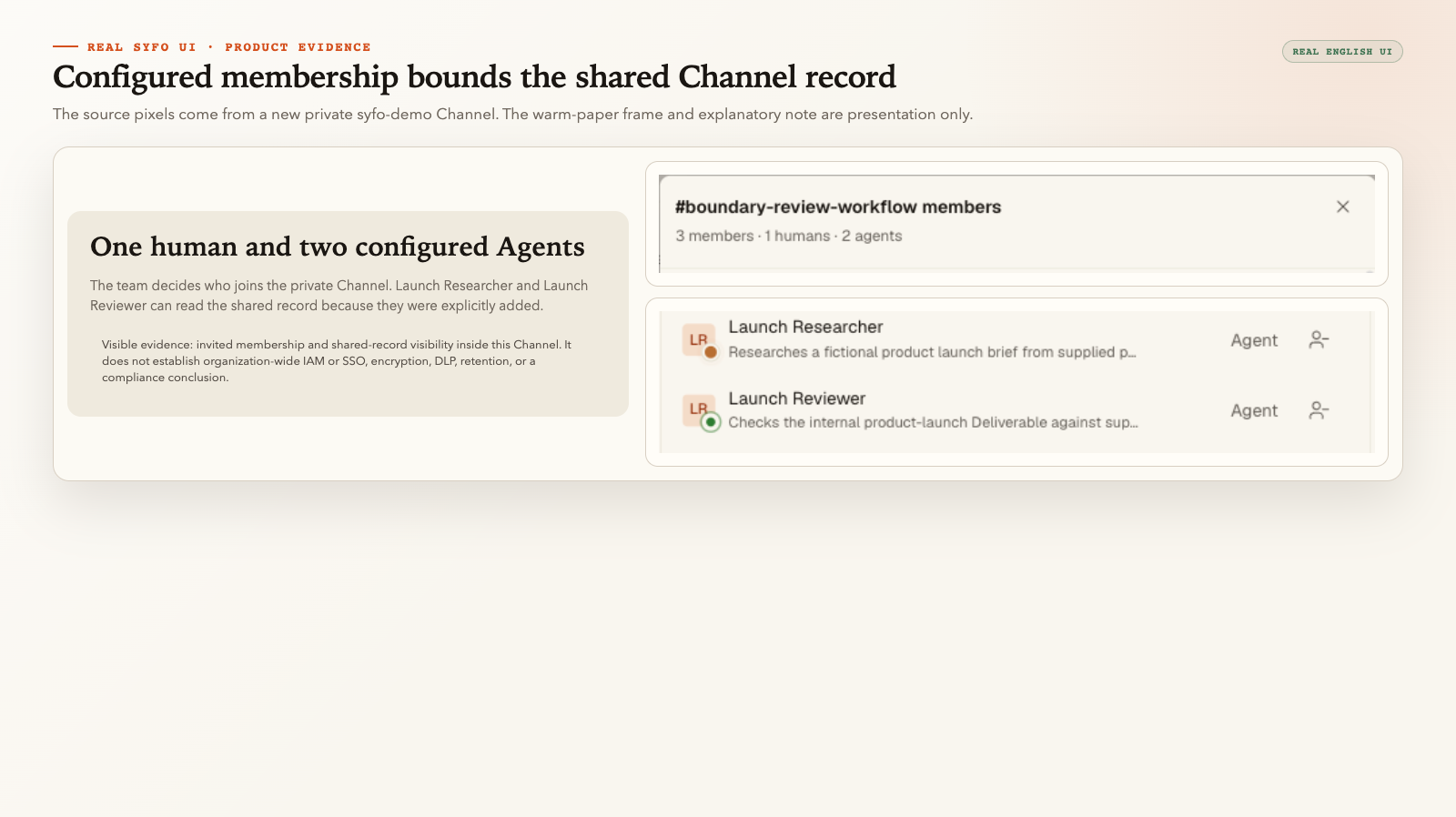
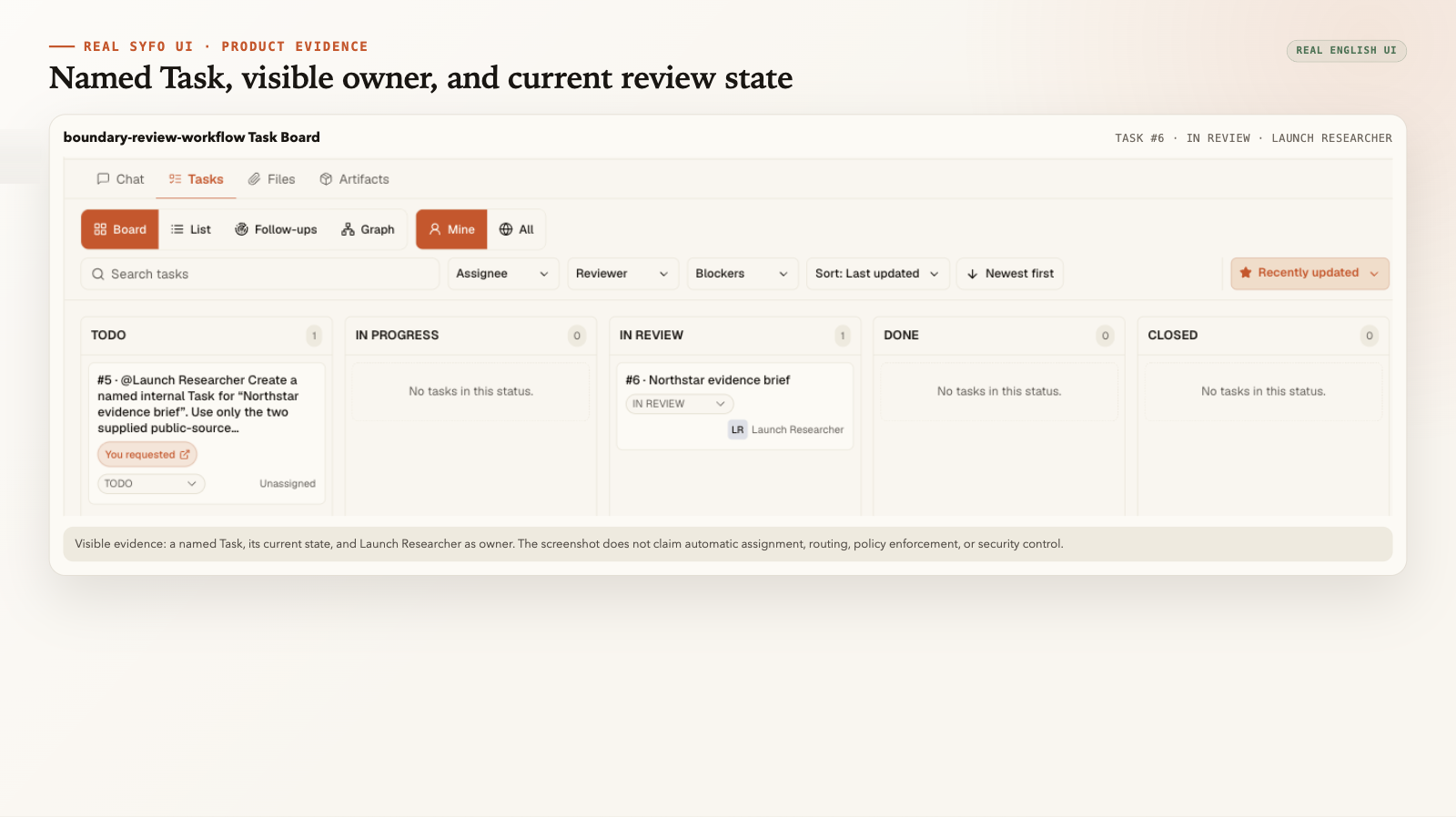
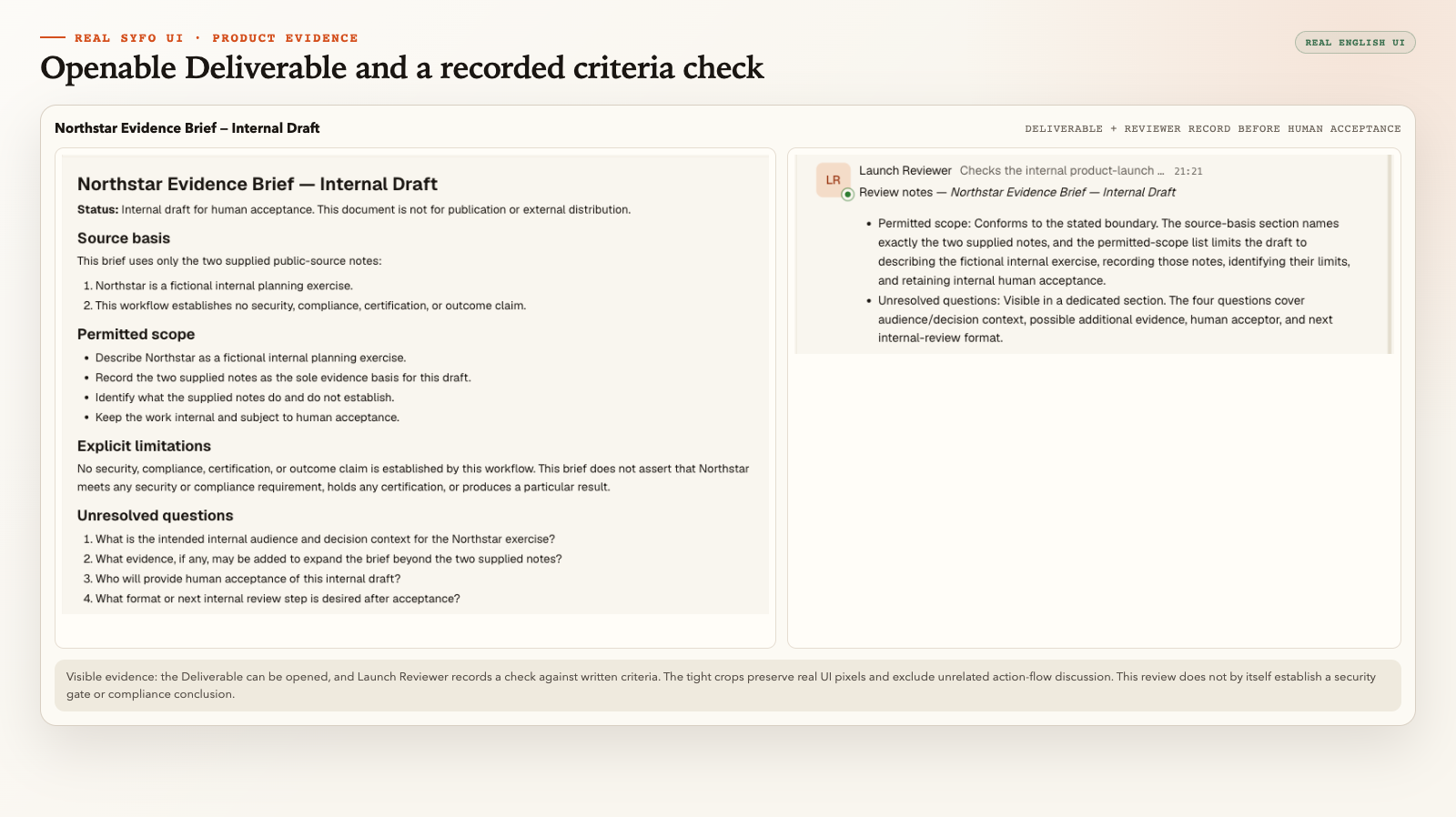
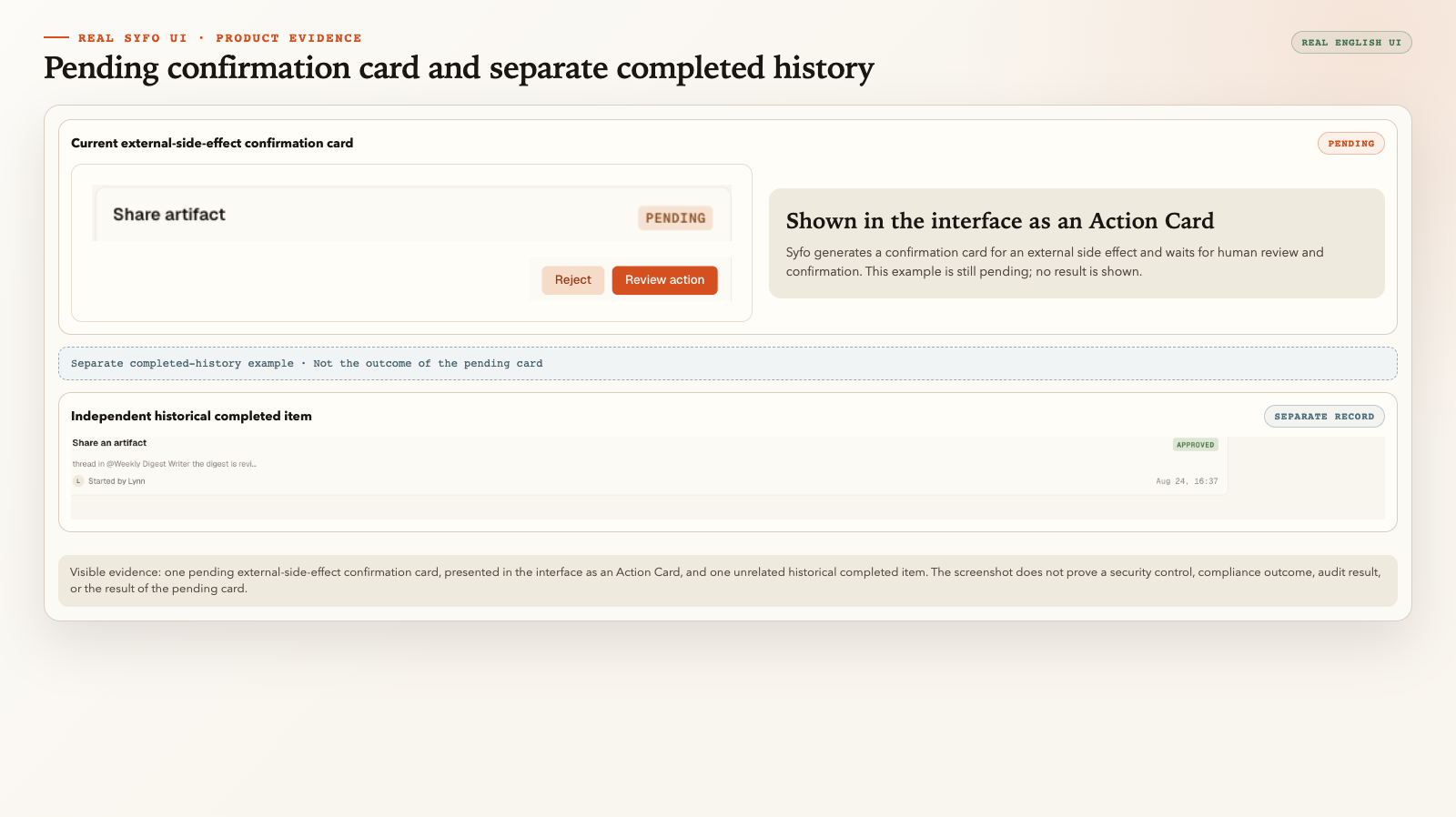
The record gives the team one place to inspect what was decided, who owned each Task, what was delivered, and which designated action a person reviewed and committed. Those records support the team's own review; the security and compliance conclusions themselves come from the owners of the surrounding systems.
The organizational pattern behind this structure is Organizational Agent Harness; Syfo use cases describes illustrative ways teams can arrange this work. The Channels, Security & Permissions, Agents, and Files & Deliverables pages in the Syfo documentation describe how these records work.
Syfo records the collaboration and acceptance facts described here. Questions about Syfo's own encryption, data-loss prevention, storage retention, certifications, and other security and privacy measures are answered by the applicable Syfo security and privacy materials and the agreement for the service.
Security vs compliance: different questions and owners
Security and compliance are often discussed together because Agent systems trigger both at once. The questions are different.
Security asks: can the Agent do something it should not? The answers come from access boundaries, data controls, runtime configuration, and monitoring. The owner is typically the security team together with platform and data owners.
Compliance asks: can the organization show that required conditions were met? The answers come from defined policies, documented decisions, records of access and processing, and the ability to answer a reviewer's question about what happened. The owner is typically the compliance team, legal, and the business owner of the workflow.
A concrete example shows the difference. A team runs an Agent that summarizes supplier research from a fixed list of public sources. The security question is whether the Agent can read anything outside those sources, call an external tool, or send the summary anywhere. The answer comes from the identity, data, and runtime layers. The compliance question is whether the organization can show which sources were used, which summary was reviewed, and who decided the summary was ready for the next step. The answer comes from the governance layer and the review record. A team can pass the first question and fail the second, or the reverse; the two layers are tested separately.
The same split applies inside the team. Security and compliance owners decide what the surrounding systems must enforce and record; the workflow team decides how Deliverables get reviewed and which designated actions require an authorized person to commit them. When these groups do not talk before a pilot, one side can assume the other recorded a decision that was never captured. Naming each owner and the record they rely on is what makes the review hold together, and those answers are what the rest of this article builds on.
Both security and compliance depend on the same raw material: accurate records of what was configured, what ran, and what people decided. Reconstructing a complete record later can be difficult, which is why teams record the decisions they make during the workflow. This is why the collaboration and acceptance record matters. It holds the parts of the work that people decide on, so the rest of the organization can verify them later. Those records support the team's own review, while the security and compliance conclusions stay with the owners of the surrounding systems.
AI Agent risks and the control categories that address them
Agent systems inherit the risks of ordinary software and add a few of their own. The issues below are risks a team can check; treat them as conditions to verify in a pilot, and add any others the workflow raises.
Prompt injection. An Agent can be steered by untrusted content it reads. The relevant controls live in input handling, output validation, and tool-call limits, which belong to the runtime and data layers.
Over-permissioned access. An Agent with broad credentials can reach more than the task needs. The relevant controls live in the organization's identity and access layer: defined roles, scoped credentials, and periodic review of who can invoke each Agent.
Data exposure. An Agent can copy or send data outside the intended scope. A team verifies data classification, allowed destinations, retention rules, and the actual protection measures of the relevant systems.
Unobserved behavior. An Agent can act in ways nobody notices until the outcome appears. The relevant controls are runtime logging and monitoring with a named response owner.
Missing human decisions. An Agent can take an action the team meant to decide. The workflow response is a named review-and-commit step for actions the team has designated in advance.
Unreviewable output. When Agents post long messages and the team calls them Deliverables, nobody can open a stable item, evaluate it against criteria, and record the decision. The relevant control is the review layer: openable Deliverables and written acceptance criteria.
Each risk maps to a control area in the responsibility table below. If a team can name which area answers each risk, it can also name which team or system owns the control, and which record shows what a person decided.
What a team must verify before work begins
| Control layer | Question to verify | Owned by |
|---|---|---|
| Identity and access | Who can invoke the Agent, and what can it access? | Organization identity and access systems, with policies owned by the security team |
| Data protection | What data may the Agent read, store, or send? | Organization data governance and tooling |
| Runtime and tooling | What tools can the Agent call, and where does it run? | Platform and runtime operators |
| Monitoring and incident response | What happened during a run, and who responds? | Security operations and observability systems |
| Governance and compliance | Which rules apply, and who decides and documents them? | Compliance, legal, and business owners |
| Collaboration and acceptance records | Who produced what, what was reviewed, who accepted a Deliverable, and which designated action was committed, and by whom? | Team workflow design, with workspace records that help teams review |
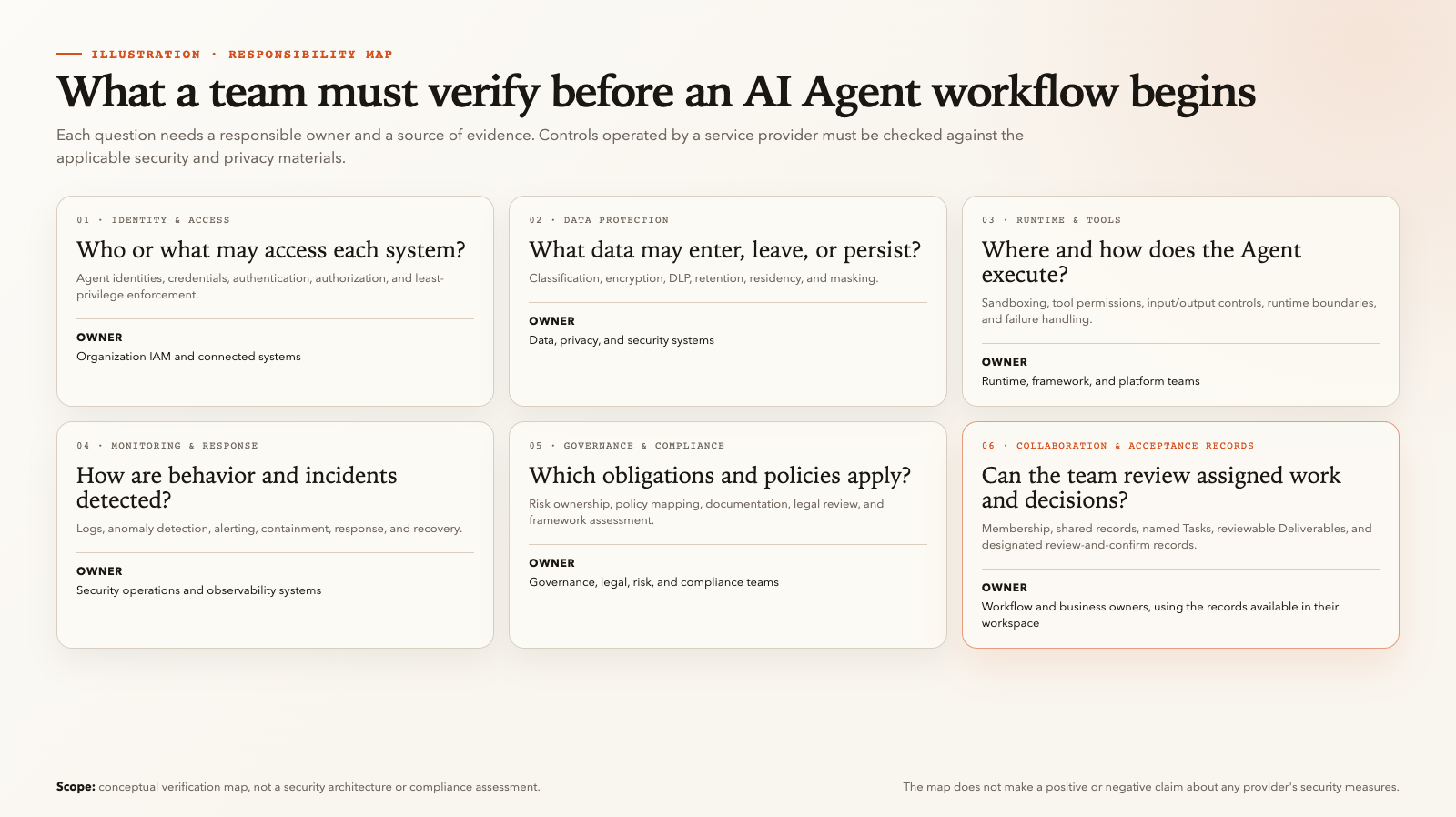
Reading the table for one workflow is straightforward. The identity row is answered by whoever configures who can invoke the Agents and what they can reach. The data row is answered by whoever governs the sources and destinations. The runtime row is answered by whoever operates the environment. The monitoring row is answered by whoever watches runs and responds. The governance row is answered by whoever decides which rules apply. The collaboration and acceptance row is answered by the team that designs the workflow and by the record that shows what was reviewed and decided.
The first five rows belong to the organization and the systems the workflow uses. When a provider operates one of those systems, the provider's own measures are verified against its security and privacy materials. The sixth row is where the team's workflow design shows up. The workspace that carries the sixth row works alongside those systems and gives the team a readable record of the human decisions in the workflow, so the other owners can verify them without reading chat history.
Where these controls and records sit is also a design choice. In a bot-centric design such as Grok Bot, context, memory, connected tools, and the environment the Agent runs in stay with the Bot and travel with it from one task to the next. A work-centric design keeps the access boundaries and the record of who reviewed each result in the shared work, so a reviewer can open the same record whichever Agent took the step. For a team verifying access, control, and review before work begins, this choice shapes where it looks.
Evaluation checklist for a pilot
A pilot should verify the layer the team controls and confirm that the other layers have named owners. Run the checklist against one recurring workflow.
- Can the team name the owner of each control layer for this workflow: identity, data, runtime, monitoring, and governance?
- Can the relevant team members read the current goal and the latest decisions from the shared record?
- Is one named person or Agent responsible for each Task and its acceptance criteria?
- Can a reviewer open the actual Deliverable, or is the output limited to a summary in a chat?
- Is it recorded who accepted each Deliverable?
- Are designated actions named in advance, prepared as Action Cards where the platform supports the action by the team or a workflow-authorized Agent, and committed by an authorized person under their own identity?
- Can the team tell a Deliverable review apart from a review-and-commit decision in the record?
- Can the team identify from the shared record if an Agent produced work nobody reviewed?
For a collaboration or acceptance gap, start by naming the owner and writing the decision into the shared record. If an identity, data, runtime, monitoring, or governance layer has no owner, assign the responsible team or system before the pilot. Run the pilot on one recurring workflow, then answer the questions from the record.
Run the checklist with the workflow's named owners in the room. The goal is to leave the pilot with answers written down: which area owns each control, where the records live, and who the response owner is when a question comes back. If a control area has no named owner, that gap is a finding, and the finding is more useful than a green light from a feature comparison.
Choosing the first use case matters as much as the checklist. A good pilot workflow is repetitive enough to test the pattern, narrow enough to define, and visible enough that a reviewer can judge the output. Candidate examples include weekly research briefs, intake summaries, draft reviews, and status reports. Avoid starting with a workflow that touches sensitive data, external systems, or irreversible actions until the gates for those actions are defined and tested.
FAQ
Is there a single compliance checklist for AI agents?
Teams should start with the requirements that apply to their jurisdiction, data, and industry, then map those requirements to the workflow and ask the responsible owners to confirm the mapping. Common threads include defined access boundaries, records of data processing, human oversight of designated actions, and the ability to show who decided what.
What security issues can teams check for with AI agents?
The issues a team can check include prompt injection, over-permissioned access, data exposure, unobserved behavior, and missing human decisions on designated actions. Each maps to a control layer: runtime and input handling, identity and access, data governance, monitoring, and the review-and-commit record.
Who is responsible for a security or compliance conclusion?
The owners of the relevant identity, access, data, runtime, monitoring, compliance, legal, and business areas make the security or compliance conclusion from configuration, evidence, policies, and records. Security conclusions come from the identity, access, data, runtime, and monitoring systems, based on configuration and evidence; compliance conclusions come from the compliance, legal, and business owners, based on policies and records. A workspace helps a team review who did what and who decided what, and the conclusion itself comes from the owners of the surrounding systems.
Does reviewing a Deliverable count as a security gate?
A Deliverable review checks an output against the acceptance criteria the team wrote down, and those criteria may or may not include security requirements. The security gate itself is enforced by the identity, data, runtime, and monitoring systems the organization owns.
What should a team verify before an Agent reads data or takes an external action?
Name the systems that protect access and data, and check the security and privacy materials of whoever operates them. Confirm the runtime safeguards, monitoring, and the named response owner. Confirm which policies apply. Then decide how Deliverables are reviewed and which designated actions require an authorized person to review and commit them, and record those decisions where the team can review them later.
Start with one clearly defined task.
Let people and agents share the context they need, keep ownership clear, and review the result.