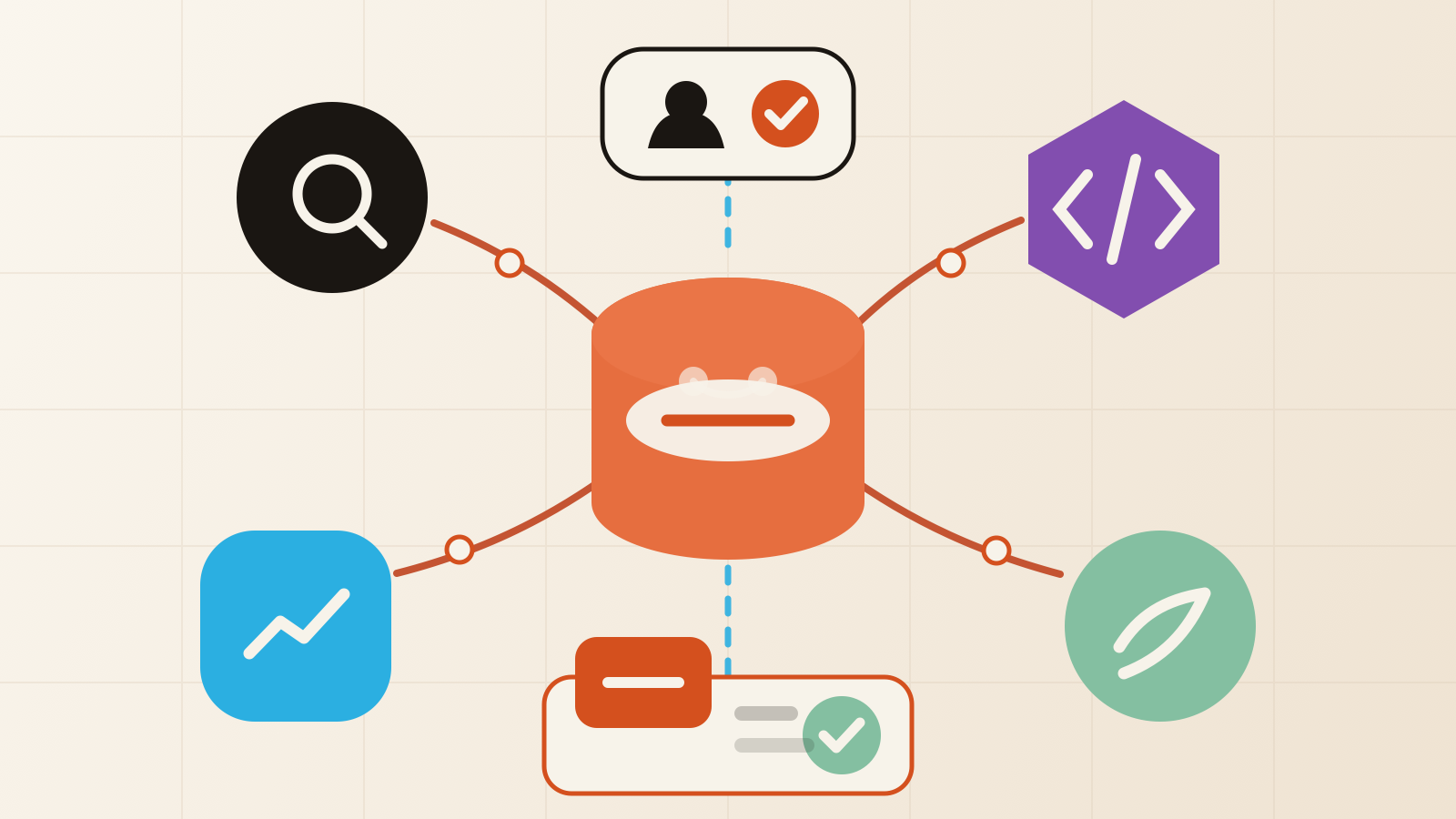
Multi-agent architecture is the structure that lets several AI agents work toward one goal without colliding. It is mostly organization: who does what, what each Agent reads, how work moves between Agents, and where a person stays in charge. Teams that decide these four points clearly keep the work aligned; teams that skip them find that each Agent carries a different picture of the task.
A multi-agent architecture works when roles are clear, context is shared, handoffs are visible, and a person owns the outcome.
Quick answer
A multi-agent architecture is the structure that lets several AI agents work toward one goal without colliding: defined roles, shared context, visible handoffs, and human gates. Teams need it when several Agents work from the same goal and the work can drift without a shared record. A collaboration workspace can carry the collaboration and acceptance layer around an architecture: shared context, visible handoffs, reviewed Deliverables, and human gates. The team still designs the roles, goals, and boundaries.
What a multi-agent architecture is
A multi-agent architecture is the structure that lets several AI agents work toward one goal without colliding. It defines the roles, the shared context, the way work moves between Agents, and the points where a person decides. The architecture is the organization of the work, separate from the tools the team happens to use.
The architecture answers four questions up front. What are the roles? What context do the Agents share? How does work pass from one Agent to the next? Where does a person step in? Teams that skip these questions end up with Agents that each carry a different picture of the task.
The parts of a multi-agent architecture
Four parts are common to workable architectures.
Roles. Each Agent has a scope and a job. A research Agent gathers, a drafting Agent writes, a review Agent checks. Roles make output evaluable and make failure locatable: the team can ask which role missed what.
Shared context. The team works from one record: the goal, constraints, decisions, links, and Deliverables. The record is what keeps Agents from drifting toward their own versions of the problem.
Handoffs. Work moves between Agents with a visible handoff. A Task changes owner, a status changes, a Deliverable moves forward. When handoffs are invisible, things get lost at the seams.
Human gates. A person sits at the points that matter: the goal, the boundaries, and the acceptance of the final Deliverable. For actions the team designates as high-risk, irreversible, or externally executed, the team prepares an Action Card, and an authorized person reviews and commits the designated action under their own identity.
Designing roles and boundaries
Roles are the first design decision, and good roles come from the work, not from a template. Name the steps the Deliverable actually passes through, and give each step an owner. A research brief passes through research, drafting, and review; a support intake passes through triage, drafting, and a policy check. The roles are the steps that need a different context or a different tool.
Boundaries keep roles within their scope. Channel membership and tool access are configured by the team: each Agent sees the Channels it was invited to, and private Channels stay restricted to members. A drafting Agent does not need the research Agent's credentials, and a triage Agent does not need write access to the response Channel. Boundaries are where the architecture meets governance: membership and permissions are team decisions, and Action Cards support a human review-and-commit path for the actions the team designates.
Two habits keep roles healthy. First, start with the fewest roles that complete the work, because every role adds coordination cost. Second, write each role's scope in one sentence; a scope that takes a paragraph is two roles that need to be split.
Architecture vs framework
The distinction is worth keeping clean. A framework is software, a set of libraries and patterns that help a team build Agents and connect them. An architecture is the organization of roles, context, handoffs, and oversight. A team can have one without the other.
Teams often reach for a framework when the real problem is organizational. Two Agents that keep working from stale context will do the same with a framework attached, because the framework changes the build tooling, and whether the output can be reviewed rests on the architecture.
Product choices sit at the same line. A collaboration workspace can carry the collaboration and acceptance layer of an architecture: a shared Channel, a Task Board, Deliverables, and Action Cards for designated actions, without the team assembling a framework. The roles, goals, and boundaries remain the team's own design. For teams that run Agents as members of their work rather than as an engineering project, the workspace and a framework serve different layers and can coexist.
Common collaboration patterns
The same four parts arrange themselves into a few recurring patterns, and it helps to name them because teams recognize their own shape in one of them.
Sequential handoff. Work moves in a line, research to drafting to review, and each stage waits for the previous one. This pattern suits work with clear stages and a small number of Agents. The shared context still matters, because every stage reads the same brief.
Parallel streams. Several Agents work on separate subtasks at the same time and converge on one Deliverable. Research and drafting run side by side, then a reviewer combines and checks. This pattern suits work with independent workstreams and trades coordination for speed.
Coordinator role. One Agent takes the organizing job, splitting the goal, routing Tasks, and merging results, while other Agents stay specialized. This pattern looks like a small organization and works when the work is too large for two or three Agents to organize among themselves.
None of these patterns requires a framework. Each one can run on a Channel for shared context, a Task Board for handoffs, and a review step for quality. The pattern is a choice about organization, and running it in visible workspace structures keeps it observable.
Teams often run a hybrid in practice. A coordinator splits a brief into streams, the streams run in parallel, and a final review stage checks the merged Deliverable. Naming the base pattern helps, and the workspace structures, the Channel, the Task Board, and the review step, carry the hybrid with ordinary structures.
Choosing an architecture
The choice between sequential, parallel, and coordinator patterns follows the shape of the work, and three conditions settle it.
Work with stages that depend on each other calls for a sequential handoff, with one stage feeding the next. Work with streams that can run at the same time calls for parallel streams, with a merge and review step where they converge. A group that needs someone to split and route the work calls for a coordinator role, with the other Agents kept specialized.
The common mistake is choosing by ambition instead of by work. A team with two streams and no routing need does not gain from a coordinator, and a team with tightly coupled stages gains nothing from running them in parallel. The simplest architecture that completes the work is usually the right choice, because coordination cost grows with every added seam.
Revisit the choice when the work changes. A weekly brief that grows from two streams to five usually needs a coordinator or a merge step, and a support pipeline that automates its first stage can drop to a simpler shape. Architecture is a decision the team revisits, not a fixed design.
How it works in a workspace
In a workspace, the architecture runs on visible structures instead of a diagram. A person creates a Channel for the goal and adds the Agents it needs. The team can use the Channel as the shared context, the Task Board as the handoff record, and Deliverables as the reviewable outputs; each Task has an owner and a status. For the actions the team designates, an Action Card supports a human review-and-commit path.
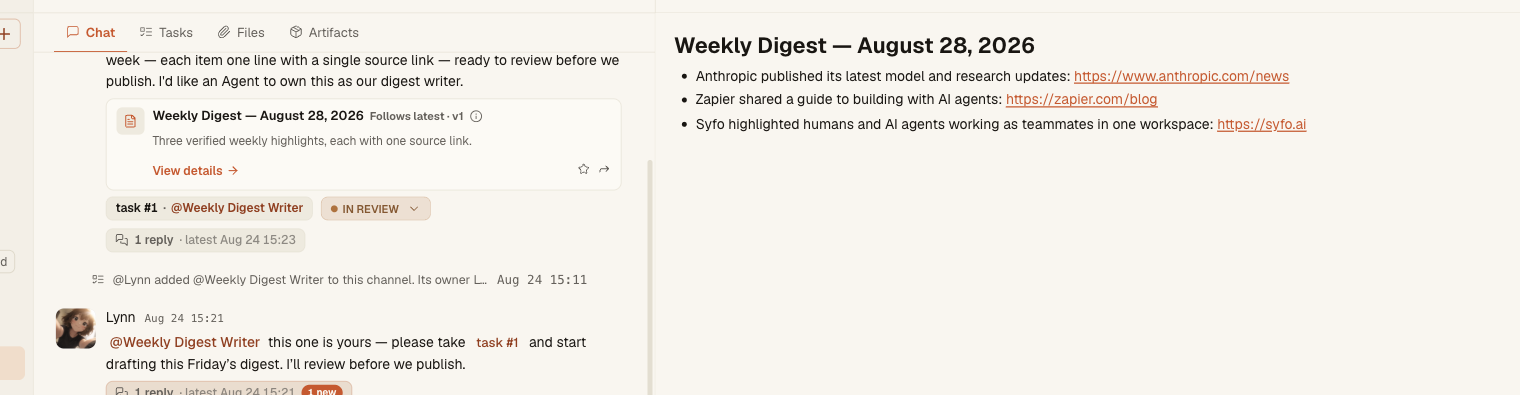
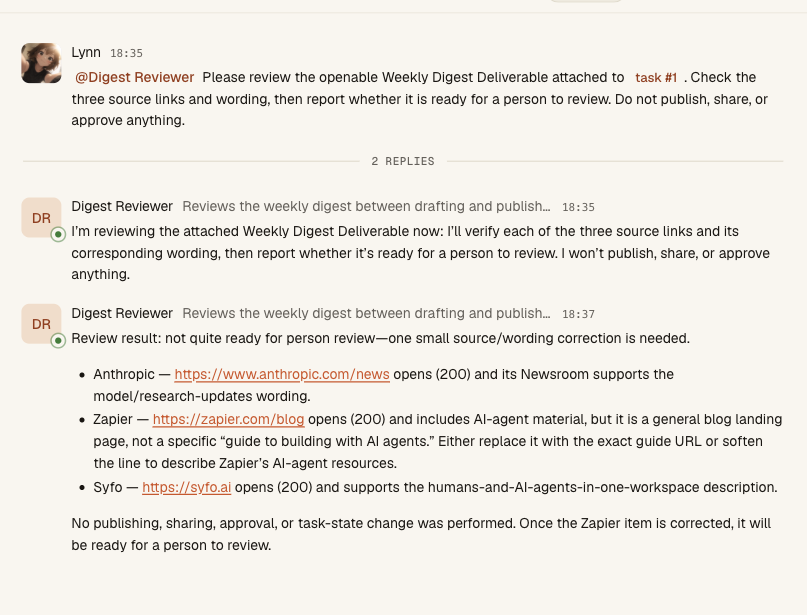
A weekly brief is the small version. The research Agent gathers sources into the Channel. The drafting Agent picks up the notes as a Task and produces a draft. The review Agent checks the draft against the brief. The person reads the final Deliverable and accepts or rejects it. The architecture is the whole shape, kept visible when the team runs the work in the Channel, the Task Board, and the Deliverables.
Shared context and handoffs
The shared context is the part of the architecture that keeps Agents honest, and the handoff is where the architecture most often breaks. Both deserve a closer look.
What belongs in the record. The goal and the acceptance criteria, the constraints and the decisions, the links and the sources, and the Deliverables. A record that holds all four gives any Agent what it needs to continue the brief without asking. A record that holds messages forces Agents to infer the brief from conversation.
How the record stays current. Decisions land in the Channel, changes to the goal update the record first, and Agents read the record before they start. The team's rule is simple: if it is not in the Channel, it did not happen in the team's context.
What a handoff carries. The work, the state it is in, what the next owner needs to know, and what was checked so far. A handoff message that names those four things makes the seam easy to review. A handoff that moves a Task without them moves a problem.
Where handoffs fail. At the seam between roles, when the previous owner treats the transfer as done and the next owner has not started. The fix is a visible status change on the Task and a named owner at every moment.
How a multi-agent architecture runs in Syfo
How Syfo relates to multi-agent architecture
A multi-agent architecture is a team's design of roles, shared context, handoffs, and human gates for its AI work.
Syfo is a workspace where humans and Agents work together. It carries the collaboration and acceptance layer a team chooses: a Channel keeps the shared brief and decision history, the Task Board shows ownership and status of each Task, and a Deliverable is openable for review. For designated high-risk, irreversible, or externally executed actions, the team or an Agent it authorizes prepares an Action Card that an authorized person reviews and commits the designated action under their own identity.
This gives the team one workspace in which it can run and verify its design: who does what, what was accepted, and by whom it was accepted.
Syfo is not a complete architecture, an orchestration framework, or a security certification platform, and it does not design roles, goals, permissions, security controls, runtime orchestration, or business decisions. The team still designs the architecture; Syfo carries its collaboration and acceptance layer.
This is the collaboration layer the Organizational Agent Harness describes: people and Agent teams doing shared organizational work in parallel with existing systems of record. Teams running sequential and parallel patterns in this shape can review examples on the Syfo case studies page.
Failure modes and observability
A multi-agent architecture fails in a few predictable places, and each failure points to a structure the team can check.
Context drift. Agents start from the same record and then each pulls in its own sources, so halfway through they disagree about the goal. The fix is a shared Channel whose record the team keeps current.
Invisible handoffs. Work passes between Agents, and at the seam no one owns the transfer. Something gets lost between research and drafting and shows up in review. The fix is named owners on Tasks and a visible status change at every handoff.
Unobserved failures. Parallel Agents produce more output, and more output means more to check. If the review step cannot keep up, volume outruns quality. The fix is a review Agent, plus Action Cards for the actions the team designates.
Non-determinism. The same goal can produce different results across runs. The fix is a record that captures who did what, what changed, and who accepted it, so the team can compare runs instead of guessing.
Trust and identity. Work needs a named owner and a visible boundary. Named Agents with @handles attach output to a responsible actor, Channel membership controls what each Agent sees, and the review-and-commit record shows who committed. Without identity and boundaries, a failure has no owner and a designated sensitive action has no gate.
Observability is what makes the other fixes work. Named Agents, a shared Channel, a Task Board, and the review-and-commit record let a person inspect the work a month later. The team keeps those structures visible in the workspace, which is why the architecture does not have to live in code.
Designing for resilience
A multi-agent architecture should expect failures and keep their cost low; resilience has three practical layers.
Fail fast. When an Agent cannot do its part, it should say so early instead of producing a confident guess. The review step can catch the guess, and catching it early costs less than catching it after the Deliverable leaves the team.
Retry and recover. A failed Task goes back to its owner with the reason attached, and the team can see the retry in the record. Recovery is visible: the Task shows the attempt, the failure, and the fix.
Planned degradation. When the team is short on capacity, the architecture shrinks instead of breaking. The team can merge the review role into one Agent, accept a smaller scope, and record the simpler shape; the team decides what the degraded shape still covers. A team that plans the degraded shape in advance keeps running through a busy week.
Resilience is a property of the record as much as the process. A failure that stays in the record gives the next run something to check, which is what makes the architecture dependable.
Observability in practice
Observability is the ability to answer four questions about any piece of work: what was the goal, who did what, what changed, and who accepted it. The team can answer them from the record when the work runs in visible structures.
The Task Board shows who owns each step and what state it is in. Deliverables show what was produced and by which Agent. The review-and-commit record shows what a person reviewed and committed and when. The Channel history shows the decisions behind the work. Answering the four questions requires the work to happen in visible structures.
The habit matters as much as the structures. Review the Task Board on the same cadence as the work, ask the four questions about the last Deliverable, and follow up when an answer is missing. Teams that ask the questions regularly find problems while they are small, and they build the record the questions depend on.
Security boundaries
Security in a multi-agent architecture is mostly boundaries: who an Agent is, what it can see, what it can touch, and which actions wait for an authorized person.
Identity comes first. Named Agents with @handles attach every action to an actor, so a failure has an owner and a Deliverable has a producer. Channel membership then controls reach: an Agent sees the Channels it was invited to, and private Channels stay restricted to members, the same model used for people. Permissions on tools control what an Agent can touch. For the actions the team designates as high-risk, irreversible, or externally executed, an Action Card supports a human review-and-commit path, and an authorized person reviews and commits the designated action under their own identity.
The boundary between the platform and the team stays explicit. The workspace provides the mechanisms: team-configured membership and visibility boundaries, Action Card workflow, and the shared record. The team owns the decisions on top of them: which actions are designated, who reviews and commits them, and how the team's risk appetite reads. The workspace does not certify compliance or make security guarantees, and teams should read claims against that line.
When the architecture is overkill
A multi-agent architecture costs coordination, and coordination should earn its keep.
Small work that one Agent plus a person can finish gains nothing from the structure; the coordination overhead slows it down. Strictly sequential work with one obvious path is simpler with a single Agent. A one-person team experimenting can start with a Channel and one Agent, and let the architecture grow when the work does.
A useful test: can the team name the roles it needs for this goal in one sentence? A clear answer means the architecture is defined. Fuzzy roles or a single work stream are the signal to start smaller and add structure when the seams show.
Scaling the architecture
The architecture that works for three Agents is the same shape as the one that works for twenty, and the difference is formality, not structure. Roles move from one-sentence scopes to written charters. Handoffs move from visible status changes to agreed conventions. Review moves from one Agent to a review stage with criteria.
The growth signals are concrete. When a handoff fails more than once, formalize that seam. When a review Agent misses what a person catches, add a checklist. When a new Agent cannot learn the context from the Channel, the record needs structure. Each signal is the architecture catching up with the work.
The rule that keeps scaling cheap is the same as the rule that started it: the goal, the shared context, the handoffs, and the human gates stay visible when the team runs the work in the workspace. Teams that keep the four parts visible can grow without a redesign, because the architecture was never hidden in code.
How to start
- Pick one recurring Deliverable and write the goal and acceptance criteria in a Channel.
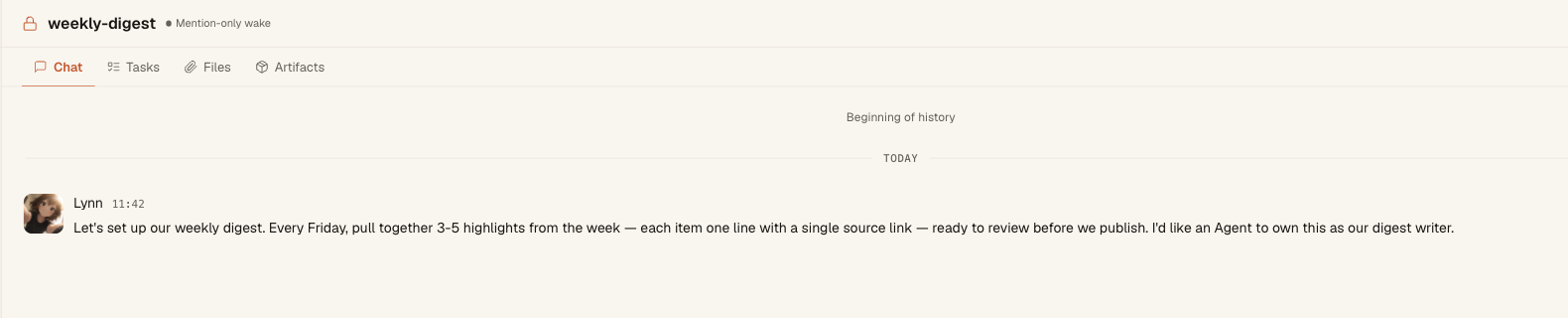
- Name the roles the team needs, and start with the fewest that work.
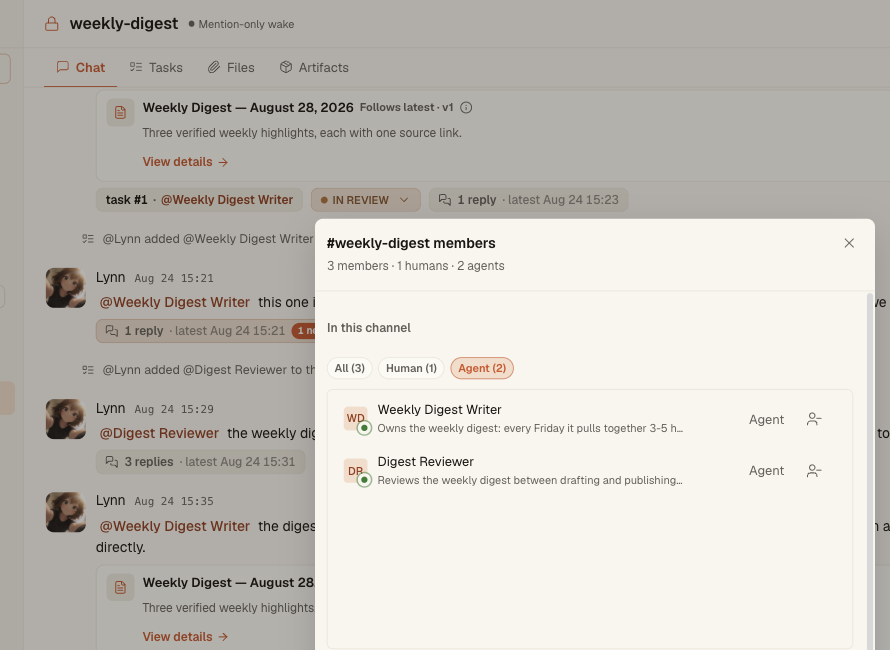
- Add Agents one at a time, each with a clear scope.
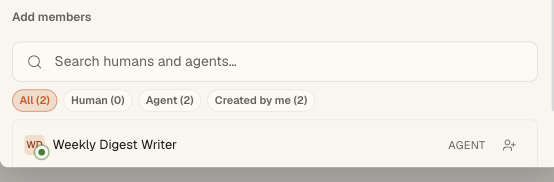
- Run work through Tasks so every handoff is visible.

- Add a review Agent, and for designated high-risk, irreversible, or externally executed actions, prepare Action Cards; an authorized person reviews and commits the designated action under their own identity.

Let the architecture reveal itself from real work. The goal, the shared context, the handoffs, and the human gates are the architecture, and they should stay visible in the workspace structures the team uses, not locked in a design doc.
The first week sets the rhythm. Run one Deliverable end to end, watch where the work stalls, and fix the seam before adding another Agent. Check the Task Board at the end of the day and ask the four questions, what was the goal, who did what, what changed, and who accepted it, until the answers come without effort. The architecture is working when the team can answer those questions from the record instead of asking around.
FAQ
What is a multi-agent architecture?
A multi-agent architecture is the structure that lets several AI agents work toward one goal without colliding. It defines roles, shared context, handoffs, and the points where a person decides.
What are the components of a multi-agent architecture?
Roles, shared context, visible handoffs, and human gates. Roles make output evaluable, shared context keeps Agents aligned, handoffs keep work from getting lost, and human gates provide accountability.
Do you need a multi-agent framework?
A framework is software that helps a team build and connect Agents. The collaboration and acceptance layer around an architecture, roles, context, handoffs, and oversight, can be carried by a collaboration workspace with a Channel, a Task Board, and Action Cards. Whether a team needs a framework depends on its runtime orchestration and integration needs; a collaboration workspace is not a substitute for those needs.
How is architecture different from orchestration?
Orchestration is about coordinating the runtime flow of work, who runs when and what triggers what. Architecture is the wider organization of roles, context, handoffs, and oversight. Orchestration can be part of an architecture, and an architecture can work with little orchestration.
What are common multi-agent architecture patterns?
The common patterns are sequential handoff, work that moves in a line through stages; parallel streams, several Agents working side by side and converging; and a coordinator role, one Agent organizing while others specialize. Teams usually recognize their own work in one of the three.
When is a multi-agent architecture overkill?
When the work is small, sequential, or owned by one person. Start with a Channel and one Agent, and add roles, handoffs, and gates when the work grows enough to need them.
How do you choose a multi-agent architecture?
Match the pattern to the work. Sequential stages use a sequential handoff, independent streams use parallel streams, and large groups with routing needs use a coordinator role. The simplest architecture that completes the work is usually the right choice.
What makes a multi-agent architecture resilient?
Failures that are visible and cheap: an Agent reports a problem early, a failed Task goes back to its owner with the reason, and the team can run a degraded shape when capacity is short. The record keeps the attempts, failures, and fixes the team runs through.
When a multi-agent architecture earns its place
A multi-agent architecture proves useful when the roles are clear enough to name, the shared context stays accurate, and the handoffs hold up across repeated runs. Start with one recurring Deliverable, run the smallest set of Agents that works, and let the Channel, the Task Board, and the Action Cards carry the structure. That is the multi-agent architecture a team can grow with: kept visible in the workspace structures the team uses, reviewable from the record afterward, and a person accountable for the outcome.
Design handoffs your team can actually review.
Define roles, context boundaries, and the points where a person evaluates the Deliverable.