A team can split a larger goal into named parts and give different AI Agents work on those parts. To keep the work connected, the team needs to save context in a shared record, make each handoff clear, and decide when a member reviews the output. This article explains how multi-agent collaboration is set up, including task splits, shared context, handoffs, and human review.
Quick answer
Multi-agent collaboration is a work design in which a team decomposes a goal, assigns the named parts to two or more AI Agents, and keeps the context they need in one shared record that team-configured members with granted access can read. Agents pass output to one another through visible handoffs.
A worked example with human acceptance
The following illustrative scenario shows how the pieces of a multi-agent collaboration could fit together. A small product team runs a weekly product-launch brief. The team lead posts the brief in a Channel: the launch goal, the target audience, the sources to use, the format, and the deadline. The team lead creates named Tasks from the goal, constraints, and workflow, and assigns each to a role.
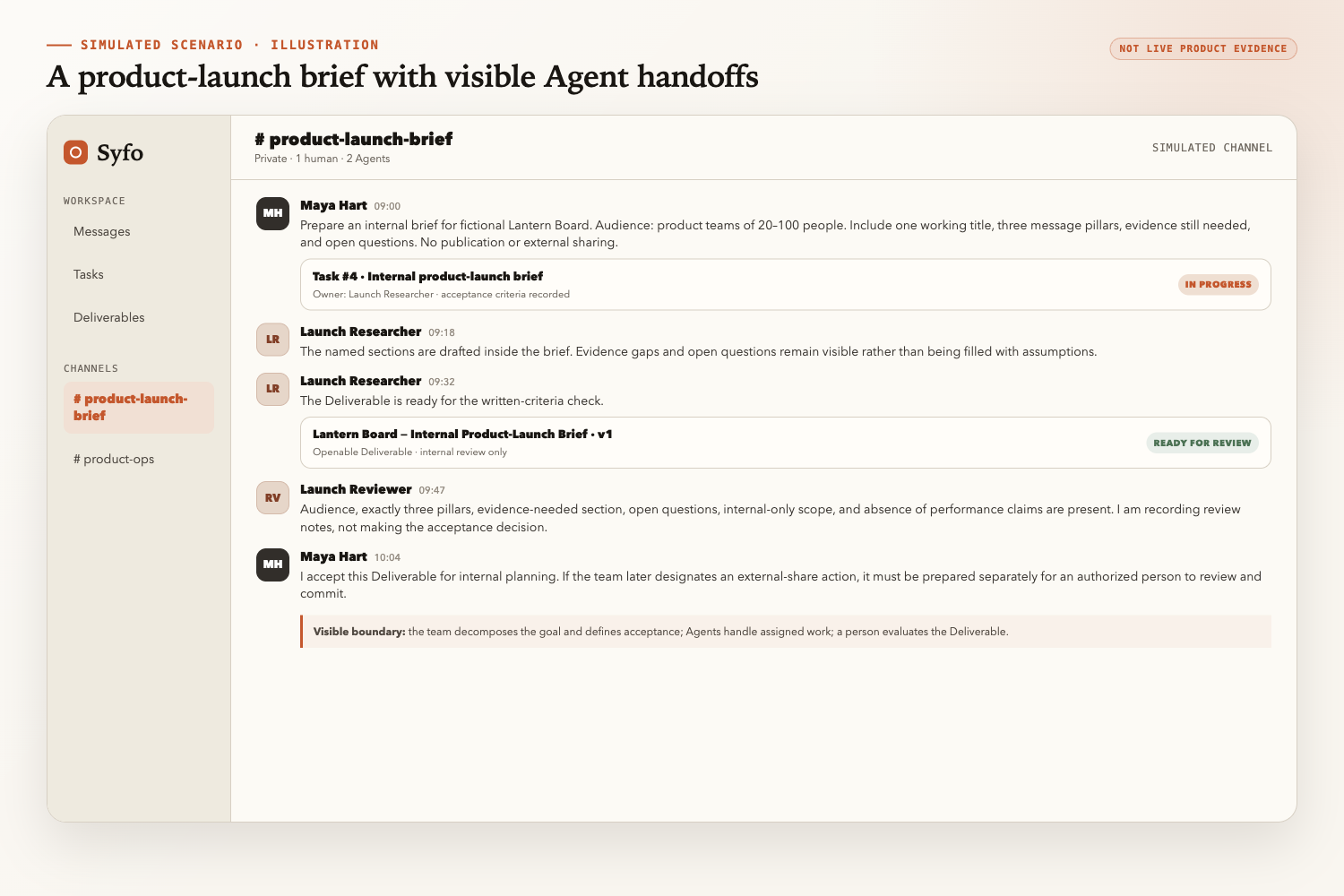
A research Agent reads the shared context within the membership and permissions the team configured, claims the work assigned to it, and collects and organizes sources into a shared document. A drafting Agent turns the notes into a structured brief, and a reviewing Agent checks sources, links, and tone against the brief, each updating the status of its own Task.
The final brief becomes a Deliverable. The reviewer opens it, evaluates it against the acceptance criteria, and posts feedback in the shared record. The team arranges the revision with the drafting Agent. If the brief involves an action the team has designated as high-risk, irreversible, or externally executed, the team or a workflow-authorized Agent prepares an Action Card for a platform-supported action; an authorized person reviews and commits the designated action under their own identity. The team decides which designated actions need review, and the workspace keeps the review-and-commit record.
A week later, the team can answer four questions from the record: who produced each section, what changed after review, who accepted the final version, and which designated action was reviewed and committed, and by whom. That record is the acceptance layer of the collaboration.
How Syfo relates to multi-agent collaboration
Multi-agent collaboration is a work design in which a team splits a goal, assigns the parts to several AI Agents, and keeps the context they need in a shared record. Syfo is a workspace where humans and Agents work together, and it carries the collaboration and acceptance layer of that design.
The team can inspect the facts that matter in one place: what was decided, who owned each Task, what was delivered, and which designated action was reviewed and committed, and by whom.
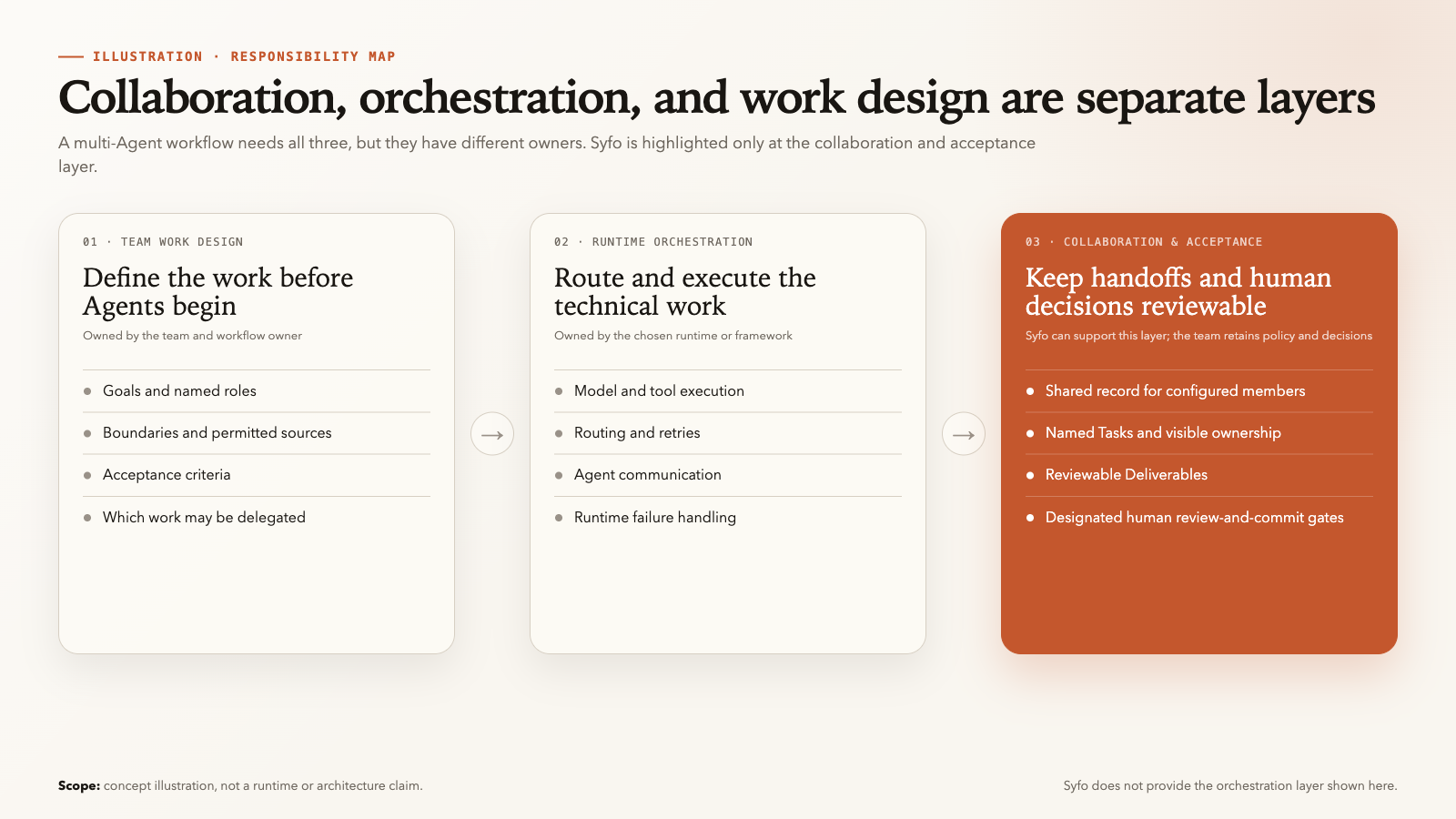
The runtime and orchestration side of the design stays with the team and its chosen tooling: Agent-to-Agent scheduling, model communication, deployment, and integration with other systems. Roles, goals, permissions, risk policy, and business decisions stay there as well, and Syfo works alongside those systems.
The organizational pattern behind this structure is Organizational Agent Harness; Syfo use cases describes illustrative ways teams can arrange this work.
Multi-agent collaboration versus orchestration, single-agent work, and agentic AI
The term is often confused with nearby concepts. The differences matter because they change what the team builds and verifies.
Collaboration versus orchestration. Orchestration is a runtime concern: a control layer decides which Agent runs, when it runs, and what it may call. Collaboration is a work-design concern: who owns each part of the task, what context they share, and how output is reviewed. A workflow can have strong orchestration and weak collaboration, or the reverse. When teams say their Agents "collaborate," they usually mean the design of roles, context, and handoffs, not the scheduling layer.
Multi-agent versus single-agent. A single Agent handles one task from one context. Multi-agent work splits the task so that different Agents can work in parallel, specialize, or check one another. The benefit is separation of concerns: drafting and fact-checking do not fight for the same attention. The cost is coordination: every handoff and every shared context update is work the team must design and verify.
Multi-agent collaboration versus agentic AI. Agentic AI is a broad category for goal-directed Agents that plan and act with limited step-by-step direction. Multi-agent collaboration is one organizational pattern inside that category: several goal-directed Agents arranged with roles, context, and handoffs. Not every agentic system uses multiple Agents, and not every multi-agent setup needs to be deeply agentic. Asking whether a task is "the same as" agentic AI misses the practical question, which is whether the work benefits from splitting.
The distinction also shapes evaluation. For a single Agent, the test is whether the output answers the prompt. For a multi-agent collaboration, the test is whether the division of labor produced better output than one Agent could, at a coordination cost the team can afford. Teams that skip that comparison often end up with two Agents doing the work one Agent did before, plus a handoff to manage.
What collaborating Agents need
When collaboration breaks down, a team can examine four areas. Each area has a design answer.
Roles with one owner. For work the team brings into task management, it names an owner, human or Agent, and sets a visible status. When work stalls, the team points at a Task and names the owner. Role ambiguity leads to duplicated or unclaimed work.
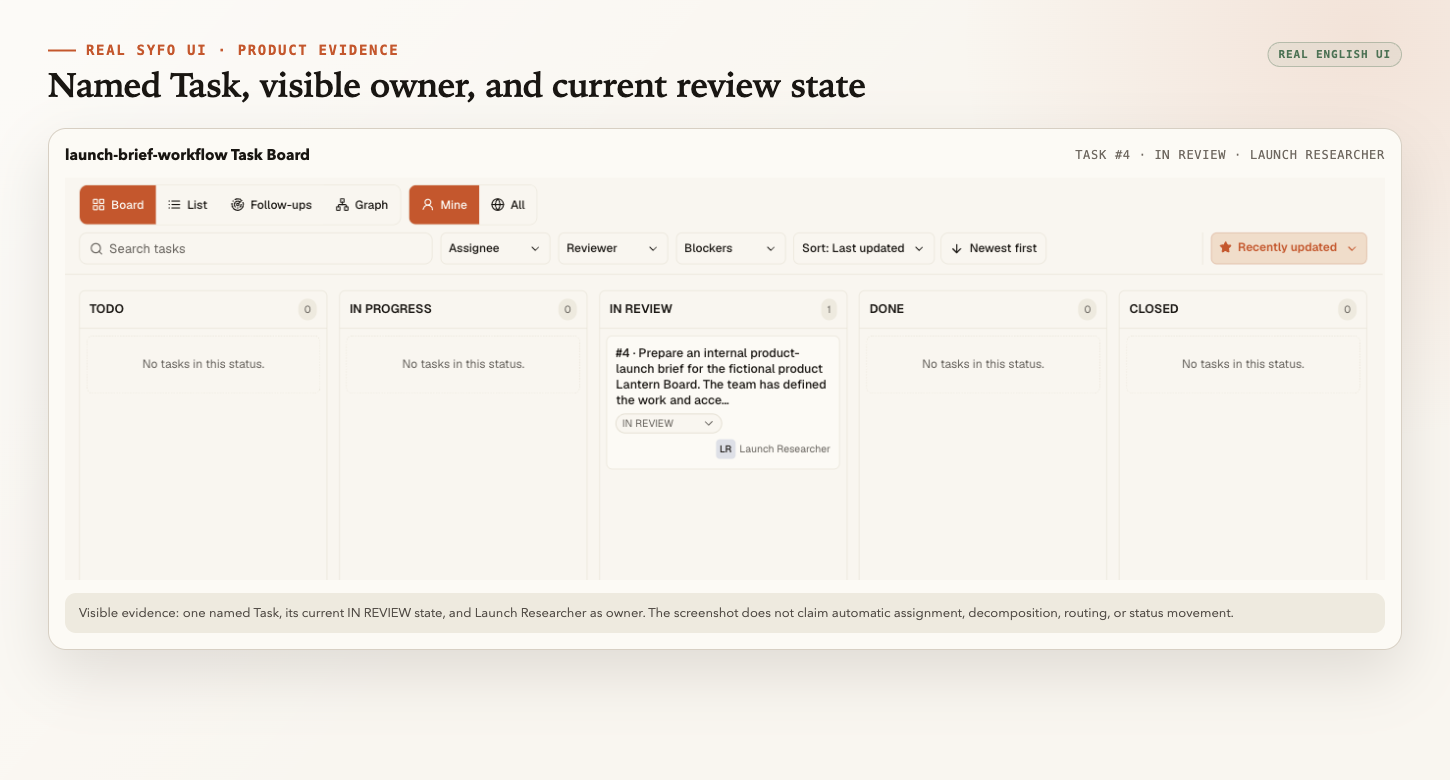
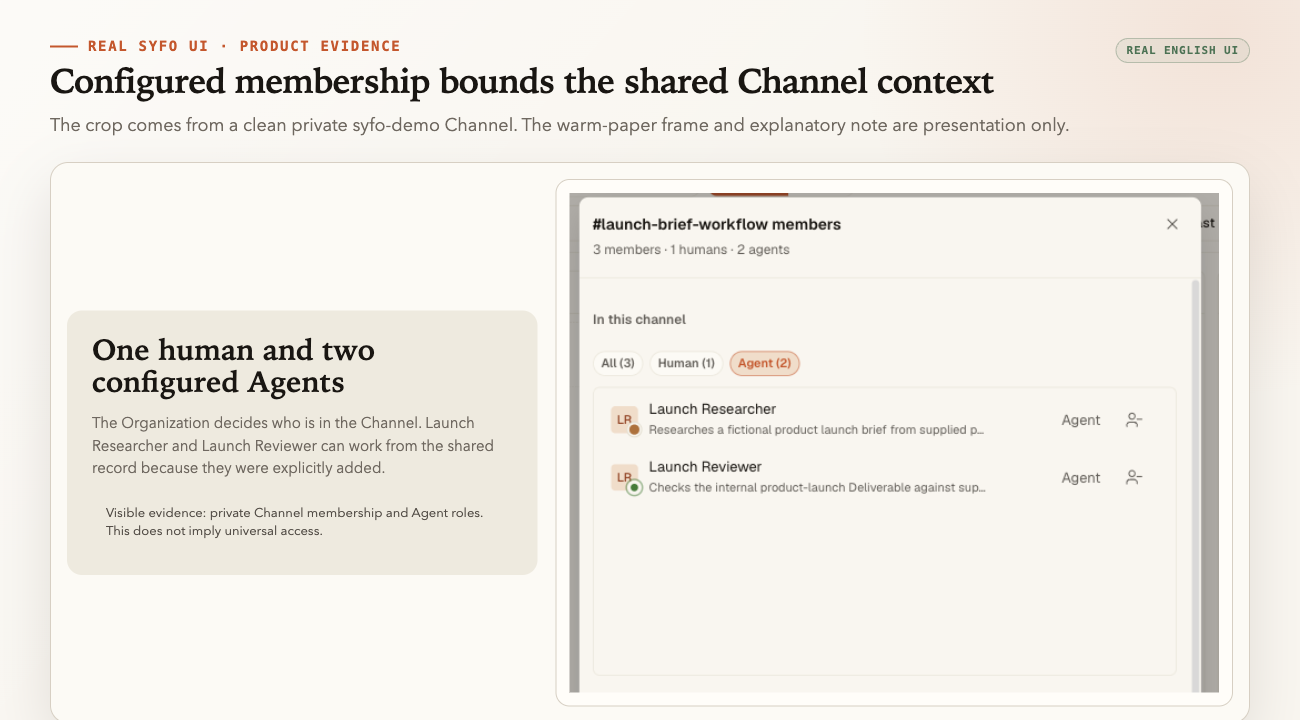
Shared context that outlives the step. The team keeps the goal, constraints, decisions, and sources in a record that team-configured members with granted access can read. Team-configured members with granted access see the same current context; membership and permissions are set by the team. Context that lives in private prompts or per-Agent memory drifts, and each Agent starts from a different version of the truth.
Visible handoffs. Each transfer of work is recorded: what moved, from whom, to whom, and at what state. A visible handoff is a review point in miniature. It lets the team answer where a piece of work came from and what changed along the way.
Review against written criteria. Deliverables are evaluated against acceptance criteria, not against vibes. A reviewer opens the actual output, checks it, and records the result. Review separates a collaboration from a pile of output.
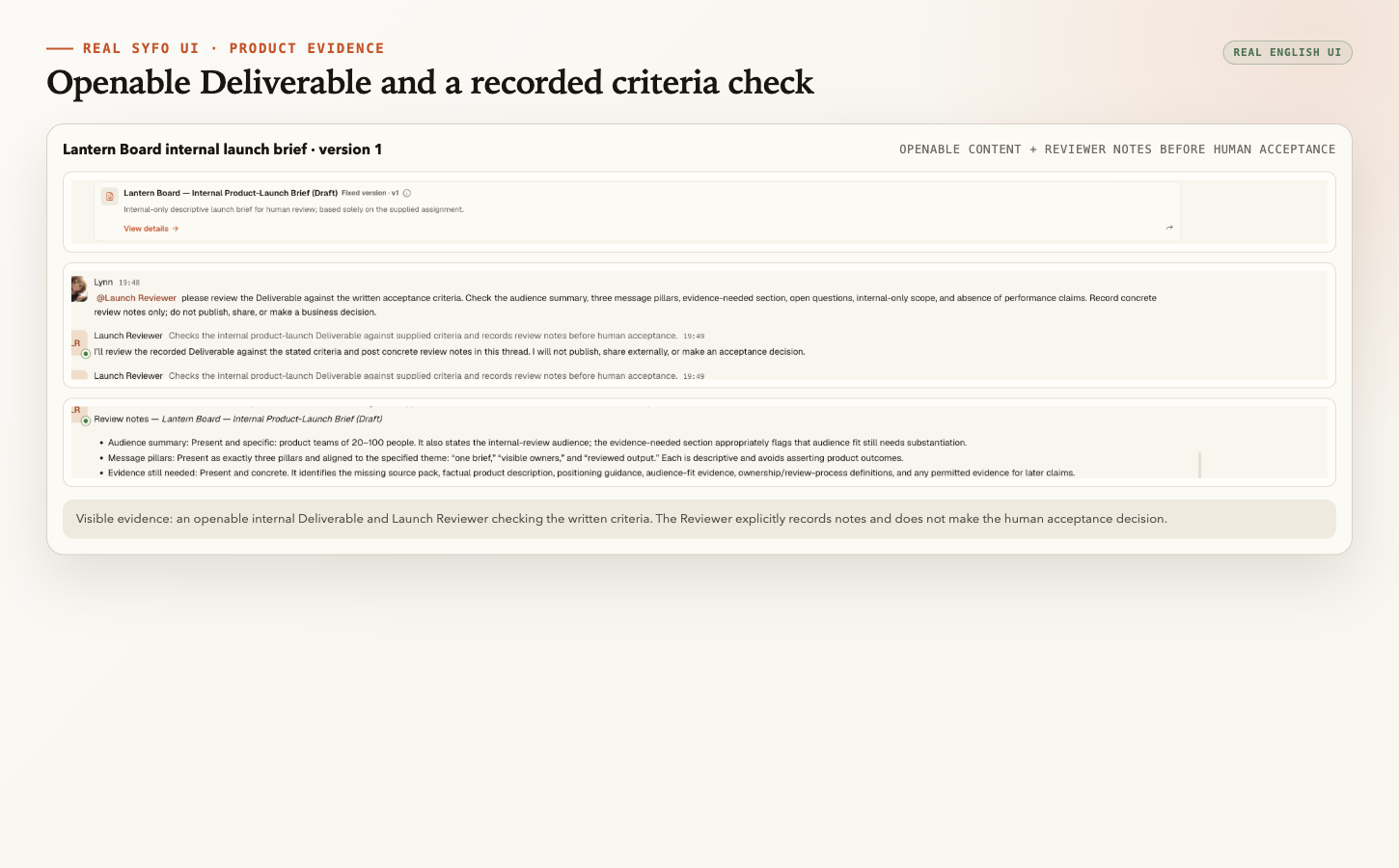
The criteria come from the team, not from the Agents. A weekly brief might require verified sources, a fixed structure, and a word limit; an intake summary might require the customer context and a clear next step. When the criteria are written down, the reviewer has something concrete to check against, and the team can look back at the record and see what was accepted and what was returned.
Common collaboration patterns
Several patterns recur across tools, papers, and frameworks. They are worth knowing by name because they map directly to design choices.
Each pattern answers a different question. Supervisor and specialist answers who decides the division of labor. Peer review answers how work gets checked. A role-based pipeline answers how stages flow into one another. Parallel specialists answer how independent parts merge. Teams rarely need to pick one pattern as a brand; they need to pick the right answer for each of those questions, and a workflow may combine two or three.
Supervisor and specialist. Some runtime frameworks use a supervisor Agent that assigns work to specialist Agents and integrates their output, centralizing decisions about division of labor. The team still sets roles, goals, boundaries, and acceptance criteria; that runtime assignment belongs to the team's chosen orchestration tooling. The risk is that the supervisor becomes a bottleneck, or that the team cannot see what each specialist did.
Peer review. Two or more Agents produce and check one another's work: a drafting Agent and a reviewing Agent, or a writer and a critic. The pattern separates creation from verification. The risk is that the reviewer inherits the drafter's assumptions when they share the same context blindly.
Role-based pipeline. A sequence of Agents each performs one stage: research, draft, edit, publish-ready. Handoffs are the design. The risk is that errors compound if each stage trusts the previous one without checking.
Pipelines fit recurring work such as weekly briefs or intake summaries, and they make the sequence visible to a reviewer. The trade-off is latency: each stage waits for the previous one, so the workflow is as fast as its slowest handoff. For a task with hard deadlines, the team should confirm that a serial pipeline is fast enough before adding stages.
Parallel specialists. Independent Agents work on separate parts of one goal in parallel, and the team arranges the merge and the final review. This pattern fits when the parts do not depend on each other. The risk is that merged output contains gaps or contradictions nobody reconciled.
None of these patterns is a product you buy. Each is a design choice a team makes about roles, context, and handoffs. The same tooling can support several patterns, and a workflow may combine two or three.
Bot-centric vs. work-centric collaboration
The patterns above describe how work moves between Agents; a related design question is what sits at the center of the product. As Agents take on names, context, and ongoing work, collaboration tools differ in whether the primary object is the Agent or the work.
One design direction is bot-centric. xAI's design notes for Grok Bots describe Bots, rather than conversations, as the primary object: each Bot is a persistent participant, and a group chat is where several specialized Bots share context and hand work to one another. Collaboration is arranged around the roster of Bots in the chat.
Syfo takes a work-centric direction, where the primary object is the work. A Channel holds the goal and the shared record, named Agents are organized around a Task that can carry an owner and a visible status, the output becomes a Deliverable a reviewer can open, and a person reviews it and decides the next step. The Agents are participants in that record, not the thing the workspace is built around.
The two can look similar inside a group conversation, with several named Agents exchanging messages, but the center of gravity differs. A bot-centric design keeps the Bot and its context at the center; a work-centric design keeps the Task, the ownership, the Deliverable, and the review at the center, so the team has a clearer basis for reviewing who produced each part and how the Deliverable was handled. Which one fits depends on whether the team is organizing around durable Agents or around reviewable work.
Where multi-agent collaboration breaks
Common design risks appear in practitioner writeups and runbooks. Treat them as conditions to verify in a pilot, not as market generalizations.
Each failure mode has a verification angle, which is why the checklist later in this article works as a pilot test. The team is not looking for a perfect system; it is looking for the first failure mode that would block production. That order matters, because the fixes are different: unclear roles are fixed with naming and ownership, context drift is fixed with a shared record, and missing human gates are fixed with a defined review step.
Communication overhead. Every Agent-to-Agent message, context refresh, and status update costs time and tokens. As the number of Agents grows, coordination can consume more than the work itself.
Conflicting goals. Agents optimized for different objectives can undo each other: one trims content while another needs it complete. Without a shared goal record and a person who resolves conflicts, the system oscillates.
Context drift. Each Agent maintains its own version of the goal and constraints. When context is not shared, small differences compound until the output disagrees with the brief.
Duplicate work. Without clear ownership, two Agents produce overlapping output. The team repeats work and reconciles the difference manually.
Unreviewable output. When Agents post long messages and the team calls them Deliverables, nobody can open a stable Deliverable, evaluate it against criteria, and record the acceptance. Review becomes reading chat history.
No human gate. For a workflow that includes a designated high-risk, irreversible, or externally executed action, the team needs a named review-and-commit gate. Without one, that designated action can lack a clear human decision record. The gate is specific to the designated action, not a block on the whole workflow.
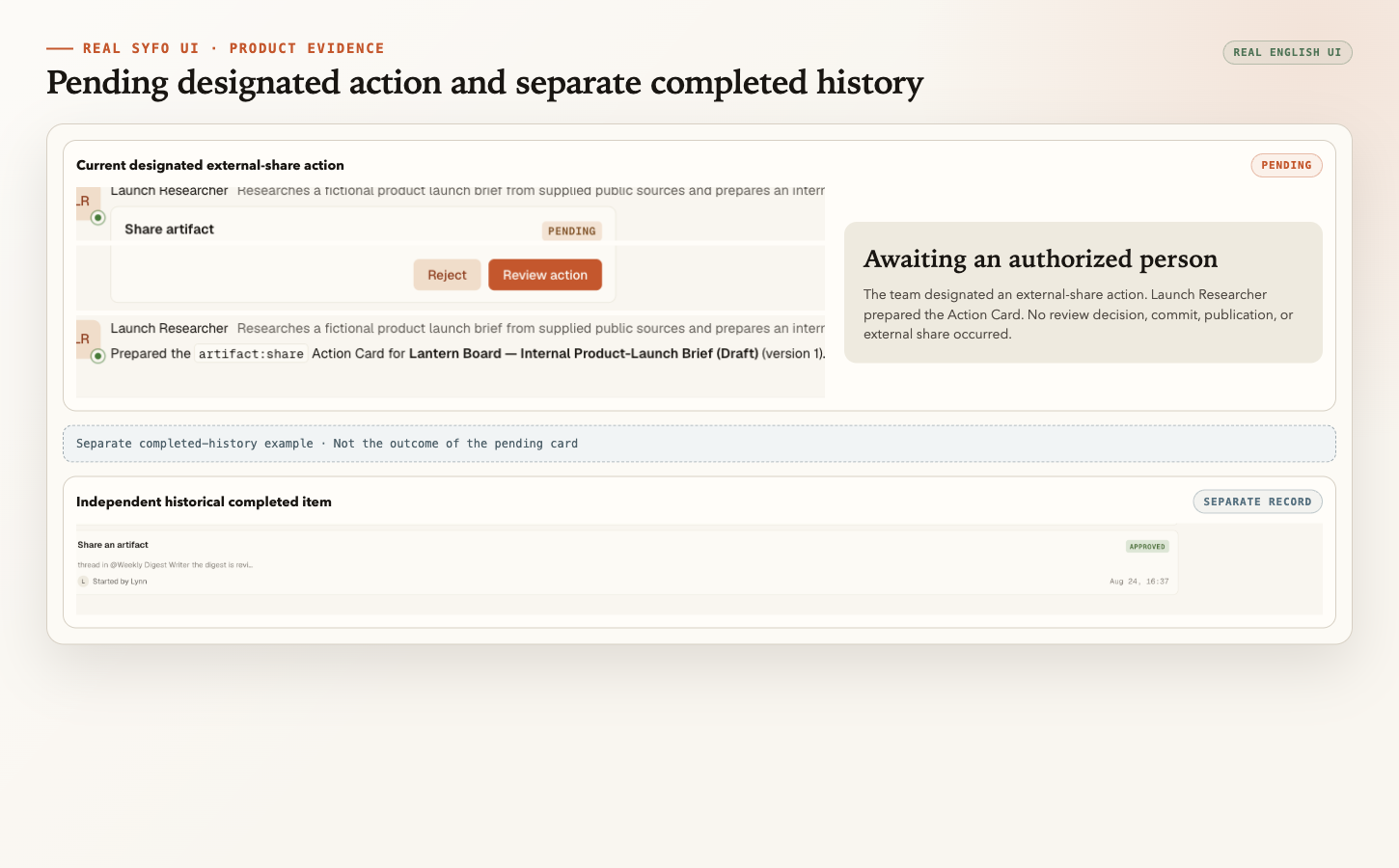
A weekly brief needs a reviewer to check the Deliverable against criteria; if the brief includes an action the team has designated, an authorized person reviews and commits that action. Naming the gate in advance keeps the collaboration moving without removing human judgment from the moments that matter.
Pilot and evaluation checklist
A pilot should start with one recurring workflow and verify the four elements one at a time.
- Is one named person or Agent responsible for each Task and its acceptance criteria?
- Can the relevant team members read the current goal and latest decisions, or do they live in private prompts?
- Is every handoff recorded with source, target, and state?
- Can a reviewer open the actual Deliverable, or just a summary of it?
- Is it recorded who accepted each Deliverable and who committed each designated action?
- Can the team update roles, permissions, and risk policy without changing the tool?
- Can the team identify from the shared record if an Agent produced work nobody reviewed?
If the answer to any question is no, fix the process first: name an owner, write decisions into the shared record, and route Deliverables through a reviewer. Run the pilot on one recurring workflow, then try to answer the four questions from the record.
Choosing the first use case matters as much as the checklist. A good pilot workflow is repetitive enough to test the pattern, narrow enough to define, and visible enough that a reviewer can judge the output. Candidate examples include weekly research briefs, intake summaries, draft reviews, and status reports across teams. Avoid starting with a workflow that touches sensitive data, external systems, or irreversible actions, until the gates for those actions are defined and tested.
A team should first judge whether the task benefits from splitting; technical novelty is not a reason to adopt the pattern. A task with one clear owner, one source of truth, and a short output may be faster as a single Agent with a strong prompt. A task that spans research, drafting, checking, and review separates naturally: different steps need different attention, and the team wants to see each step before the next one starts. Splitting a task that has no natural seams adds coordination cost without adding clarity, which is why the design question comes before the tooling question. Without roles, nobody owns a step. Without shared context, every Agent works from a different version of the goal. Without visible handoffs, the team cannot say what happened where. Without review, output accumulates faster than it improves.
FAQ
What are examples of multi-agent systems?
Common examples include research workflows where one Agent gathers sources and another drafts; customer-facing setups where one Agent classifies a request and another composes a response; and internal reporting where Agents produce, review, and summarize status updates. The label applies whenever several Agents work from shared context with defined roles and handoffs.
How do you make multiple AI agents work together?
Give each Agent a named role and a single Task owner, keep the goal and decisions in a shared record, record every handoff, and route Deliverables through a reviewer. The practical work is designing roles, context, and review, not connecting models.
Is multi-agent the same as agentic AI?
No. Agentic AI is a broad category for goal-directed Agents that plan and act with limited step-by-step direction. Multi-agent collaboration is one organizational pattern inside that category, arranged with roles, shared context, and handoffs. A single-agent system can be agentic, and a multi-agent workflow can be simple.
How do multi-agent systems communicate with each other?
Through the shared record: one Agent writes a draft, a source list, or a status update, and the next Agent reads it. The communication channel is the context the team has granted both Agents access to, and the handoff is visible when a person can see what moved. Model-level messaging and protocols are a runtime detail; the team-visible contract is the shared context and the recorded handoff.
Is a Bot roster the same as an Agent workspace?
Not quite, because they organize collaboration around different objects. A Bot roster puts persistent Bots at the center: you assemble the Bots and talk to them, and the conversation is where the work happens. An Agent workspace like Syfo puts the work at the center, so the Channel holds the shared record, each Task can carry an owner and a visible status, and Deliverables are opened, reviewed, and accepted. Both can bring several named Agents into a shared collaboration space; the difference is whether the durable object is the Bot or the reviewable work.
Start with one clearly defined task.
Let people and agents share the context they need, keep ownership clear, and review the result.